

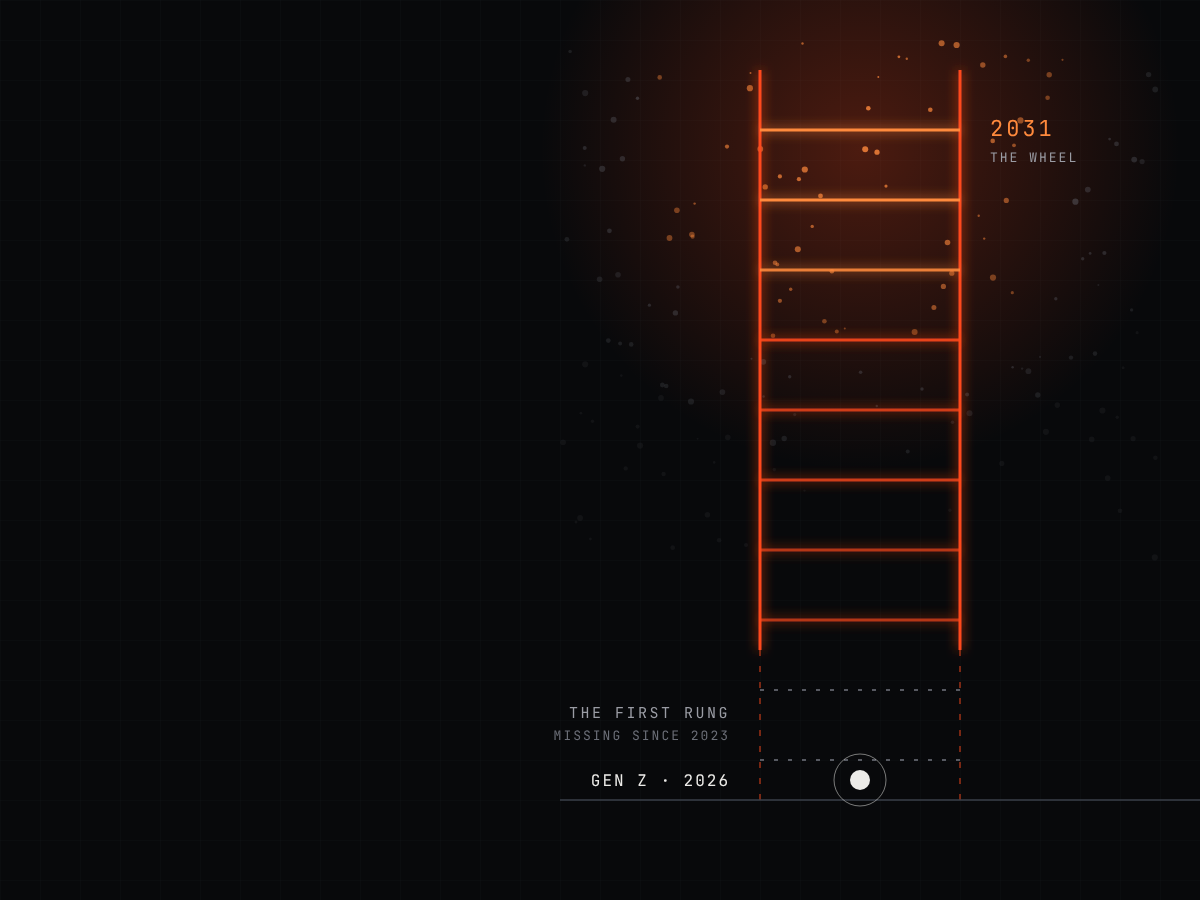
Scenario · Tuesday, 14 October 2031 · A forecast, not a report
Priya is 29 and runs a planning team at a regional logistics firm: four people and about thirty AI agents. Her agents rebuilt last night’s delivery routes, drafted the supplier claims and flagged three contracts that need a human signature. Priya decides which of the flags matter. Nobody calls her an AI expert. She is a manager.
She got lucky with her timing. She graduated in 2019 and spent three years doing the dull work that now belongs to the agents: reconciling spreadsheets, writing first drafts, sitting in on calls. That was where she learned what a bad contract smells like.
Her brother Arjun is 23. He is faster with AI than she has ever been, and he has sent 140 applications this year. Most of the jobs he applies for ask for “two to three years of experience”. The jobs that used to give people that experience are the ones the agents now do.
Priya and Arjun are fictional, and so is 2031. Everything else in this feature is built from what can be measured today, in October 2026, and from the record of how the internet and the PC changed careers. Where I forecast, I say so.
Every big technology gets a generation. The PC belonged to the baby boomers who brought it into the office, the internet to Gen X and the millennials who grew up beside it. AI, everyone assumed, would belong to Gen Z.
The data from 2026 tells a stranger story. Gen Z is the most fluent generation with AI, and the one most squeezed by it. Over the next five years, the question is not whether young people can use AI. It is whether anyone will still pay them to learn the judgment that AI cannot supply.
Where We Stand: October 2026
01 · Measure · Pew Research Center · Gallup · Deloitte · 2026
The fluent generation is not the one running AI at work
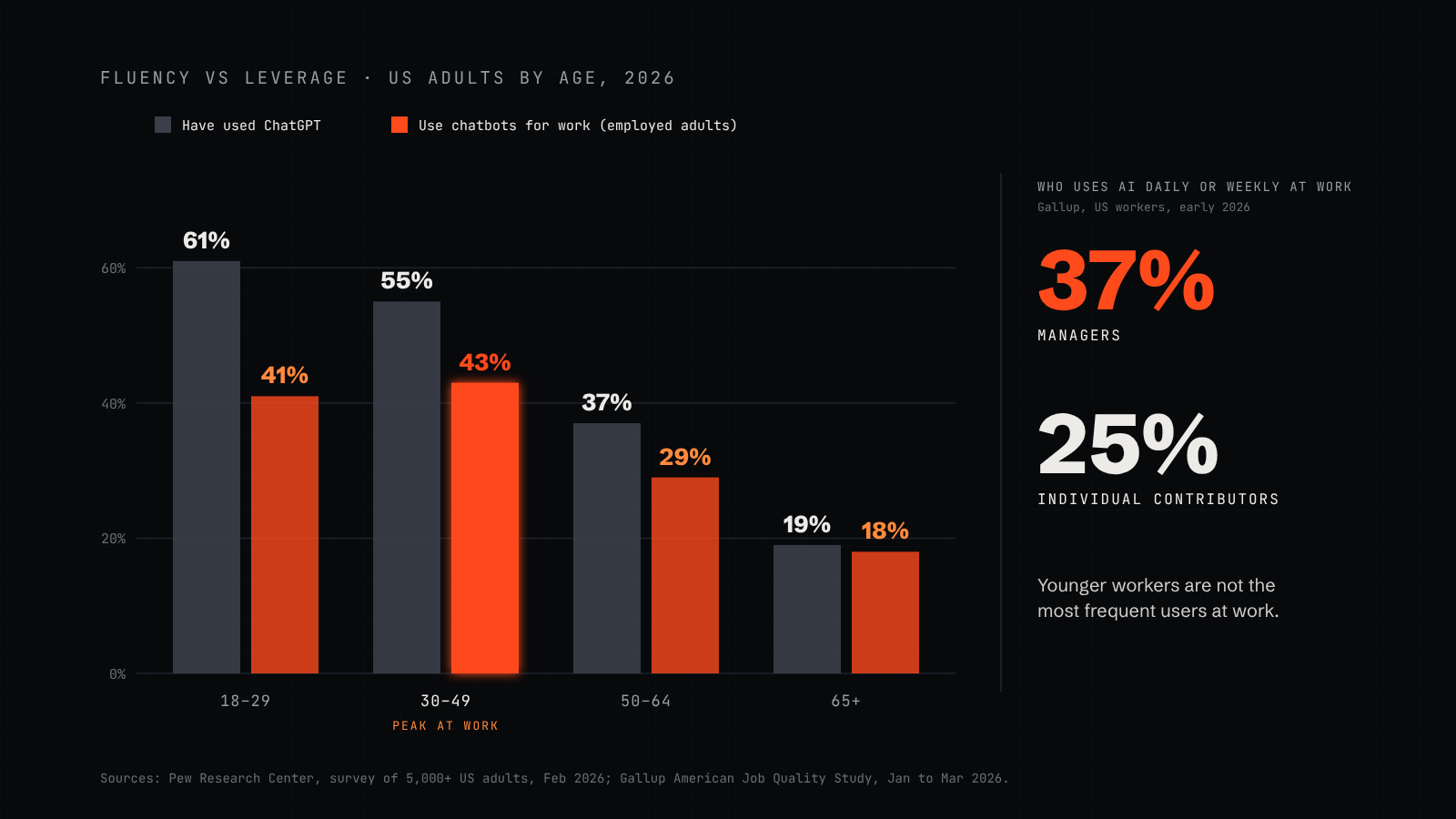
Outside work, the age gap is exactly what you would expect. In a Pew Research Center survey of more than 5,000 US adults in February 2026, 61% of those aged 18 to 29 had used ChatGPT, against 37% of 50 to 64-year-olds and 19% of those 65 and older. Young adults were also the most confident: 31% felt extremely or very confident using chatbots, against 6% of over-65s.
At work, the order changes. Among employed adults, Pew found that 43% of those aged 30 to 49 use chatbots for work, slightly ahead of the under-30s at 41%. Gallup’s American Job Quality Study, fielded in early 2026 across 17,874 US workers, found that 28% of employees use AI at least weekly, and that younger workers are not the most frequent users. Managers are: 37% use AI daily or weekly, against 25% of individual contributors.
Deloitte’s 2026 survey of more than 22,500 Gen Zs and millennials in 44 countries found exactly the same share of each, 74%, using AI in their daily work. The fluency belongs to the young. The leverage, for now, belongs to the people who already have something to apply it to: a team, a client list, a decade of knowing what good looks like.
Who uses AI, 2026
- 61%of US adults aged 18 to 29 have used ChatGPT, against 19% of those 65 and olderPew Research Center, Feb 2026
- 43%of employed 30 to 49-year-olds use chatbots for work, against 41% of under-30sPew Research Center, Feb 2026
- 37% vs 25%of managers use AI daily or weekly, against individual contributorsGallup, survey Jan to Mar 2026
- 74%of both Gen Zs and millennials use AI in their daily workDeloitte Gen Z and Millennial Survey 2026
Knowing the tool is not the same as being given the work to use it on.
The Missing First Rung
02 · Evidence · Stanford Digital Economy Lab · Harvard · Anthropic · 2025 to 2026
Not fired. Just never hired.
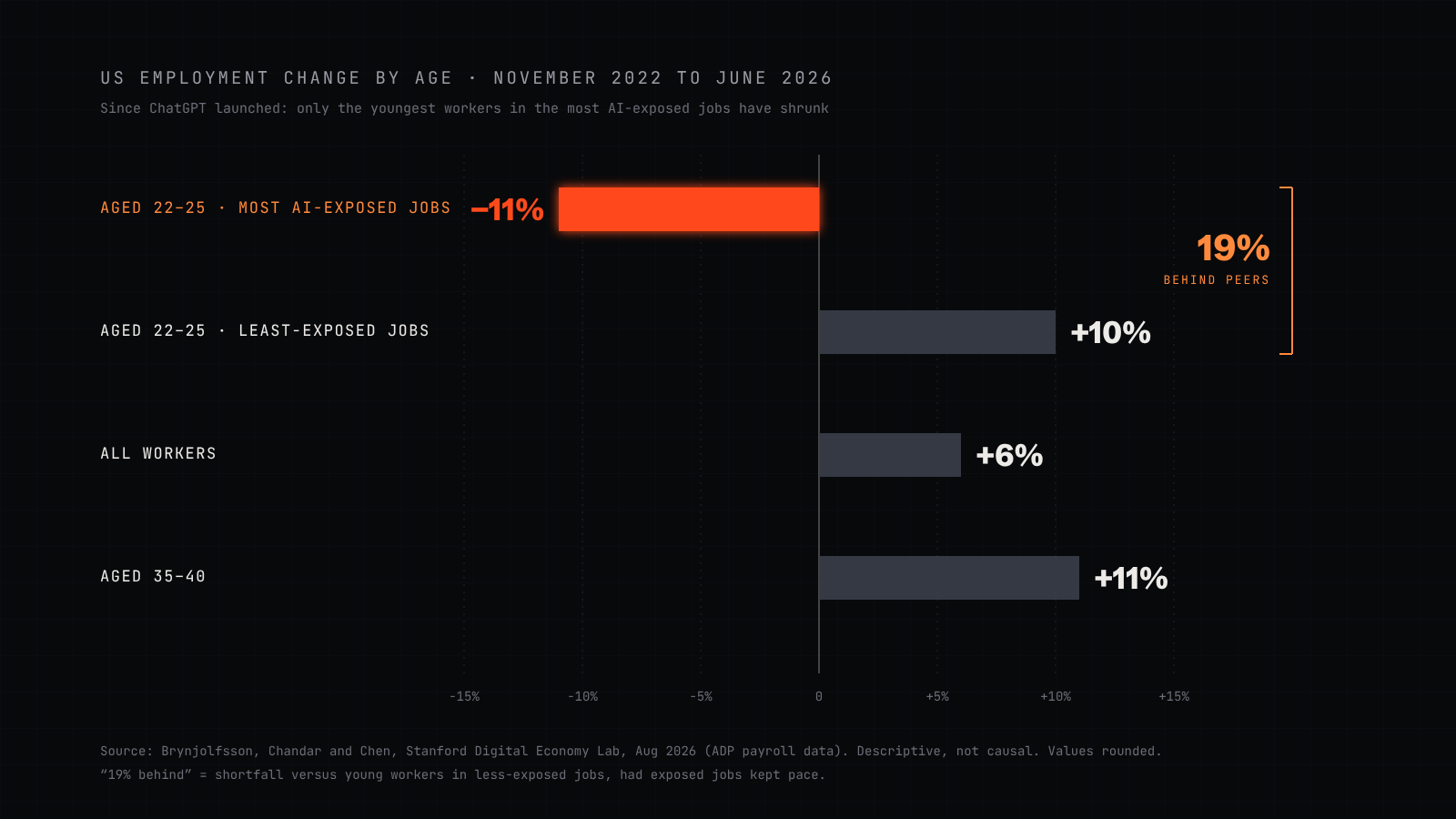
The clearest early signal of AI in the labour market is not mass layoffs. It is a missing intake. Erik Brynjolfsson, Bharat Chandar and Ruyu Chen at Stanford track monthly payroll data from ADP covering millions of US workers. In their August 2026 update, employment of 22 to 25-year-olds in the most AI-exposed occupations had fallen about 11% between November 2022 and June 2026. Young workers in the least-exposed jobs grew about 10% over the same period. Every older age group grew, by as much as 11% for those aged 35 to 40.
Put differently, young workers in AI-exposed jobs are now 19% behind where they would be had they kept pace with their peers, up from 15% a year earlier. Experienced workers in the same occupations show no such gap. The authors describe their results as descriptive rather than causal, but the pattern is consistent: the effect is concentrated where AI automates tasks, not where it assists people.
Two other studies point the same way. Seyed Hosseini and Guy Lichtinger at Harvard, using résumé data for about 65 million workers, found that junior employment at firms that adopted generative AI fell about 9% relative to other firms within six quarters, while senior employment kept rising. The cause was slower hiring, not more firing. Anthropic’s own March 2026 analysis found no rise in unemployment among highly exposed workers overall, but a 14% drop in the rate at which 22 to 25-year-olds found jobs in the most exposed occupations.
The wider market makes it worse. The New York Fed puts unemployment among recent college graduates at about 5.6% in the second quarter of 2026, with 42% underemployed in jobs that do not need a degree. US employers are in a low-hire, low-fire pattern: the quits rate was 1.9% in August 2026, and the Burning Glass Institute found that quits among 16 to 24-year-olds had fallen to their lowest since 2014. Median job tenure for 25 to 34-year-olds rose from 2.7 years in 2024 to 3.0 years in January 2026.
That is the job mobility story of 2026. The young cannot get in, and the people already inside are not moving. Mobility has not disappeared. It has frozen at the bottom.
AI didn’t take Gen Z’s jobs. It took the first rung.
We Have Seen This Gap Before
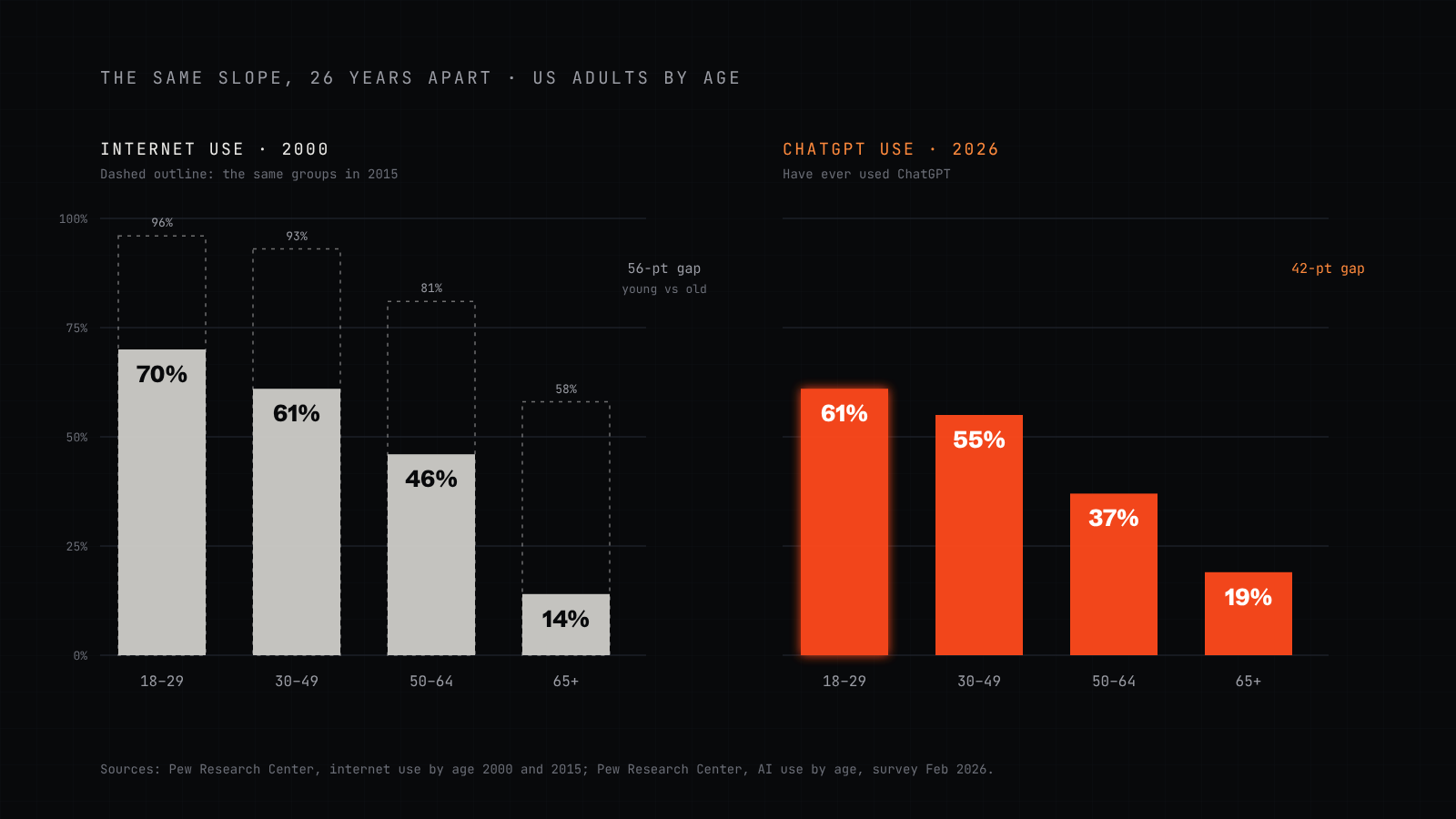
The age gap in AI looks remarkably like the age gap in the early internet. In 2000, Pew found that 70% of Americans aged 18 to 29 used the internet, against 14% of those 65 and older: a 56-point gap. By 2015 the young were at 96% and the oldest group at 58%. The internet did not stay a young person’s technology. It became everybody’s, with the old catching up fastest.
What the internet era teaches is who captured the value. The share of US workers using a computer at work rose from about a quarter in 1984 to nearly half by 1993. Economists estimate that computerisation explains 30 to 50% of the extra growth in demand for skilled workers since 1970. Computers did not make work simpler. They raised the premium on education and judgment, and the gains went to people who could combine the new tool with knowledge of the work.
The internet also created work nobody had imagined. David Autor and colleagues found that the majority of US employment in 2018 was in job types introduced after 1940, and that since 1980 new work has gone mainly to high-paid professionals and, secondarily, to low-paid services. Webmaster, social media manager and data scientist were not on any careers list in 1995.
But there is one big difference. The internet created a huge number of junior jobs: people to build websites, answer email, run the help desk and key in data. AI is aimed at exactly those tasks first. The internet widened the bottom of the ladder. AI is narrowing it.
The internet widened the bottom of the career ladder. AI is narrowing it.Kintoro
More Complex Skills, or Fewer?
Two forces pull in opposite directions, and both are real.
The first force lowers the floor. In the best-known field study, by Brynjolfsson, Danielle Li and Lindsey Raymond, an AI assistant raised customer support agents’ productivity by 14% on average and by 34% for the newest. AI hands novices the accumulated practice of experts. MIT’s David Autor argues that, used well, AI could let more people take on decisions now reserved for elite experts, and rebuild the middle of the labour market.
The second force raises the bar. PwC’s 2026 AI Jobs Barometer, analysing 2.4 million US entry-level postings, found that the most AI-exposed entry-level roles are seven times more likely to require senior-level, human-intensive skills. Their openings rose 35% since 2019 while other entry-level roles fell 10%. Jobs that require specific AI skills grew 69%, against 9% for the market, and carry a 62% wage premium. The World Economic Forum’s employers expect nearly 40% of core skills to change by 2030, with 59 in every 100 workers needing training.
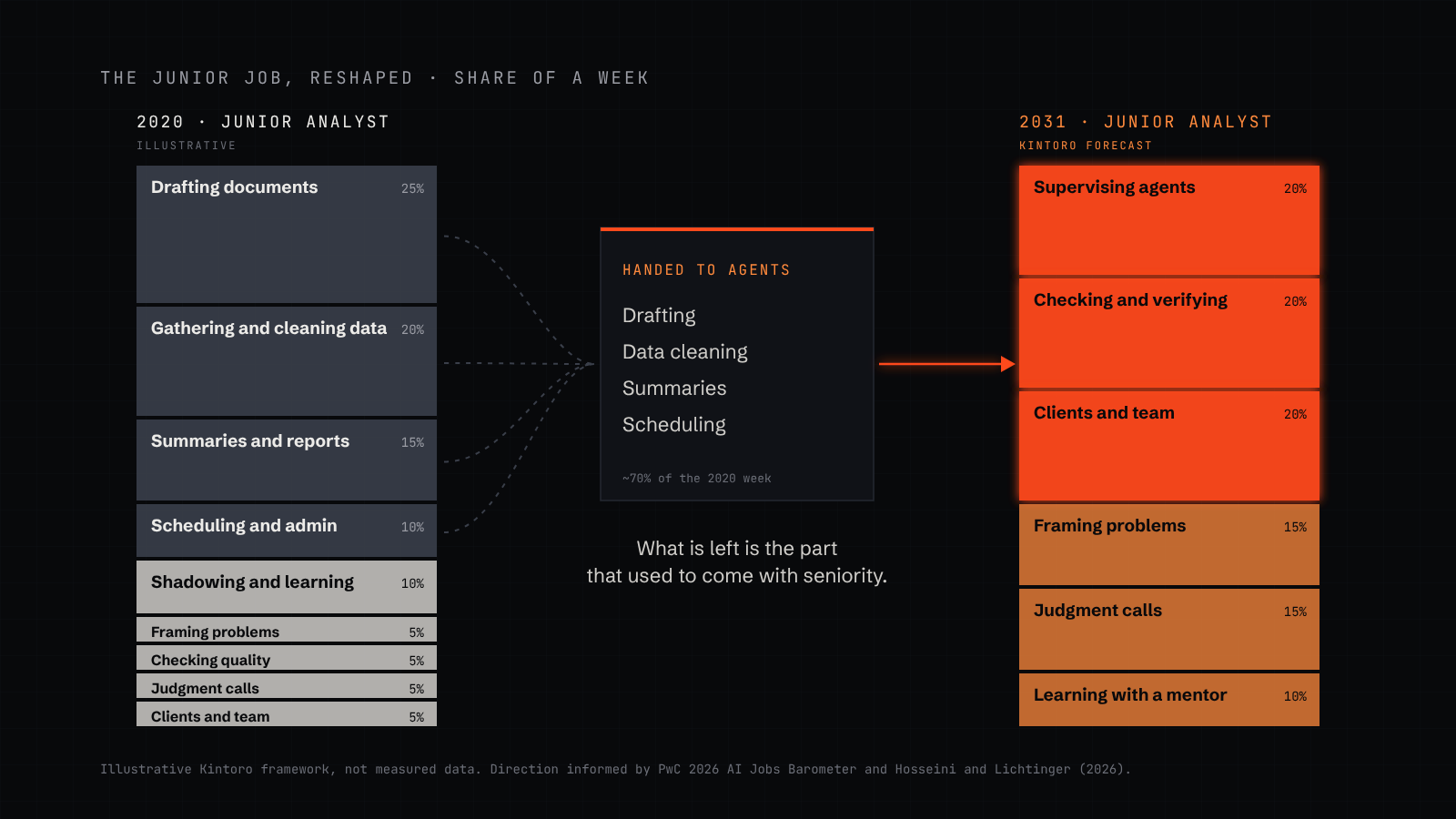
So the answer to “more complex or less?” is both, at different levels. Individual tasks get easier. Writing a first draft, cleaning a dataset or summarising a meeting now takes minutes. Jobs get harder, because what remains for a person is the part that used to come with seniority: framing the problem, checking the machine’s work, making the judgment call and dealing with people. The entry ticket is going up even as the tools get easier.
What employers now pay for
- 7×more likely: AI-exposed entry-level roles require senior-level, human-intensive skillsPwC 2026 AI Jobs Barometer
- 62%wage premium for jobs that require AI skills, up from 57%PwC 2026 AI Jobs Barometer
- ~40%of core skills expected to change by 2030World Economic Forum, Future of Jobs 2025
- 71%of leaders would hire a less experienced candidate with AI skills over a more experienced one withoutMicrosoft and LinkedIn, Work Trend Index 2024
My forecast, clearly marked as one: by 2031, the most valuable skills at work will be the ones hardest to learn without an apprenticeship. Judgment, verification, problem framing and the ability to manage both people and agents. AI fluency becomes a baseline, like typing. The scarce skill is knowing when the machine is wrong.
The tasks get easier. The jobs get harder.
Four Generations, Four Positions
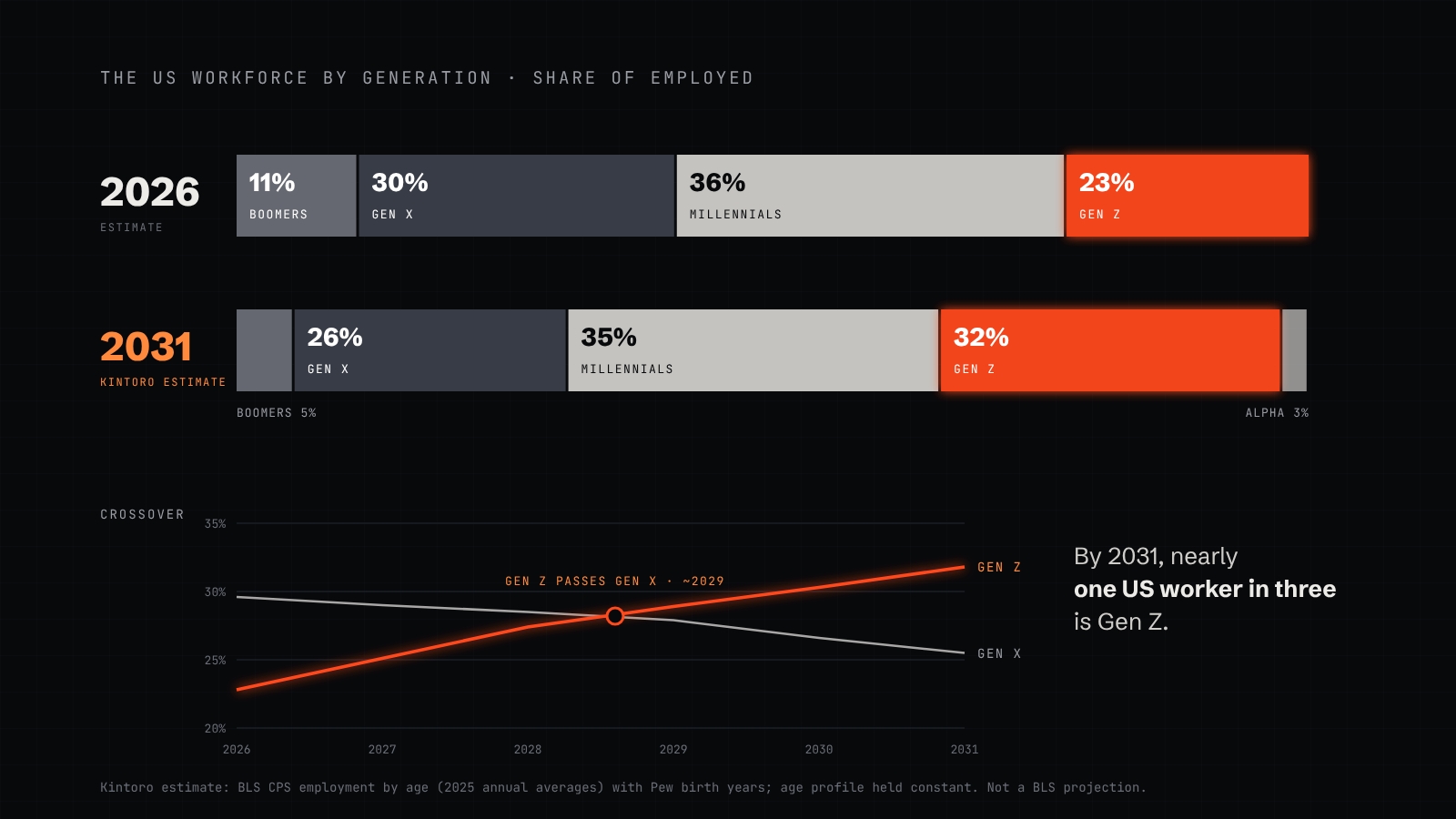
Using Pew’s birth-year definitions, the US workforce in 2026 is roughly 23% Gen Z, 36% millennial, 30% Gen X and 11% baby boomer, by my estimate from Bureau of Labor Statistics employment data. Five years on, if the age profile of work stays roughly as it is, Gen Z reaches about 32% and the boomers fall to about 5%. Each generation goes into the AI transition from a different position.
Z · Gen Z · Born 1997 to 2012 · Aged 14 to 29 in 2026
Fluent, squeezed, and splitting in two
Gen Z is really two generations at work. The older Zs, who started careers before 2023, got the old apprenticeship: the drafting, the spreadsheets, the shadowing. The younger Zs, graduating from 2024 to 2030, are meeting a narrower door. They are also routing around it. Enrolment in vocational programmes at public two-year colleges is up nearly 20% since 2020, according to National Student Clearinghouse data, and 18 to 25-year-olds made up nearly a quarter of new skilled-trade hires in 2024. Many do not want the traditional ladder anyway: in a Robert Walters poll, 57% of US Gen Z professionals said they did not want a middle management role.
M · Millennials · Born 1981 to 1996 · Aged 30 to 45 in 2026
The hinge generation
Millennials are the generation with the most leverage in the AI transition. According to Glassdoor, they became the largest share of US managers in mid-2025, overtaking Gen X. They use AI at work as much as anyone, and they hold the jobs where it pays off: the managers and team leads in Gallup’s data. They will design most of the human-agent teams of 2028 to 2031. They are also exposed: Gartner predicted that through 2026, one organisation in five would use AI to flatten its structure, cutting more than half of its middle management roles.
X · Gen X · Born 1965 to 1980 · Aged 46 to 61 in 2026
Holding the senior seats
Gen X runs most companies, and will for the rest of the decade. The average new S&P 1500 chief executive in 2025 was 54.4, according to Spencer Stuart, which in 2031 still means someone born in the late 1970s. The Stanford data suggests experience is a shield: AI complements workers aged 41 and over rather than replacing them. The risk for Gen X is not being displaced. It is signing off on decisions about AI while using it least: only 29% of employed 50 to 64-year-olds use chatbots for work.
B · Baby boomers · Born 1946 to 1964 · Aged 62 to 80 in 2026
The great handover
America is in its “Peak 65” years: more than 4.1 million Americans turn 65 each year through 2027, according to the Alliance for Lifetime Income. Boomers who stay are working longer; the BLS expects participation among 65 to 74-year-olds to rise from 27.1% to 29.6% by 2034. But their exit takes decades of tacit knowledge with it, exactly when the junior roles that once absorbed that knowledge are shrinking. Their most valuable job in the next five years is teaching.
Gen Z has the fluency. Millennials have the leverage. Gen X has the authority. Boomers have the knowledge. The next five years are a negotiation between them.
When Gen Z Takes the Wheel
Leadership follows age more than technology. In 2031, the oldest Gen Zs turn 34, the age when many people take their first real management job. Gen Z is already climbing: ADP Research found Gen Z made up about 14% of managerial hires in 2023, and Glassdoor reports that roughly one manager in ten is now Gen Z.
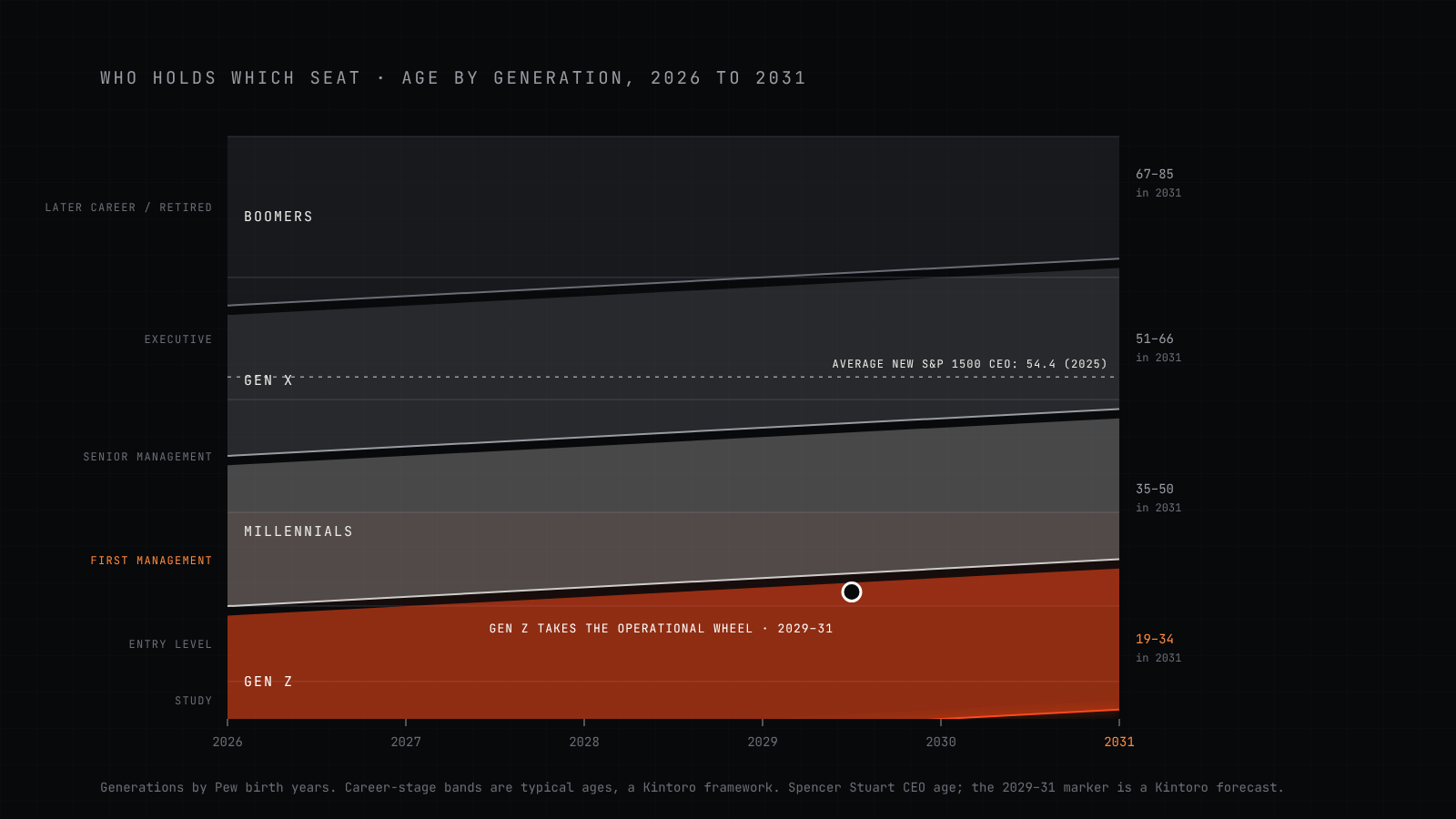
My forecast: Gen Z takes the operational wheel between 2029 and 2031, as first-line managers and team leads of human-agent teams, not the corner office. In practice, that is where AI work is steered: deciding what the agents do, checking what they produce and owning the outcome. The C-suite stays with Gen X and the oldest millennials well into the 2030s. A Gen Z chief executive at a large company remains, on today’s average ages, a story for the 2040s.
There is a catch. Gen Z can only take that seat if it has learned judgment, and judgment has always been learned on the bottom rung. If employers keep hiring fewer juniors, the generation best equipped to run AI-powered teams will arrive at 30 with less practice than any generation before it.
Five Checkpoints to 2031
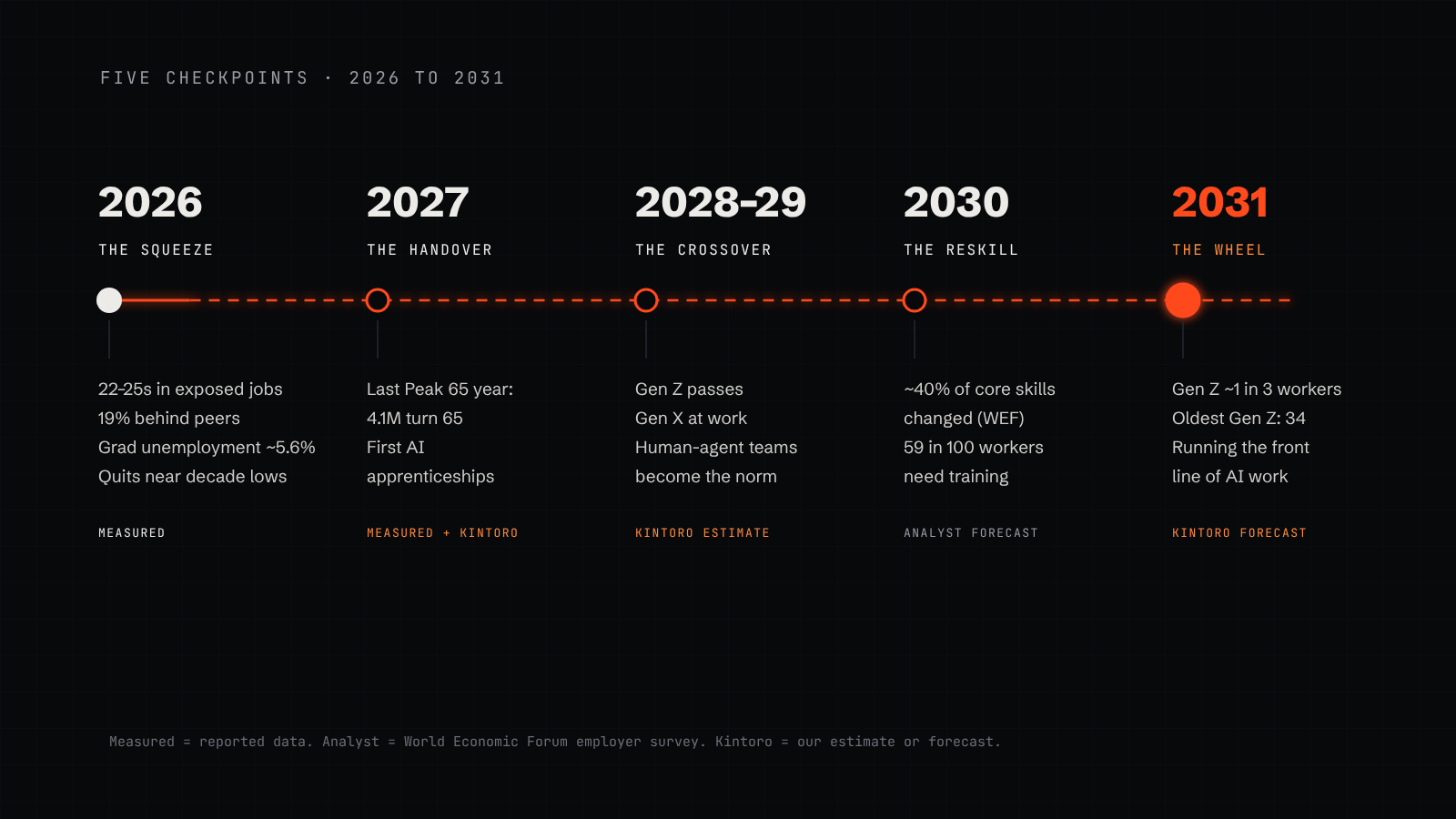
These are the checkpoints I expect, each marked as measured today, forecast by analysts, or forecast and estimated by Kintoro.
- 2026
The squeeze Measured
Employment of 22 to 25-year-olds in the most AI-exposed jobs sits 19% behind their peers (Stanford, June 2026). Recent graduate unemployment is about 5.6% (New York Fed). Quits are near decade lows. Millennials hold the largest share of management, and the fluency gap between young and old looks like the internet in 2000.
- 2027
The handover Measured trend · Kintoro forecast
The last “Peak 65” year: more than 4.1 million Americans turn 65. My forecast: employers that cut junior intake start to notice the gap in their mid-level pipeline, and the first formal “AI apprenticeships” appear, pairing new hires with agents and senior mentors.
- 2028–29
The crossover Kintoro estimate
Gen Z rises past 27% of US workers in 2028 and outnumbers Gen X from about 2029, on our estimate. Gen Z managers become common in operations, sales and software. The human-agent team becomes the normal unit of work, and the person who runs it is increasingly under 32.
- 2030
The reskill Analyst forecast
The World Economic Forum’s employers expect nearly 40% of core skills to have changed and 170 million jobs to have been created against 92 million displaced worldwide, with 59 in every 100 workers needing training. Judgment, verification and AI supervision become standard parts of entry-level job descriptions.
- 2031
The wheel Kintoro forecast
Gen Z is nearly one US worker in three; the oldest are 34. They run the front line of most human-agent teams. The C-suite is still Gen X and millennial. The companies that rebuilt the first rung in 2026 to 2028 have a bench of 30-year-olds who can run AI. The rest are hiring them away.
What Job Mobility Looks Like in 2031
For most of the last forty years, job mobility meant climbing: junior, senior, manager, director, ideally by changing employers every few years. AI changes the shape of that path in three ways.
- Fewer rungs, longer jumps. With fewer entry-level and middle management roles, careers move in bigger steps. The jump from junior to “runs a team of people and agents” comes earlier and is harder to fake.
- Lattices, not ladders. Skills travel further than job titles. A logistics planner who can run agents can move into procurement or finance; PwC’s data shows the AI skills premium in every sector it tracks. Expect more sideways moves, inside companies and between them.
- Proof over pedigree. When a degree no longer signals that someone can do the junior work, because nobody does the junior work, employers need other evidence: portfolios, trial projects, apprenticeships and skills-based hiring. That opens doors for Gen Zs without degrees, including the growing number coming through the trades.
For Gen Z, that means mobility returns, but on different terms. My forecast is that the freeze of 2025 to 2026 thaws as boomers retire and AI-native firms grow, and that the young workers who move fastest are the ones who can show judgment, not just fluency. For millennials and Gen X, mobility depends on whether they adapt the way they manage. A manager who supervises people but not agents will find fewer seats to move into.
By 2031, nobody will ask whether Gen Z knows AI. They will ask whether anyone taught them judgment.The central question
The Business Conclusion
So: what happens to the generations at work over the next five years? My answer, as a forecast, is that AI becomes as ordinary for every generation as the internet did, and faster. Gen Z will not be displaced as a generation. It will be delayed, and the delay is the risk: for young people, and for every company that will need experienced 30-year-olds in 2031.
For a business leader, that becomes five moves over the next eighteen months:
- Rebuild the first rung. Keep hiring juniors, and redesign their work around supervising agents, checking output and handling exceptions, rather than the tasks the agents now do.
- Pair the generations on purpose. Put AI-fluent juniors alongside experienced staff: the juniors teach the tools, the seniors teach the judgment. Both learn faster.
- Capture knowledge before it retires. Turn the know-how of your most experienced people into playbooks, test cases and decision rules your teams and agents can use.
- Promote on judgment, not tenure. Measure who makes good calls with AI, and give them a team earlier than your old career ladder would.
- Redesign middle management, don’t delete it. Someone has to own every human-agent team. Flattening the structure without that owner saves money for a year and costs it back in errors.
None of this requires waiting for the technology. All of it gets more expensive the longer the bottom rung stays missing.
Nobody Says “Digital Native” Anymore
In 2001, “digital native” was a label for the young. Twenty-five years later, it describes almost everyone. “AI native” will go the same way, probably faster. Fluency will stop being a generational advantage and become a baseline.
At Kintoro, that is how we build piMonk: AI agents handle routine work inside the systems that run the business, while people keep control of the decisions that commit it. That design matters for careers too. When agents do the routine work, the decisions people keep are where the next generation learns its trade.
Gen Z was born fluent. Whether it gets the wheel depends on whether the rest of us leave it a way to learn to drive.
Fluency gets you in the car. Judgment gets you the wheel.
Sources
- https://digitaleconomy.stanford.edu/app/uploads/2026/08/Canaries_August2026.pdf,Erik Brynjolfsson, Bharat Chandar and Ruyu Chen, “Canaries in the Coal Mine? Six Facts about the Recent Employment Effects of Artificial Intelligence”, Stanford Digital Economy Lab, August 2026 update (ADP data to June 2026)
- https://papers.ssrn.com/sol3/papers.cfm?abstract_id=5425555,Seyed M. Hosseini and Guy Lichtinger, “Generative AI as Seniority-Biased Technological Change: Evidence from U.S. Résumé and Job Posting Data”, Harvard, version of 6 May 2026
- https://www.anthropic.com/research/labor-market-impacts,Anthropic, “Labor market impacts of AI: A new measure and early evidence”, 5 March 2026
- https://www.technologyreview.com/2026/05/26/1137865/its-time-to-address-the-looming-crisis-in-entry-level-work/,Georgios Petropoulos, “It’s time to address the looming crisis in entry-level work”, MIT Technology Review, 26 May 2026
- https://www.newyorkfed.org/research/college-labor-market,Federal Reserve Bank of New York, “The Labor Market for Recent College Graduates”, data for 2026 Q2, accessed 24 October 2026
- https://www.bls.gov/news.release/jolts.htm,US Bureau of Labor Statistics, Job Openings and Labor Turnover Summary, August 2026 data, released 29 September 2026
- https://www.burningglassinstitute.org/bginsights/whos-still-quitting-the-uneven-end-of-the-great-resignation,Burning Glass Institute, “Who’s Still Quitting? The Uneven End of the Great Resignation”, 22 September 2025
- https://www.bls.gov/news.release/archives/tenure_09242026.htm,US Bureau of Labor Statistics, “Employee Tenure in January 2026”, 24 September 2026
- https://www.pewresearch.org/internet/2026/06/17/how-opinions-and-use-of-ai-differ-by-age/,Pew Research Center, “How opinions and use of AI differ by age”, June 2026 (survey of more than 5,000 US adults, February 2026)
- https://news.gallup.com/poll/714602/benefits-work-unevenly-distributed.aspx,Gallup, “AI Benefits at Work Unevenly Distributed”, 6 October 2026 (American Job Quality Study, fielded 26 January to 24 March 2026, 17,874 workers)
- https://www.deloitte.com/global/en/issues/work/genz-millennial-survey.html,Deloitte, “2026 Gen Z and Millennial Survey”, 13 May 2026 (more than 22,500 respondents in 44 countries)
- https://www.microsoft.com/en-us/worklab/work-trend-index/ai-at-work-is-here-now-comes-the-hard-part/,Microsoft and LinkedIn, “2024 Work Trend Index: AI at Work Is Here. Now Comes the Hard Part”, 8 May 2024
- https://www.pewresearch.org/chart/young-adults-are-most-likely-to-use-the-internet-but-seniors-show-faster-adoption-rates/,Pew Research Center, “Young adults are most likely to use the internet, but seniors show faster adoption rates”, internet use by age, 2000 to 2015
- https://www.nber.org/digest/sep97/how-has-computer-use-changed-labor-market,NBER Digest, “How Has Computer Use Changed the Labor Market?”, September 1997 (on Autor, Katz and Krueger)
- https://www.nber.org/papers/w30389,David Autor, Caroline Chin, Anna Salomons and Bryan Seegmiller, “New Frontiers: The Origins and Content of New Work, 1940–2018”, NBER Working Paper 30389, August 2022
- https://www.nber.org/papers/w32140,David Autor, “Applying AI to Rebuild Middle Class Jobs”, NBER Working Paper 32140, February 2024
- https://www.nber.org/papers/w31161,Erik Brynjolfsson, Danielle Li and Lindsey Raymond, “Generative AI at Work”, NBER Working Paper 31161
- https://www.pwc.com/gx/en/news-room/press-releases/2026/pwc-2026-ai-jobs-barometer.html,PwC, “AI reshapes global labour market into two distinct paths, rewarding human skills: PwC 2026 Global AI Jobs Barometer”, 15 June 2026
- https://www.weforum.org/media/future-of-jobs-report-2025-78-million-new-job-opportunities-by-2030-but-urgent-upskilling-needed-to-prepare-workforces,World Economic Forum, “Future of Jobs Report 2025: 78 Million New Job Opportunities by 2030”, January 2025
- https://www.bls.gov/cps/cpsaat03.htm,US Bureau of Labor Statistics, Current Population Survey, Table 3: employment by age, 2025 annual averages (basis for the Kintoro generational estimate)
- https://www.hiringlab.org/2026/04/07/why-labor-force-participation-is-projected-to-fall-through-2034/,Indeed Hiring Lab, “Why labor force participation is projected to fall through 2034”, 7 April 2026 (on BLS 2024–2034 projections)
- https://www.protectedincome.org/wp-content/uploads/2024/01/Peak-65-Release-final-011024.pdf,Alliance for Lifetime Income, “America to Hit Peak 65 in 2024”, January 2024
- https://allwork.space/2025/07/millennials-are-officially-running-the-future-of-work-expect-chaos-compassion-and-burnt-out-leadership/,Fortune via Allwork.Space, on Glassdoor’s Worklife Trends 2025 midyear check-in (millennials largest share of managers), July 2025
- https://www.adpresearch.com/gen-z-rises-into-management/,ADP Research, “Gen Z rises into management”, 11 March 2024
- https://www.robertwalters.us/insights/news/blog/concious-unbossing.html,Robert Walters, “Conscious unbossing”, 29 October 2024
- https://www.ciodive.com/news/Gartner-symposium-top-predictions-CIOs-AI-impact/730659/,CIO Dive, on Gartner’s top strategic predictions for 2025 and beyond, 22 October 2024
- https://www.spencerstuart.com/-/media/2026/02/ceo-transitions-us/2025-s-p-1500-ceo-transitions-behind-the-ceo-moment.pdf,Spencer Stuart, “2025 S&P 1500 CEO Transitions”, January 2026
- https://www.ccdaily.com/2025/09/equipping-the-toolbelt-generation/,Community College Daily, “Equipping the toolbelt generation”, September 2025 (citing National Student Clearinghouse and Department of Labor data)
See the idea working in piMonk
piMonk is the AI company we built on this thinking: agents do the work, people keep the decisions. Try the app this piece points to, or book a demo.
Book a demo