

Scenario · Thursday, 18 May 2028 · A forecast, not a report
A customer calls her insurer for the third time about the same water-damage claim. In 2025, she would have explained everything again, from the beginning, to a person or a chatbot that knew nothing of the first two calls.
This time, the claims agent remembers. It knows the plumber’s report arrived on Tuesday, that she prefers email to calls, and that last week a human handler corrected its estimate because the policy covers the kitchen floor but not the cabinets. It applies that correction without being told again, and drafts a settlement for the handler to approve.
One memory is wrong: the agent believes she has a second property, from a note made about a different customer with the same surname. The handler spots it, deletes it, and the deletion is logged. That evening, the agent’s memory is reviewed and tidied overnight, and the mistake is flagged as a pattern to watch.
The insurer, the customer and her claim are fictional, and so is May 2028. Everything else in this feature comes from research and product announcements from 2025 and 2026. Where I forecast, I say so.
In my last feature, I quoted MIT’s finding that most companies see little return from generative AI, and that the core problem was learning: AI that “forgets context, doesn’t learn, and can’t evolve.” Readers rightly asked two questions. If AI forgets, how is it useful at all? And is the MIT number even right?
Both questions deserve a straight answer. The short version: the famous 95% figure is weaker than its headlines, but the forgetting it describes is real. Forgetting does not make AI useless. It limits where AI can go. And in 2026, the fixes are finally arriving, though more slowly than the marketing suggests.
What MIT Actually Found
01 · Evidence · MIT NANDA · 80,000 Hours · Wharton · 2025 to 2026
A weak number about a real problem
MIT Project NANDA’s report, “The GenAI Divide: State of AI in Business 2025”, was published in July 2025 and became one of the most quoted statistics in technology. Its own description of its method is modest: 52 interviews, 153 survey responses gathered at industry conferences, and a review of more than 300 public AI initiatives, presented as preliminary findings.
The 95% comes from a funnel. Of the organisations studied, about 60% looked at custom or vendor-built enterprise AI tools, 20% piloted one, and only 5% reached production with a “marked and sustained” impact on productivity or profit within about six months. As Rob Wiblin of 80,000 Hours pointed out in April 2026, that means roughly a quarter of the companies that actually ran a pilot succeeded, against a demanding bar. Critics also noted that the authors work on agent infrastructure, the very fix the report recommends.
Other studies paint a brighter picture. Wharton’s 2025 AI adoption report found that 74% of enterprises measuring returns from generative AI reported positive ROI, and 82% used it weekly. And MIT’s own data showed something its headline buried: employees at more than 90% of the companies surveyed were using personal AI tools for work.
But the diagnosis in the MIT report holds up. Its interviewees described the problem precisely: “Most GenAI systems do not retain feedback, adapt to context, or improve over time.” One said a tool “repeats the same mistakes and requires extensive context input for each session.” Another: “For high-stakes work, I need a system that accumulates knowledge and improves over time.” That is the forgetting problem, and the rest of the evidence confirms it.
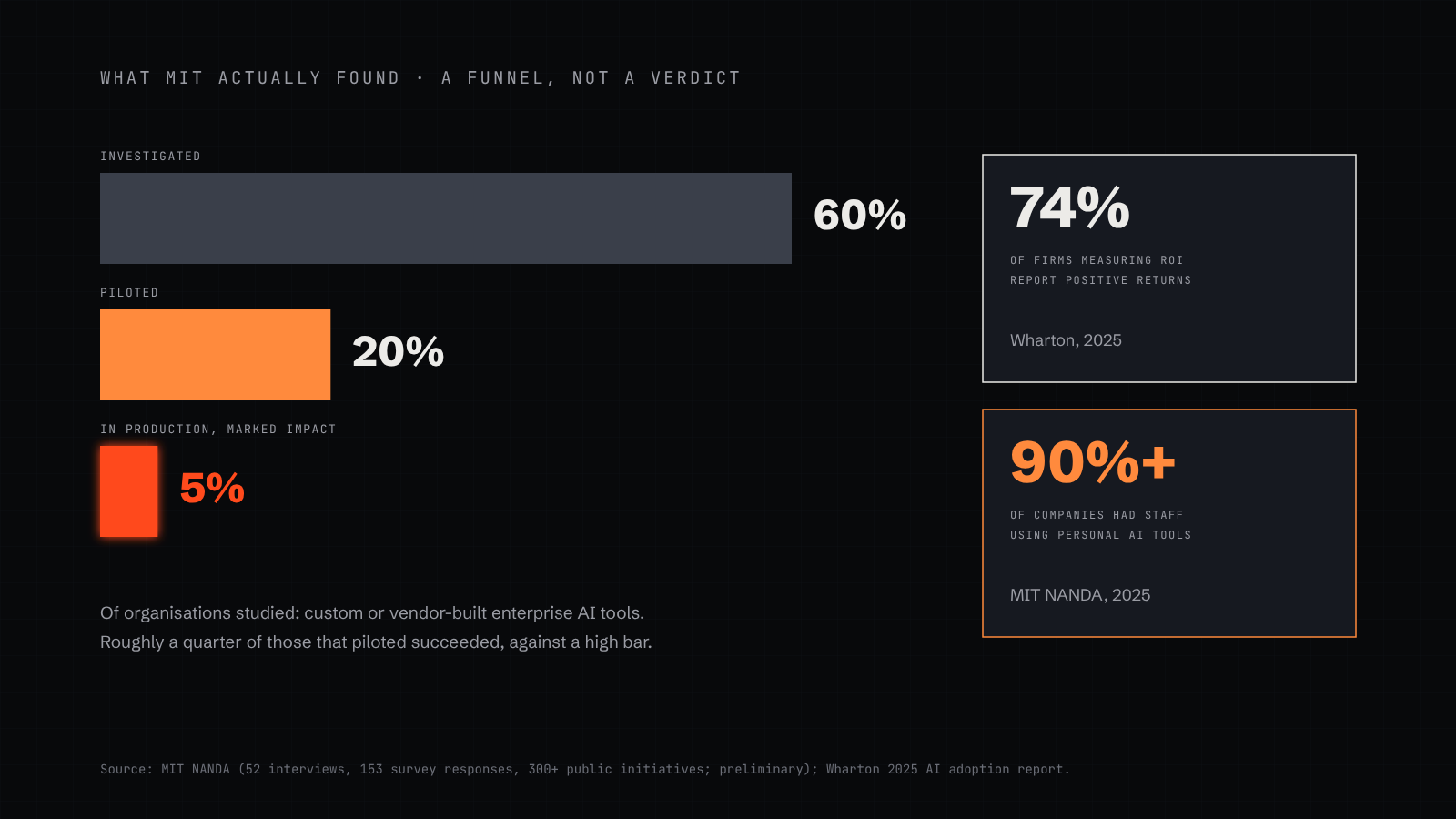
The 95% figure is weaker than its headlines. The forgetting it describes is not.
The memory problem in numbers
- 5%of organisations in MIT’s sample got custom AI tools into production with marked, sustained impactMIT NANDA, Jul 2025 (small sample)
- 74%of enterprises measuring generative AI returns reported positive ROIWharton, 2025
- 18leading models tested by Chroma; performance degraded as input grew in every experimentChroma, Jul 2025
- ~10 yrsAndrej Karpathy’s estimate to work through agents’ problems, including continual learningDwarkesh Podcast, Oct 2025
How Is Forgetful AI Useful?
Very, for the right work. Today’s models arrive knowing an enormous amount about the world. What they do not know is you: your customers, your exceptions, last week’s correction. So their usefulness depends on how much of a task depends on memory.
Wharton found the top uses were data analysis, summarising documents and meetings, and editing and writing. Each of those is self-contained: everything the model needs is in front of it. That is why adoption by individuals has been so fast. A person who brings the context with them, in a prompt or a document, gets a brilliant assistant that needs no history.
Forgetting hurts where work is continuous: a customer relationship over months, a project with a history, a process with exceptions, a team that corrects the same mistake every week. There, a forgetful AI is like a gifted temp who arrives every morning with no memory of yesterday. You can get a lot of work out of a temp. You cannot make one your account manager.
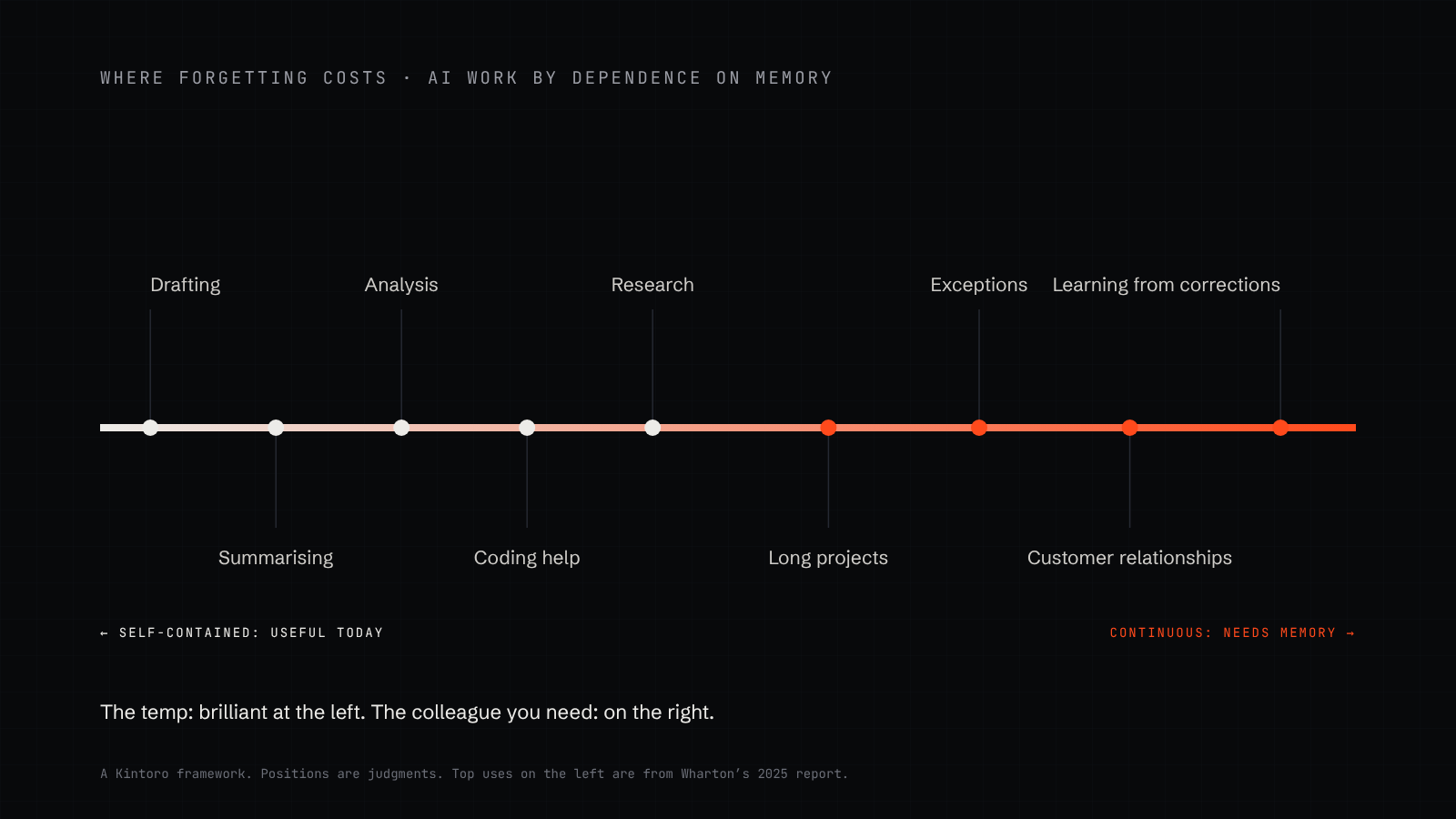
A forgetful AI is a gifted temp who arrives every morning with no memory of yesterday.Kintoro
How True Are the Claims?
02 · Evidence · Chroma · CL-Bench · Anthropic · OpenAI · 2025 to 2026
Bigger windows, real memory features, and a gap in between
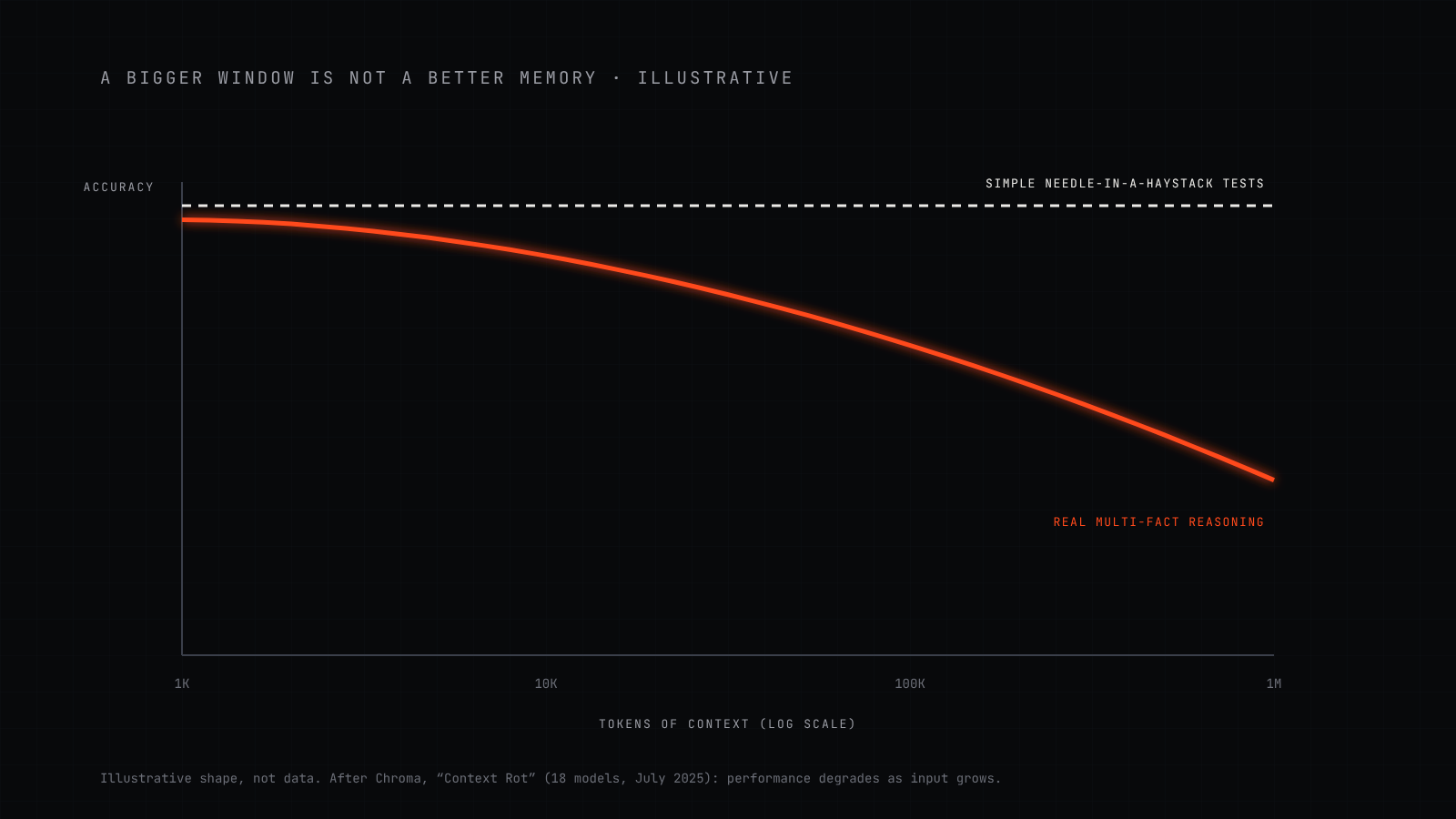
Claim one: “Our context window holds a million tokens.” True, and now standard. Anthropic made its 1M-token window generally available at standard pricing in March 2026, and every major frontier lab now offers one. But accepting a million tokens is not the same as using them well. In July 2025, Chroma tested 18 leading models and found that “model performance consistently degrades with increasing input length”, a pattern it called context rot. Simple needle-in-a-haystack tests, the ones vendors often quote, overstate how reliable long context is for real reasoning.
Claim two: “Our agents remember and improve.” Partly true, and newly so. In April 2026, Anthropic launched memory for Claude Managed Agents in beta: memories stored as files that agents read and write, shared across agents with set permissions, with every change in an audit log that can be rolled back or redacted. Rakuten reported “97% fewer first-pass errors at 27% lower cost and 34% lower latency”, and Wisedocs said memory “sped verification up 30%”. In May, Anthropic added “dreams”, a research preview that reorganises a memory store overnight, merging duplicates and replacing stale entries. The day before Anthropic’s launch, OpenAI said its new workspace agents “retain memory across runs” and “improve the more a team uses them.” These are real products. The results are customers’ own claims.
Claim three: “AI that learns on the job.” Not yet, in the full sense. In June 2026, researchers including Berkeley’s Matei Zaharia and Joseph Gonzalez published Continual Learning Bench, testing whether frontier systems improve from experience across six domains. Their finding was sobering: “agents frequently overfit to immediate observations or fail to reuse knowledge across instances,” and simple in-context learning outperformed dedicated memory systems. Andrej Karpathy put it bluntly in October 2025: “They don’t have continual learning. You can’t just tell them something and they’ll remember it.” He estimated about a decade to fix agents’ shortcomings.
The window got bigger. The memory got real. The learning is still mostly a promise.
Six Paths to a Memory
As a Kintoro framework, there are six ways the industry is trying to cure forgetting, from the simplest to the hardest.
- Bigger windows. Put more in front of the model. Available now, but costly at scale and prone to context rot.
- Retrieval. Search company documents and feed the relevant parts in at the moment of need. Available now, and good for knowledge. But it retrieves; it does not learn.
- Context engineering. Anthropic’s guidance treats context as a finite “attention budget”: summarise long sessions (compaction), keep structured notes outside the window, and give sub-agents fresh windows. Available now, and the main reason coding agents can work for hours.
- Agent memory stores. Persistent, permissioned, auditable memory that agents read and write across sessions, now shipping from Anthropic, OpenAI and specialists. In beta and early production in 2026.
- Organisational memory. Decision records, context graphs and skills, the enterprise brain from my last feature: memory that belongs to the company, not to a model or an agent. Early.
- Continual learning in the model. Models that update themselves from experience, such as Google’s Titans and Nested Learning research. In the lab, with “catastrophic forgetting” of old knowledge the central obstacle.
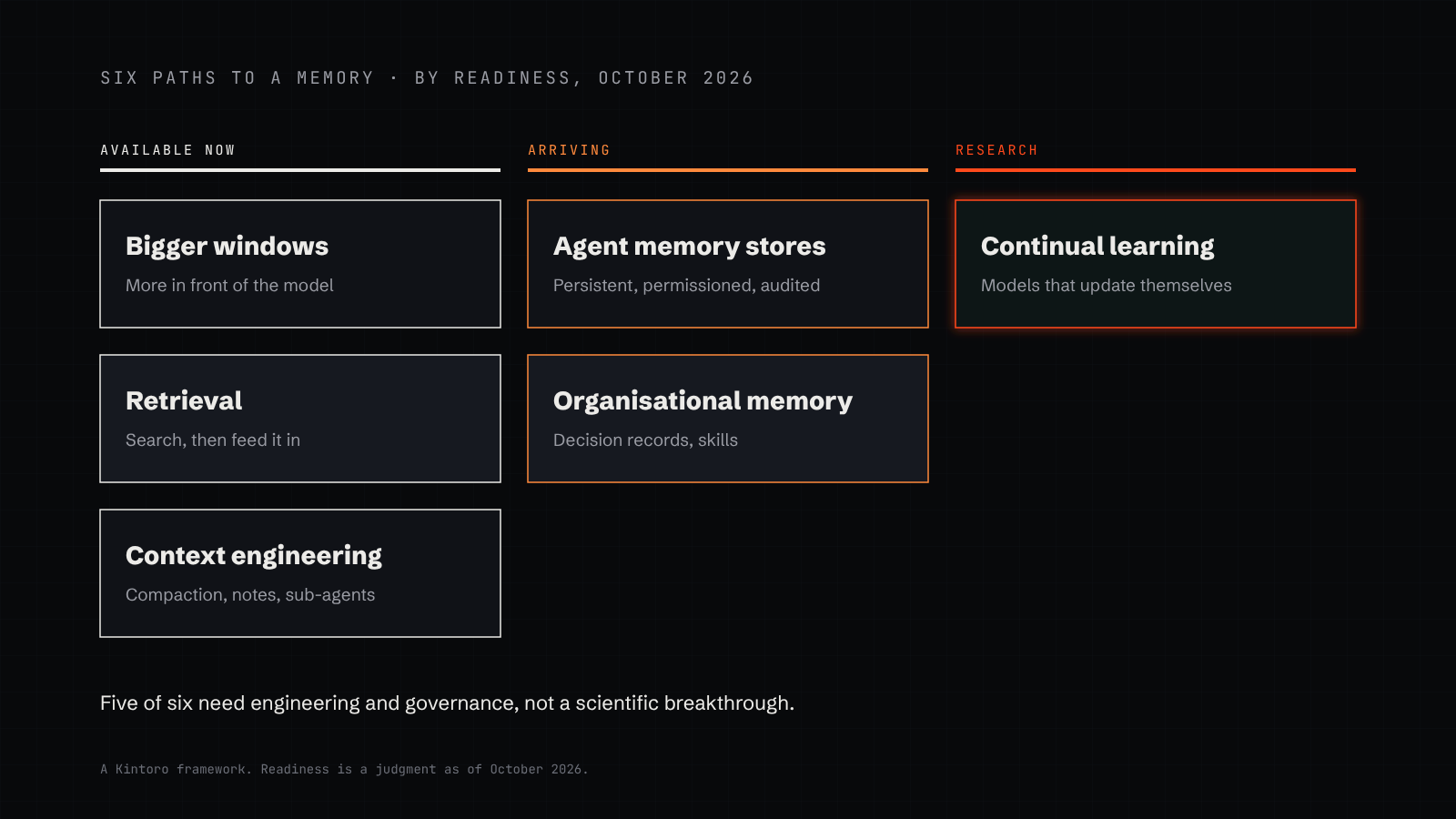
The important point for a business is that the first five do not require a scientific breakthrough. They are engineering and governance. Most of the memory a company needs can be built today, around the model, rather than inside it.
Forgetting does not make AI useless. It makes AI a brilliant temp. Memory is what turns it into a colleague.The central statement
Memory Has Its Own Risks
An AI that remembers can also remember wrongly, remember too much, or remember the wrong person’s details, as in our scenario. Three rules follow, and the better products already build them in.
- Memory must be visible. People should be able to see what an agent has learned and where it came from. Anthropic shows memory updates as session events and keeps an audit log.
- Memory must be correctable. Wrong memories must be easy to edit, delete or roll back, with a record of who did it.
- Memory must be owned. What an agent learns from your work is your company’s knowledge. It should stay within your walls, be returned if you leave, and never train someone else’s model.
There is a fourth rule, which is the theme of every Kintoro feature. The best memory signal is a human correction. When a person edits, approves or rejects an agent’s work, that is the most valuable thing the agent can learn from. A company that keeps people in the loop is not slowing its AI down. It is teaching it.
How We Build It into piMonk
03 · Kintoro · piMonk · October 2026
Corrections recorded. Memory per app. Shared memory in build.
I should declare an interest. At Kintoro we build piMonk, a suite of twelve business applications for mid-market companies, on one rule: agents do the work, people keep the decisions.
In piMonk, every agent action is recorded as “proposed, approved, edited or rejected”, and every item waiting for approval shows “the agent’s reason: why, not only what.” Those corrections are exactly the signal agents need to learn from. Our responsible AI page says “agents learn from the work as it happens,” and our trust page says what they learn from “trains your agents only.” Today, each app remembers its own work: piRevenue holds the history of accounts, and piCS holds guides, tickets and history.
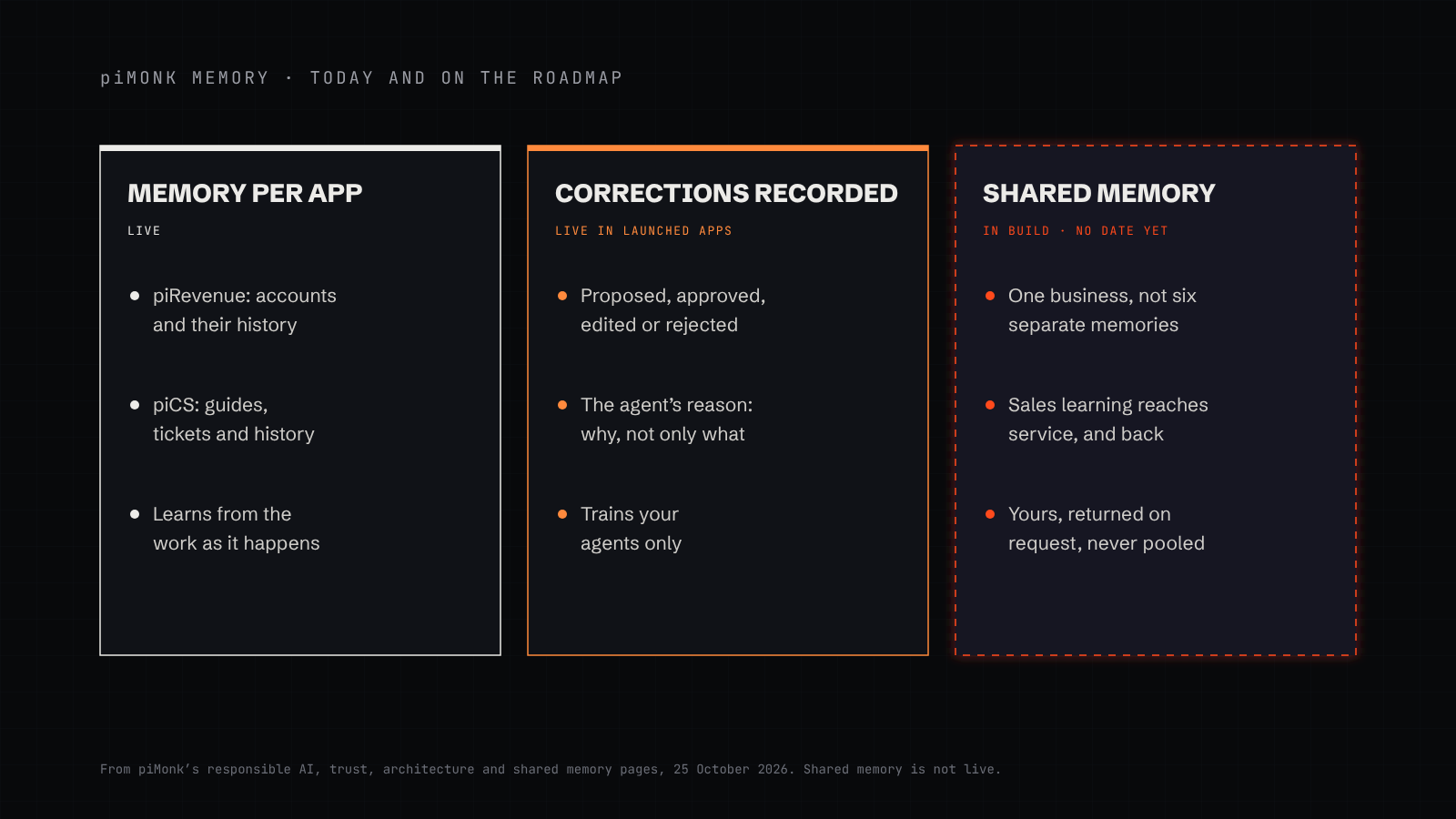
What is not finished, we say plainly: our architecture page lists “no shared memory yet.” A shared business memory, so that what sales learns reaches service, is in build with no date. Its rules are set in advance: “Yours. Returned on request. Never pooled.”
Five Checkpoints to 2035
This is how I expect AI memory to develop, with each checkpoint marked as measured, forecast by an expert, or forecast by Kintoro.
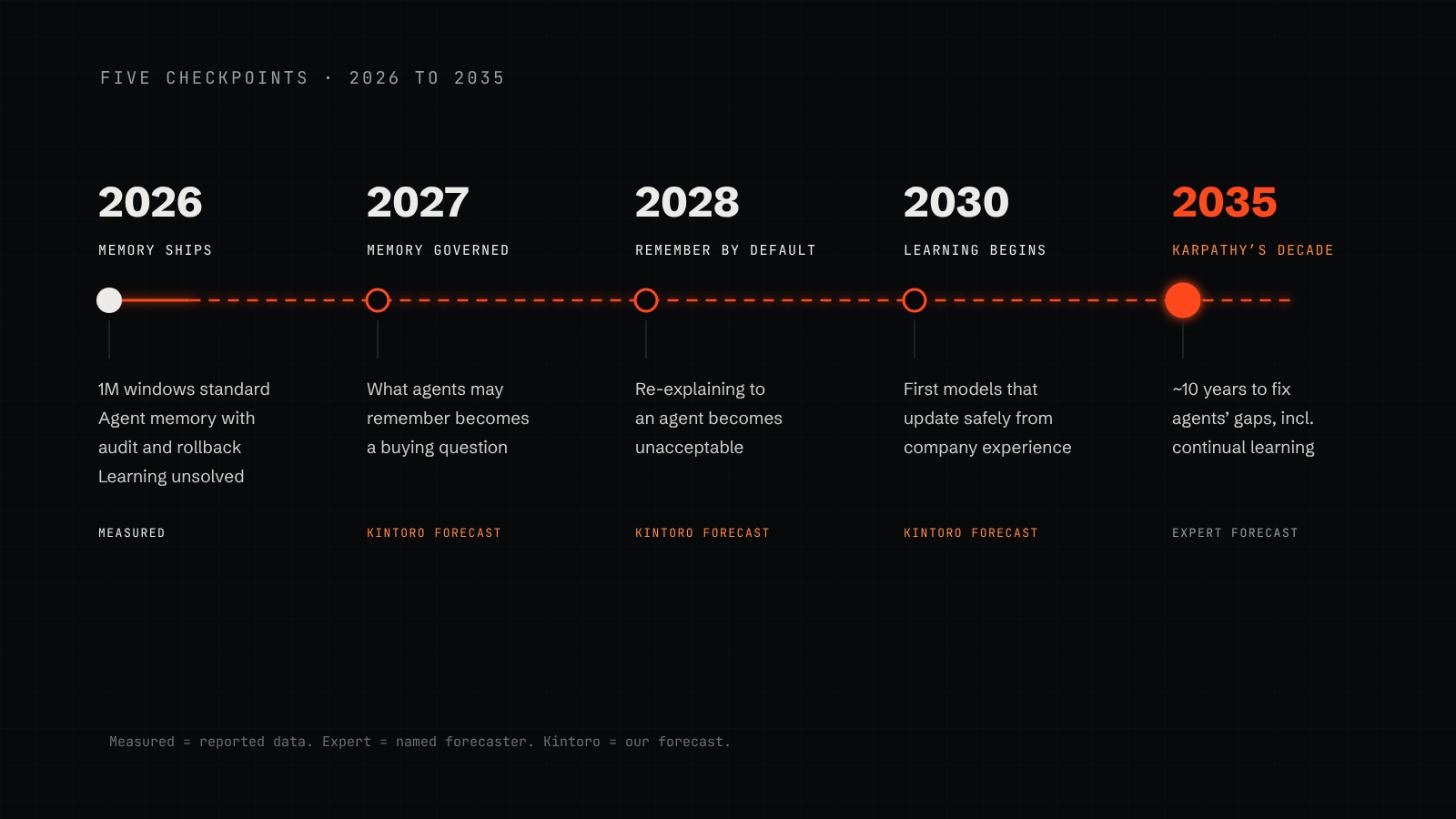
- 2026
Memory ships Measured
Million-token windows become standard. Anthropic and OpenAI ship persistent memory for enterprise agents, with audit logs and rollback. Research shows long context degrades and true continual learning is not solved.
- 2027
Memory gets governed Kintoro forecast
My forecast: memory controls, such as what agents may remember, who can see it, how it is corrected and where it lives, become standard questions in every enterprise AI purchase.
- 2028
Agents remember by default Kintoro forecast
My forecast: most enterprise agents carry governed memory across sessions, and having to re-explain context to an agent becomes as unacceptable as a call centre that loses your file.
- 2030
Learning in the model begins Kintoro forecast
My forecast: the first production models that update themselves safely from a company’s own experience appear in narrow, well-governed domains.
- 2035
Karpathy’s decade Expert forecast
Karpathy’s October 2025 estimate of about a decade to work through agents’ shortcomings, including continual learning, runs out around here.
The Business Conclusion
Do not wait for AI that learns on the job. Use forgetful AI where it shines today, and build the memory around it yourself.
For a business leader, that becomes five moves over the next twelve months:
- Sort your AI work into self-contained tasks, where today’s AI already pays, and continuous work, where it needs memory first.
- For continuous work, write the context down: customer histories, exceptions, procedures and decisions, in a form agents can read.
- Treat every human correction as a lesson. Record approvals, edits and rejections, and feed them back to your agents.
- Ask every vendor four memory questions: what does the agent remember, can we see it, can we correct it, and who owns it?
- Test long context on your own work before trusting it. A bigger window is not a better memory.
Then measure the one number that tells you whether your AI is learning: how often people have to correct the same mistake twice.
From Temp to Colleague
AI that forgets has already changed how people work, one self-contained task at a time. AI that remembers will change how companies work, because companies are made of continuity: relationships, histories, lessons learned the hard way.
The memory is arriving in pieces, and the learning will take longer. In the meantime, the best teacher an AI can have is a person who corrects it, and a record that keeps the lesson. At Kintoro, that is how we build piMonk: agents do the work, people keep the decisions, and every correction becomes something the company remembers.
It forgets. It is still useful. And the companies that teach it to remember will be the ones that pull ahead.
Brilliant temp today. Trusted colleague tomorrow.
Sources
- https://pureai.com/articles/2025/09/23/most-genai-investments-fail.aspx,Pure AI, on MIT Project NANDA, “The GenAI Divide: State of AI in Business 2025”, 23 September 2025
- https://ecommercefastlane.com/mit-95-percent-ai-failure-stat/,eCommerce Fastlane, “The MIT 95% AI failure stat: what the study actually found”, on the report’s methodology and critics
- https://80000hours.org/podcast/episodes/ai-workplace-mit-study/,80,000 Hours, Rob Wiblin, on the MIT study, 28 April 2026
- https://www.interviewquery.com/p/wharton-study-genai-roi-2025,Interview Query, on Wharton’s 2025 AI adoption report
- https://trychroma.com/research/context-rot,Chroma, Kelly Hong, Anton Troynikov and Jeff Huber, “Context Rot”, 14 July 2025
- https://www.refontelearning.com/blog/llm-context-window-race,Refonte Learning, “Every frontier model hit 1M tokens. Few can use it.”, 2026
- https://platform.claude.com/docs/en/release-notes/overview,Anthropic, Claude Platform release notes (1M context, Managed Agents memory, dreams, compaction), 2026
- https://claude.com/blog/claude-managed-agents-memory,Anthropic, “Built-in memory for Claude Managed Agents”, 23 April 2026
- https://venturebeat.com/orchestration/openai-unveils-workspace-agents-a-successor-to-custom-gpts-for-enterprises-that-can-plug-directly-into-slack-salesforce-and-more,VentureBeat, on OpenAI’s workspace agents, 22 April 2026
- https://arxiv.org/abs/2606.05661,Asawa et al., “Continual Learning Bench: Evaluating Frontier AI Systems in Real-World Stateful Environments”, arXiv, 4 June 2026
- https://simonwillison.net/2025/Oct/18/agi-is-still-a-decade-away/,Simon Willison, quoting Andrej Karpathy on the Dwarkesh Podcast, 18 October 2025
- https://venturebeat.com/technology/four-ai-research-trends-enterprise-teams-should-watch-in-2026,VentureBeat, “Four AI research trends enterprise teams should watch in 2026” (Titans, Nested Learning), 1 January 2026
- https://agentic-ai.readthedocs.io/en/latest/ContextEngineering/anthropic/,Summary of Anthropic, “Effective context engineering for AI agents”
- https://pimonk.com/trust/ai-governance/,piMonk, Responsible AI page, accessed 25 October 2026
- https://pimonk.com/platform/architecture/,piMonk, Architecture page, accessed 25 October 2026
- https://pimonk.com/platform/memory/,piMonk, Shared business memory page, accessed 25 October 2026
See the idea working in piMonk
piMonk is the AI company we built on this thinking: agents do the work, people keep the decisions. Try the app this piece points to, or book a demo.
Book a demo