

Scenario · Tuesday, 16 March 2032 · A forecast, not a report
At 6:30 in the morning, before Amara Osei has made coffee, her team has already done a night’s work. Amara is operations director at a 160-person company in Leeds that makes and distributes commercial kitchen equipment. Her team is five people and thirty-four AI agents.
Overnight, the agents routed 1,240 orders, confirmed 96 supplier deliveries, answered 310 customer questions, and drafted this morning’s status for every open project. They also stopped three times and waited, because three things needed a person: a supplier in Vietnam missing a ship date, a refund above the limit, and a new customer asking for credit terms.
Amara’s job is no longer to find out what happened. The agents tell her. Her job is to decide what happens next, to coach the people who will decide after her, and to answer for all of it.
Amara, her company and her day are fictional, and so is 2032. Later in this feature I follow her through the whole day. Everything before that is built from what can be measured today, in October 2026: what companies, workers and researchers are actually reporting. Where I forecast, I say so.
For most of the last six years, “hybrid work” meant one thing: where people sit. Office on Tuesdays, home on Fridays. That argument is not over, but a bigger one has started. The workforce itself is becoming hybrid. Not people in two places, but two kinds of worker: people and AI agents.
That raises questions every business will have to answer before 2032. What exactly is a hybrid workforce? Who manages the agents? How do work, decisions and accountability flow between people and software? And what does an ordinary working day look like inside one?
What “Hybrid Workforce” Now Means
The McKinsey Global Institute put it plainly in November 2025: “Work in the future will be a partnership between people, agents, and robots.” Its analysis found that today’s technology could in theory automate activities taking up about 57% of US work hours: 44% by AI agents and 13% by robots. It stressed that this is technical potential, not a forecast of job losses, because most work is not a job that disappears but a set of tasks that gets redistributed.
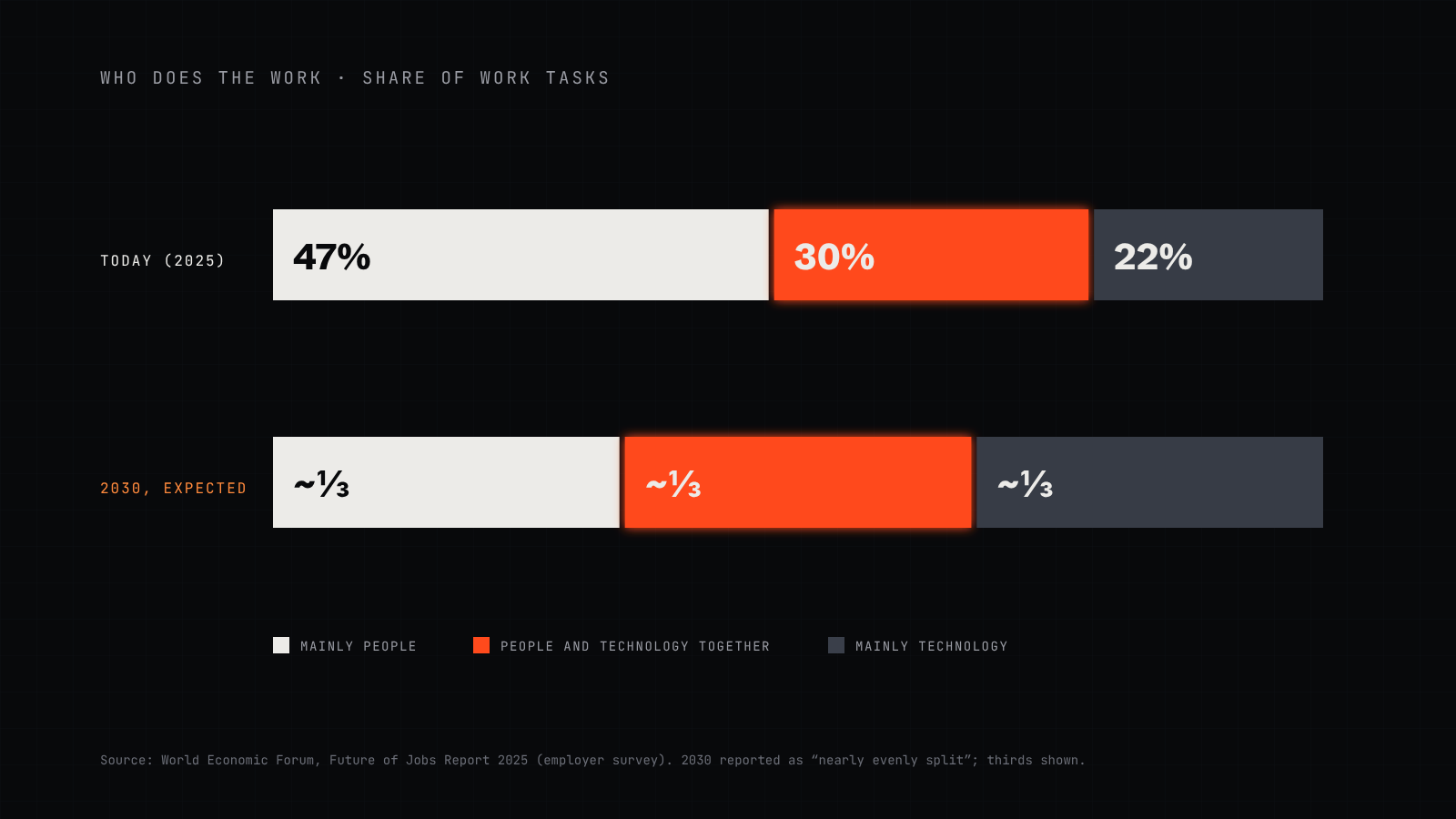
Employers see the same shift. In the World Economic Forum’s Future of Jobs Report 2025, they estimated that 47% of work tasks are done mainly by people today, 22% mainly by technology, and 30% by a combination. By 2030, they expect those three to be nearly evenly split.
Microsoft gave the new arrangement a vocabulary in its 2025 Work Trend Index, built on a survey of 31,000 workers in 31 countries. It described the “agent boss”, someone who “builds, delegates to and manages agents to amplify their impact”, and told leaders to track a new metric: the human-agent ratio. Leaders expected their staff to be training agents (41%) and managing them (36%) within five years.
So here is my definition, as a Kintoro framework. A hybrid workforce is one where work is planned, assigned, measured and governed across people and AI agents as a single system. Each piece of work goes to whoever does it best, person or agent. Every agent has a job, a manager and limits. And people stay accountable for every outcome.
The old chart shows who reports to whom. The new one shows who may decide what.Kintoro, “The company of 2030”
Where We Stand: October 2026
01 · Measure · Microsoft · Gartner · Deloitte · 2025 to 2026
The agents have arrived. The organisations have not.
Microsoft’s 2026 Work Trend Index, published in May and based on 20,000 AI users in ten countries, found that active agents in the Microsoft 365 ecosystem grew fifteenfold in a year. Sixteen percent of AI users are what it calls “Frontier Professionals”, who routinely use agents for multi-step work. But only 26% said their leadership was clearly aligned on AI, and only 13% said they were rewarded for reinventing work with AI even when results fell short. Microsoft calls this the “Transformation Paradox”: workers are ready, and the system around them still rewards the old way. Organisational factors explained more than twice as much of AI’s reported impact as individual ones.
Production use is still thin. Deloitte’s 2025 research found only 11% of organisations actively using agentic systems in production. Gartner expects more than 40% of agentic AI projects to be cancelled by the end of 2027, and estimates that only about 130 of the thousands of “agentic AI” vendors are real. Yet a Gartner survey of more than 700 CIOs, published in November 2025, found they expect that by 2030, no IT work will be done by humans without AI: 75% will be done by people augmented with AI, and 25% by AI alone.
The hybrid workforce, 2026
- 15×growth in active agents in the Microsoft 365 ecosystem in one yearMicrosoft, Work Trend Index, May 2026
- 16%of AI users are “Frontier Professionals” who routinely work with agentsMicrosoft, Work Trend Index, May 2026
- 11%of organisations actively using agentic systems in productionDeloitte, 2025
- 0%of IT work CIOs expect to be done by humans without AI by 2030Gartner CIO survey, Nov 2025
The technology for a hybrid workforce exists. The management system for one mostly does not.
What the Evidence Says About Mixed Teams
02 · Evidence · P&G · Stanford · Klarna · 2024 to 2025
An AI can be a teammate. It cannot be the whole team.
The best field evidence comes from Procter & Gamble. In a 2025 experiment with 776 professionals, researchers from Harvard and Wharton found that individuals working with AI matched the performance of two-person teams working without it. AI also blurred the line between specialists: with AI, R&D and commercial staff proposed more balanced ideas, and people reported more positive emotions while working.
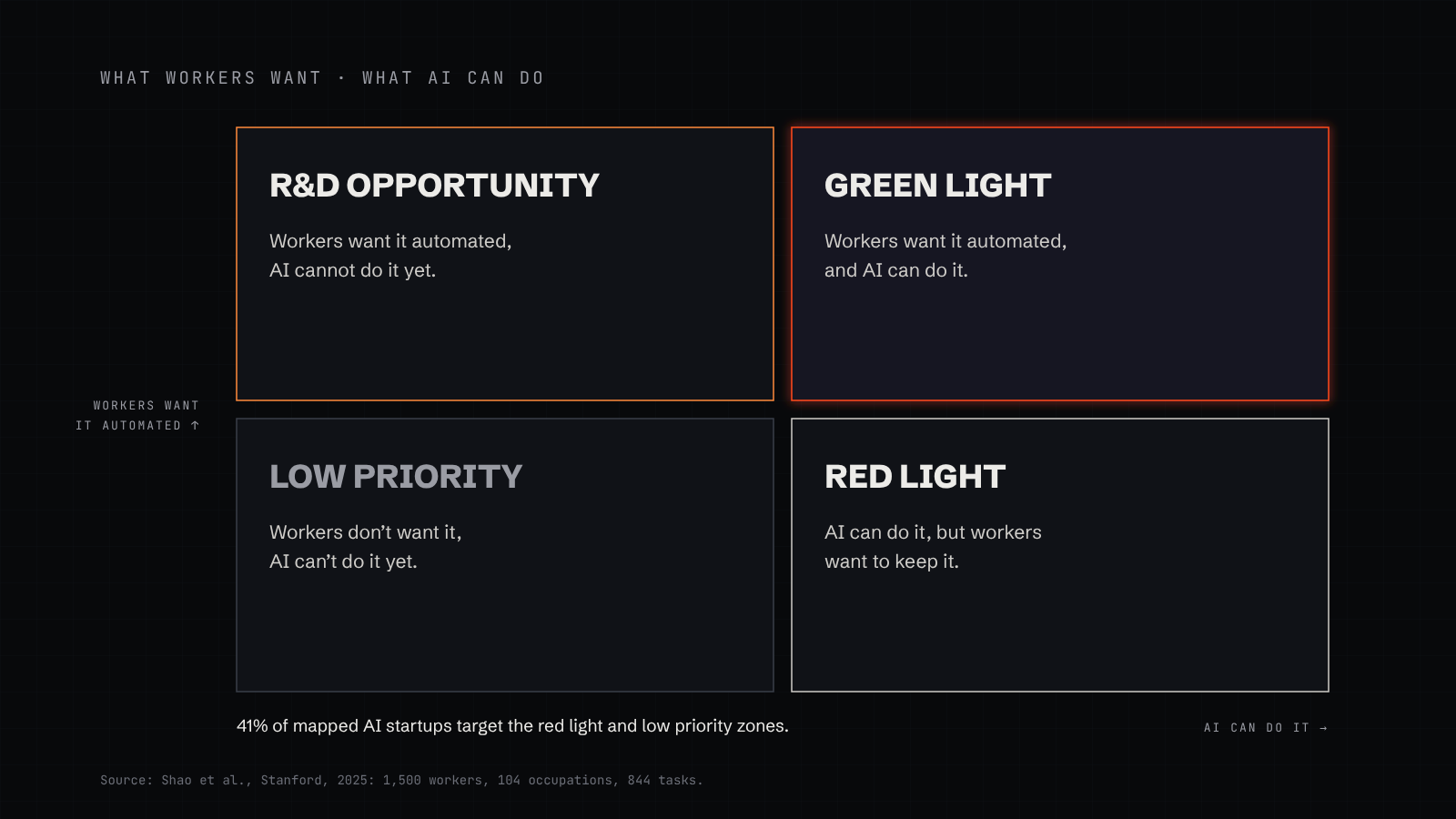
What do workers want? A Stanford team led by Diyi Yang and Erik Brynjolfsson asked 1,500 workers in 104 occupations about 844 tasks. Workers wanted AI to automate 46.1% of tasks, mostly to free time for higher-value work. But the most common preference was not full automation. In 45.2% of occupations, the dominant wish was an equal partnership, where human and AI together outperform either alone. The study also found that skills in information processing are losing value, while coordination, organisation and interpersonal skills are gaining it.
And there is a cautionary tale. In February 2024, Klarna said its AI assistant was doing the work of 700 customer service agents, handling about three-quarters of its customer chats within a month. By May 2025, its chief executive said the AI had produced “lower quality” service and that “investing in the quality of human support is the way of the future for us”. Klarna started hiring people again, promising there would “always be a human if you want”. The lesson is not that agents failed. It is that the right mix is a design choice, not a cost target.
The question is never “people or agents?” It is “which work, for whom, and who answers for it?”
How a Hybrid Workforce Operates
If a hybrid workforce is one system, it needs the same things any workforce needs: a plan, roles, managers, handoffs, measures and accountability. Here is how I expect each to work, as a Kintoro framework built on what the leading companies are already doing.
- Plan work, not headcount. Moderna merged its HR and technology functions in 2025 under a Chief People and Digital Technology Officer, Tracey Franklin, to “architect the flow of work”, moving “from a people-only lens to a systems view” of humans and AI agents working side by side. Workforce planning becomes work planning: list the work, then decide who or what should do each part.
- Give every agent a job, a manager and an identity. Microsoft now tells IT teams to treat agents “as managed entities with identities, permissions, policy enforcement, and lifecycle management”. In practice, that means a job description, a named human manager, limits, a trial period, a review and, eventually, retirement.
- Design the handoffs. Work fails at the seams. Microsoft found Frontier Professionals far more likely to document agent workflows and human handoffs at the level of the function (29% against 17%). Every handoff between agent and person needs a written rule: what passes, what waits, and who catches it.
- Measure the team, not the head. Output per person stops making sense when a person runs thirty agents. Measure the team’s outcomes, its human-agent ratio, its cost per outcome, and the quality of its decisions.
- Keep judgment and accountability with people. Agents can draft, sort, chase and report. Decisions that commit the business stay with named people, and every agent action is recorded. That is what the Stanford workers asked for, and what customers, courts and regulators will expect.
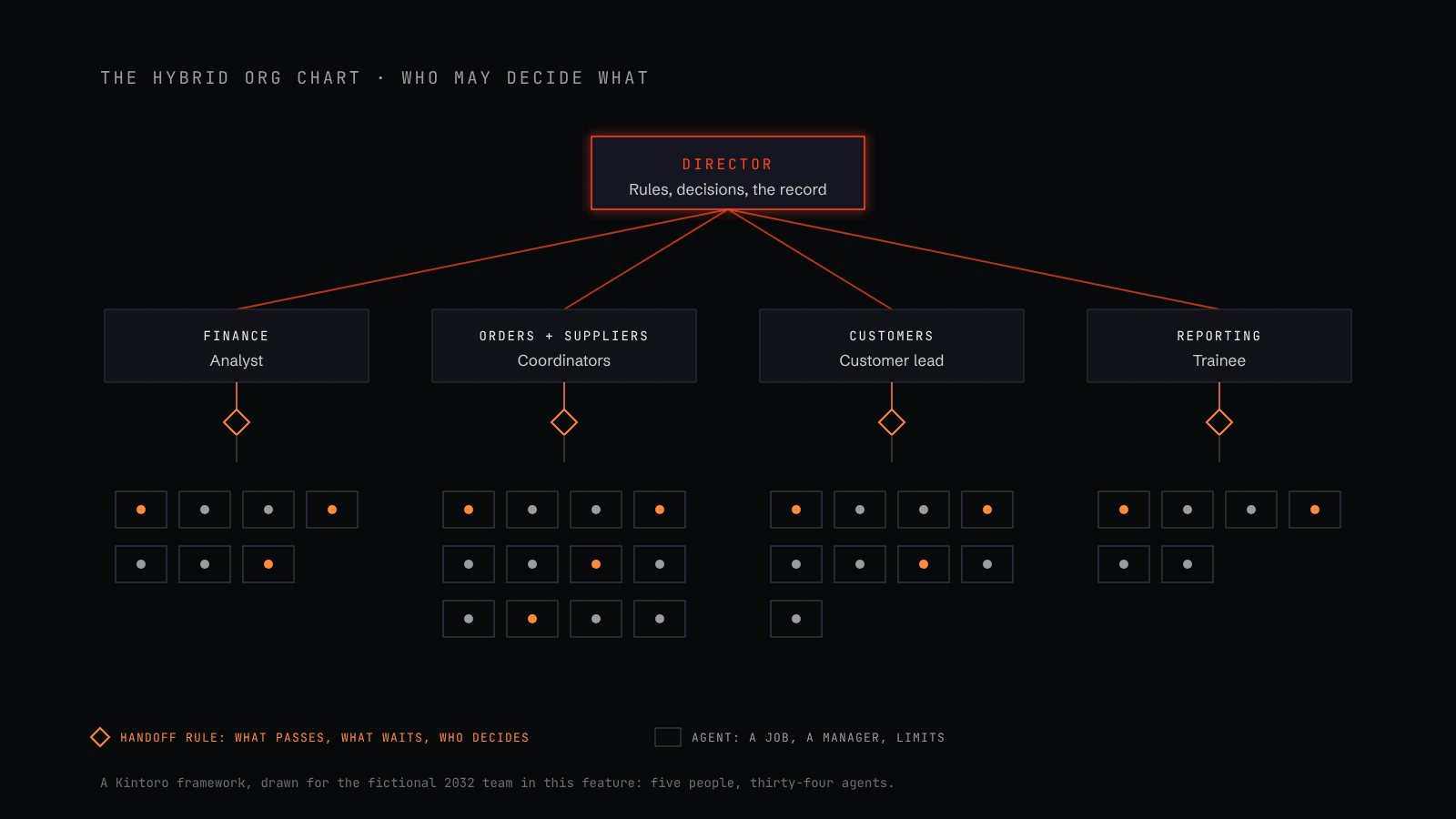
Managers change most. As Kintoro argued in “The company of 2030”, middle management grew to collect, summarise and relay information, and agents now do much of that. Managers become more like editors: they judge, approve and coach, instead of chasing updates. Companies will need to promote people for the quality of their decisions, not for gathering and relaying information.
Which Jobs Become Hybrid
Not every job changes the same way. McKinsey grouped US jobs by who could do their work. About a third are people-centric, such as healthcare and building maintenance, where people remain central. About 40% are agent-centric, such as legal and administrative roles, where agents could take on much of the work. Around one in five are true people–agent partnerships, like teachers and engineers. Smaller groups combine people with robots, or all three.
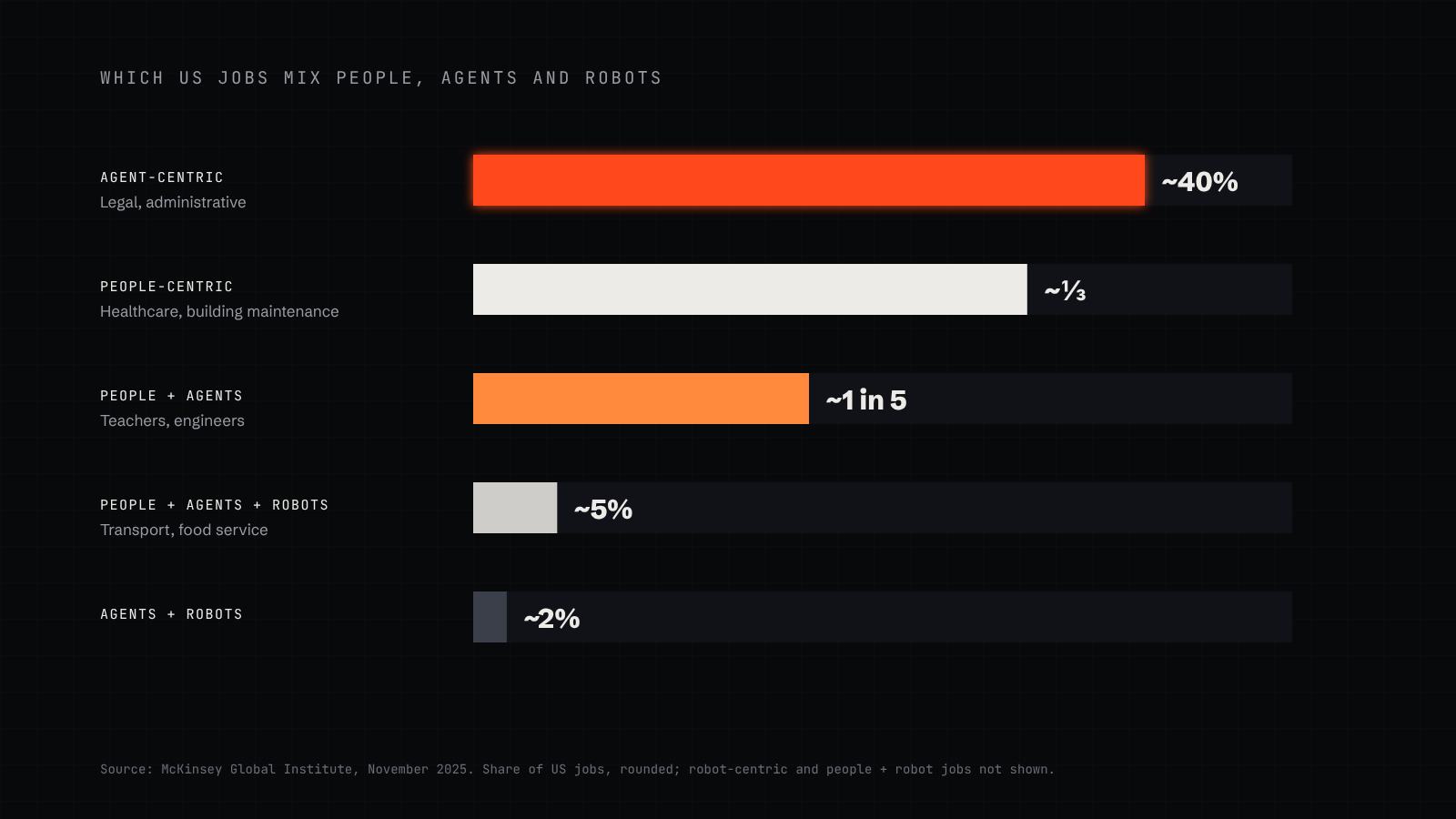
The skill that grew fastest in US job postings over the past two years was AI fluency, up sevenfold according to McKinsey, and now required in occupations employing about seven million workers. But more than 70% of the skills employers seek are used both in work that can be automated and in work that cannot. Most skills do not disappear. They get used differently.
There is a risk for the young. If agents take the routine tasks juniors used to learn on, where do juniors learn? The best teams are already answering on purpose: Microsoft found that 43% of Frontier Professionals deliberately do some work without AI to keep their skills sharp. In a hybrid workforce, apprenticeship has to be designed in, or it disappears.
A Day in 2032
Back to Amara, on Tuesday 16 March 2032. This is a Kintoro forecast, built from the trends above. Her team: five people, a finance analyst, two coordinators, a customer lead and a 23-year-old trainee named Sam, and thirty-four agents across orders, suppliers, customers, finance and reporting.
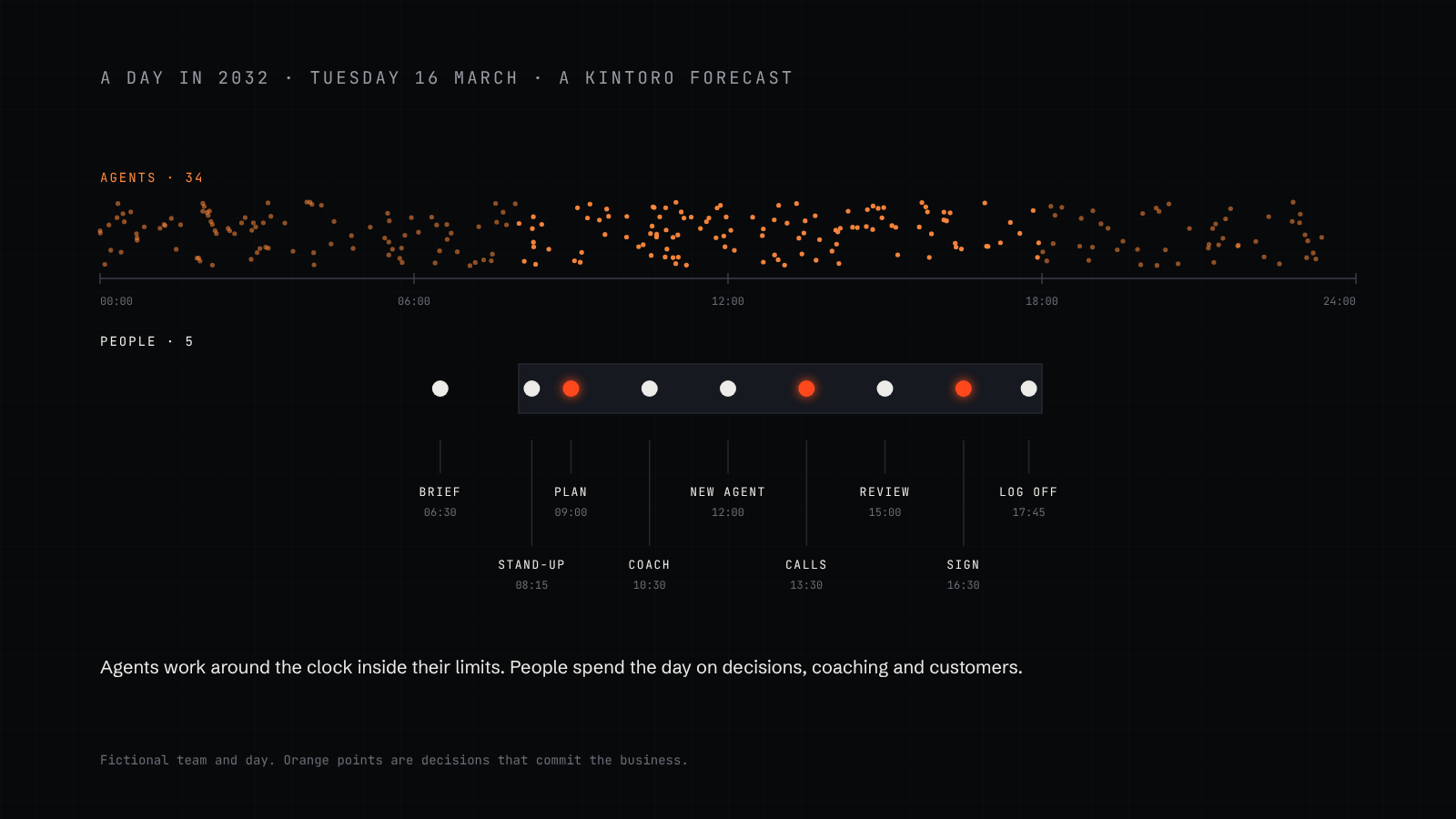
- 06:30
The night shift hands over Kintoro forecast
The overnight work arrives as a one-page brief: what the agents did, what they could not do, and three items waiting for a person. Nothing that commits money or a customer went out without a rule that allowed it.
- 08:15
A stand-up with no status Kintoro forecast
Nobody reads out updates; the agents wrote them. The fifteen minutes go on one question: the Vietnam supplier is ten days late. Who tells which customers, and what do we offer them?
- 09:00
Approving the plan, not the steps Kintoro forecast
The supplier agent proposes a recovery plan: air freight for every affected order. Amara approves most of it, but rejects air freight for the two biggest customers. She will call them herself. One decision, made by the person who knows the relationships.
- 10:30
Teaching Sam Kintoro forecast
Sam has flagged three agent decisions that looked wrong. Two were fine; one was a pricing error the agent had copied from an old contract. They fix the rule together. This is how Sam learns the business now: by reviewing and correcting the agents’ work, and by doing one task a week without them.
- 12:00
A new hire, of sorts Kintoro forecast
A returns agent joins the team. It has a job description, limits, a trial month, and a manager: Sam, his first direct report. Amara signs off its approval rules: refunds up to the standard limit run alone; anything above waits for the customer lead.
- 13:30
The call only a person can make Kintoro forecast
Amara phones the two big customers. The agents prepared the history, the options and the costs. The customers want to hear it from a person who can commit. One agrees to split the delivery; one asks for a discount. Amara gives half of it.
- 15:00
The agents’ monthly review Kintoro forecast
The team reviews its agents the way it reviews its work. One agent’s requests were approved unchanged 99% of the time, so it moves down an approval tier. One is edited too often, so its instructions get rewritten. One duplicates another, so it is retired.
- 16:30
Signing the numbers Kintoro forecast
The board pack drafts itself: costs, delivery, quality, the human-agent ratio and the decision log. Amara changes two sentences and signs it. The numbers that go to the board are hers.
- 17:45
Logging off Kintoro forecast
Amara goes home. The agents keep working inside their limits. Anything that commits the business waits for the morning, or for the on-call person. Tomorrow starts with another one-page brief.
Notice what Amara did not do. She did not chase updates, compile reports, re-key orders or answer routine questions. Notice what she did: she made eleven decisions that mattered, coached a junior, managed a new agent, kept two customers, and signed her name to the result. That is the job a hybrid workforce leaves for people. It is harder, and it is better.
In a hybrid workforce, nobody manages the work. They manage the decisions.The central statement
How piMonk Runs a Hybrid Team Today
03 · Kintoro · piMonk · October 2026
Agents with names, jobs and limits. People with the decisions.
I should declare an interest. At Kintoro we build piMonk, a suite of business applications for growing mid-market companies, and it is designed for exactly this kind of team. Amara’s day is a forecast. The way of working behind it is something we build for now.
Every agent in piMonk is a named role with a defined job and a record of what it did, such as the Analyst in piRevenue, our CRM, or the Resolver in piCS, our customer service app. Agents propose; your rules decide what needs a person first. Every action sits in one of four approval tiers: do and log, do and tell, propose and wait, or people only. Money, customers, prices and contracts wait for a person. When an agent is unsure, it waits too. And every action is recorded where nobody can edit it.
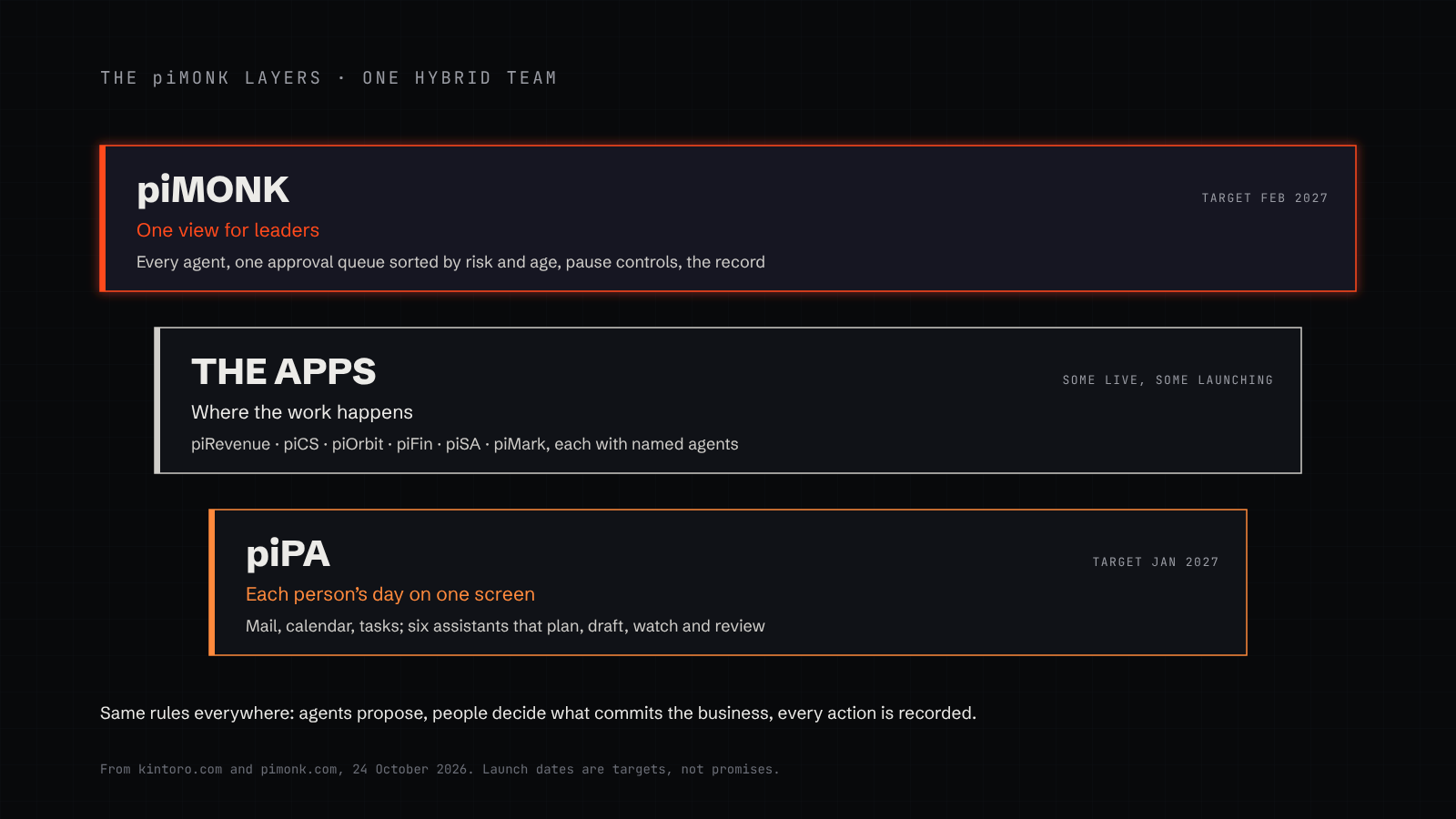
Amara’s one-page brief is the idea behind piPA, our app for “every employee’s day on one screen”, now in daily use at Kintoro and targeted for launch in January 2027. Its six assistants plan, analyse, draft, watch for what needs you, summarise threads and review work before it goes out, while people decide what is sent, what is shared and what counts as done. Her stand-up without status is piOrbit, where agents sort incoming work, chase updates, flag slipping dates and draft the weekly status for a lead to review. And her view of the whole team is piMonk itself, in build for a February 2027 target: one screen showing what every agent is doing, one approval queue sorted by risk and age, and the controls to pause an agent or an app, each with a reason.
The agents’ monthly review is how we already ask customers to run approval rules. Start one tier stricter than feels necessary. Use the record to loosen it. An action approved unchanged almost every time moves down a tier; one often edited needs better instructions, not more freedom. Every rule needs a named approver, a time limit, an escalation path and a deputy. That is HR for agents, written down.
Agents do the work. People keep the decisions.
Five Checkpoints to 2032
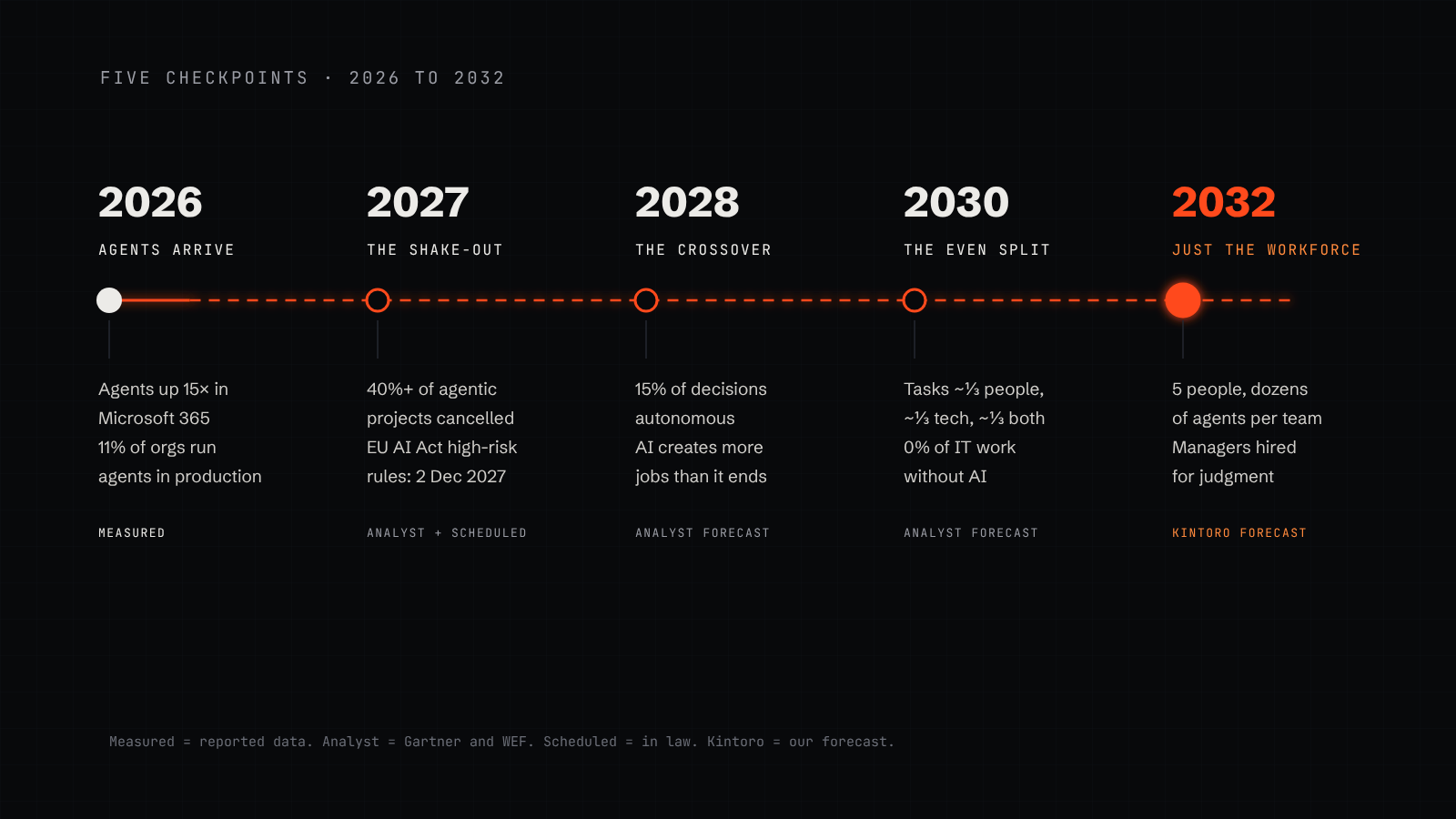
This is how I expect the hybrid workforce to arrive, with each checkpoint marked as measured today, scheduled in law, forecast by analysts, or forecast by Kintoro.
- 2026
The agents arrive Measured
Active agents in Microsoft 365 grow fifteenfold in a year. Sixteen percent of AI users routinely work with agents. Only 11% of organisations run agentic systems in production, and workers are readier than their employers.
- 2027
The shake-out Analyst forecast · Scheduled
Gartner expects more than 40% of agentic AI projects to be cancelled by the end of the year. The EU AI Act’s rules for high-risk systems, including AI used in hiring and managing people, apply from 2 December 2027. The survivors are the ones with managers, rules and records.
- 2028
The crossover Analyst forecast
Gartner predicts 15% of day-to-day work decisions will be made autonomously by agents, 33% of enterprise software will include agentic AI, and AI will create more jobs than it destroys. Merging HR and IT, as Moderna did, stops being unusual.
- 2030
The even split Analyst forecast
Employers expect work tasks to be split roughly evenly between people, technology and the two together. CIOs expect no IT work to be done by people without AI. The human-agent ratio is a standard management metric.
- 2032
Just the workforce Kintoro forecast
My forecast: nobody says “hybrid workforce” any more, because there is no other kind. Mid-market teams of five to ten people run dozens of agents each. Managers are hired for their judgment and their coaching. Every company can show who, or what, did each piece of work, and who answered for it.
The Business Conclusion
A hybrid workforce is coming whether or not a company plans for it. Employees are already bringing agents to work, and software vendors are already putting agents into every product. The choice is whether those agents join an organisation that knows how to manage them, or drift around one that does not.
For a business leader, that becomes five moves over the next twelve months:
- Map the work, not the jobs. For one team, list every recurring task and decide which should be done by a person, an agent, or both.
- Write a job description for every agent. A job, a named manager, limits, a review date and a way to switch it off.
- Draw the handoffs. For each process, write down what an agent may finish alone, what waits for a person, and who that person is.
- Start measuring the team. Track outcomes, cost per outcome, the human-agent ratio and decision quality, alongside the usual numbers.
- Protect how people learn. Give juniors the job of reviewing agents, and keep some work deliberately manual so the next generation of decision-makers still knows the craft.
Start with one team, one process and thirty days. The organisations that work this out first will not just be more efficient. They will be the ones good people want to work for, because the work left for people will be the interesting part.
The Team You Can’t See
By 2032, the team on your org chart will be the smaller part of the team doing the work. The rest will be agents: tireless, fast, and without judgment of their own. Whether that makes a company better or merely busier depends on the people: on how clearly they decide what the agents may do, and how well they make the decisions that are left.
At Kintoro, that is how we build piMonk. AI agents handle the routine work inside the systems that run the business, each with a name, a job and limits. People keep control of the decisions that commit it. And every step is written down, so everyone can see the team they cannot see.
The hybrid workforce is not people versus machines. It is people deciding, and machines doing, in one team.
Agents do the work. People keep the decisions.
Sources
- https://www.mckinsey.com/mgi/our-research/agents-robots-and-us-skill-partnerships-in-the-age-of-ai,McKinsey Global Institute, “Agents, robots, and us: Skill partnerships in the age of AI”, 25 November 2025
- https://unleash.ai/artificial-intelligence/analysis/5-things-hr-needs-to-know-from-wefs-2025-future-of-jobs-report,UNLEASH, “5 things HR needs to know from WEF’s 2025 Future of Jobs Report”, 10 January 2025 (World Economic Forum, Future of Jobs Report 2025)
- https://www.uctoday.com/collaboration/frontier-firms-and-agent-bosses-microsoft-outlines-its-future-of-work-vision/,UC Today, “‘Frontier Firms’ and ‘Agent Bosses’: Microsoft Outlines Its Future of Work Vision”, April 2025 (Microsoft 2025 Work Trend Index)
- https://www.microsoft.com/en-us/worklab/work-trend-index/agents-human-agency-and-the-opportunity-for-every-organization,Microsoft WorkLab, “2026 Work Trend Index: Agents, human agency, and the opportunity for every organization”, 5 May 2026
- https://www.geekwire.com/2026/microsofts-new-research-finds-an-ai-paradox-holding-companies-back/,GeekWire, “Microsoft’s new research finds an AI ‘paradox’ holding companies back”, 5 May 2026
- https://www.deloitte.com/ro/en/Industries/technology/perspectives/agentic-reality-check-preparing-silicon-based-workforce.html,Deloitte, “The agentic reality check: Preparing for a silicon-based workforce”, Tech Trends 2026
- https://www.gartner.com/en/newsroom/press-releases/2025-06-25-gartner-predicts-over-40-percent-of-agentic-ai-projects-will-be-canceled-by-end-of-2027,Gartner, “Gartner Predicts Over 40% of Agentic AI Projects Will Be Canceled by End of 2027”, 25 June 2025
- https://www.gartner.com/en/newsroom/press-releases/2025-11-10-gartner-survey-finds-artificial-intelligence-will-touch-all-information-technology-work-by-2030,Gartner, “Gartner Survey Finds AI Will Touch All IT Work by 2030”, 10 November 2025
- https://www.nber.org/papers/w33641,Fabrizio Dell’Acqua et al., “The Cybernetic Teammate: A Field Experiment on Generative AI Reshaping Teamwork and Expertise”, NBER Working Paper 33641, April 2025
- https://arxiv.org/pdf/2506.06576,Yijia Shao, Humishka Zope, Yucheng Jiang, Jiaxin Pei, David Nguyen, Erik Brynjolfsson and Diyi Yang, “Future of Work with AI Agents: Auditing Automation and Augmentation Potential across the U.S. Workforce”, Stanford University, 2025
- https://www.entrepreneur.com/business-news/klarna-ceo-reverses-course-by-hiring-more-humans-not-ai/491396,Entrepreneur, “Klarna Is Hiring Customer Service Agents After AI Couldn’t Cut It on Calls, According to the Company’s CEO”, 9 May 2025
- https://unleash.ai/artificial-intelligence/interview/why-moderna-merged-hr-and-it-to-better-architect-the-flow-of-work,UNLEASH, “Why Moderna merged HR and IT to better architect the flow of work”, 27 June 2025
- https://fpf.org/blog/the-ai-act-implementation-timeline-what-changes-under-the-ai-omnibus/,Future of Privacy Forum, “The AI Act implementation timeline: What changes under the AI Omnibus?”, 2026
- https://kintoro.com/perspectives/the-company-of-2030/,Kintoro Perspectives, “The company of 2030”
- https://pimonk.com/platform/agents/,piMonk, “Agents” platform page: named agent roles, approval flow and record, accessed 24 October 2026
- https://pimonk.com/resources/guides/approval-rules/,piMonk, “Writing approval rules for agents” guide, accessed 24 October 2026
- https://pimonk.com/products/pipa/,piMonk, piPA product page, accessed 24 October 2026
- https://pimonk.com/products/piorbit/,piMonk, piOrbit product page, accessed 24 October 2026
- https://pimonk.com/products/pimonk/,piMonk, piMonk leadership view product page, accessed 24 October 2026
See the idea working in piMonk
piMonk is the AI company we built on this thinking: agents do the work, people keep the decisions. Try the app this piece points to, or book a demo.
Book a demo