

Scenario · Thursday, 9 November 2028 · A forecast, not a report
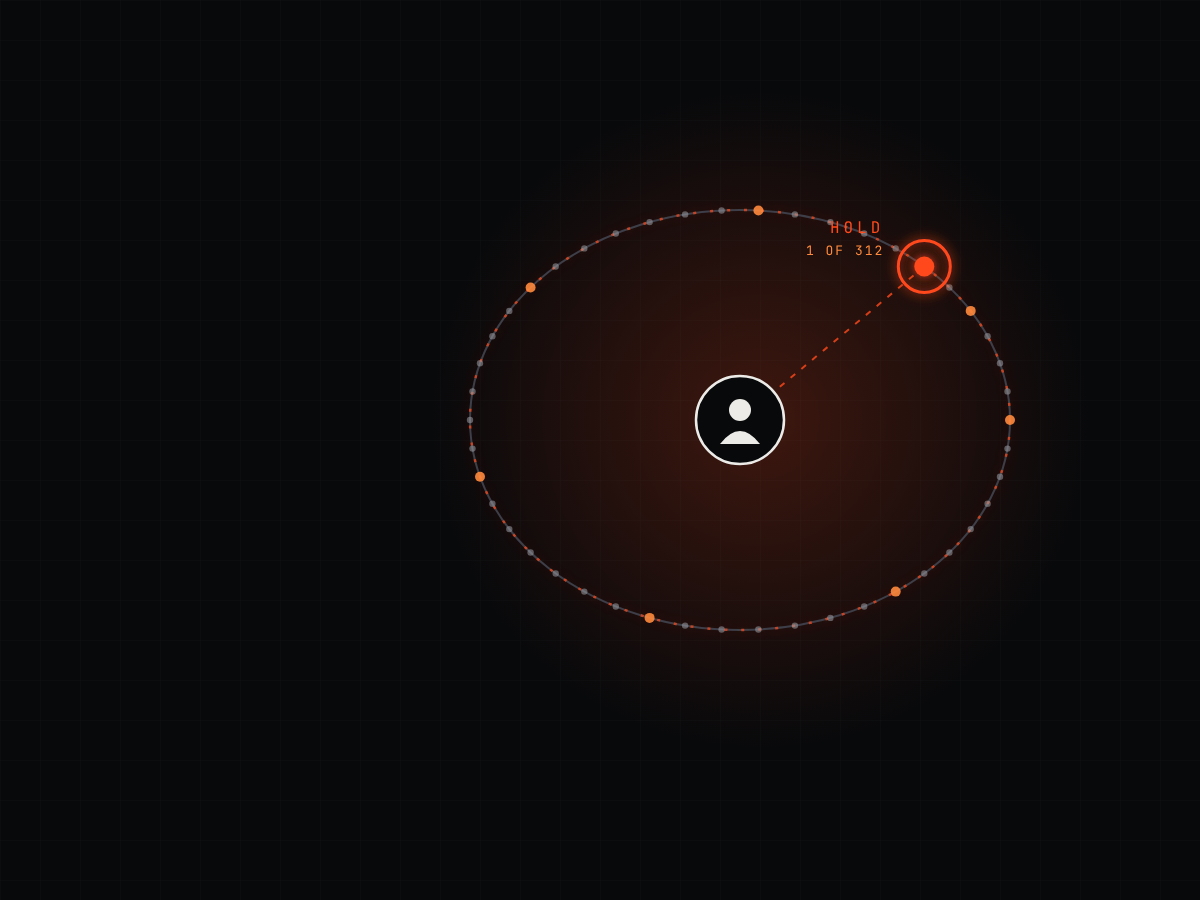
At 4:52 in the afternoon, Lena, who runs accounts payable at a mid-size manufacturer, clicks “approve” for the 288th time that day. Her payment agent has proposed 312 supplier payments. She is the human in the loop. Payment 288 goes to a supplier whose bank details changed that morning, after an email that looked exactly like the real thing. It is fraud, and €184,000 leaves the account.
The audit asks one question: why did Lena approve it? Nobody asks why the system was designed so that a bank-detail change looked exactly like the 311 routine payments around it, or why one person was expected to give 312 decisions the same attention before five o’clock.
The company redesigns the loop. The agent now pays routine invoices on its own, inside limits. It stops and asks for two people to confirm any change of bank details, and it shows them why. Lena now reviews six decisions a day instead of 312. She catches the next attempt in under a minute.
Lena and her company are fictional, and so is 2028. The pattern is not. Everything else in this feature is built from what can be measured today, in October 2026, and from fifty years of research on people and automation. Where I forecast, I say so. And the redesign Lena’s company makes is the one we have built into piMonk from the start: agents prepare the work, and money waits for a person.
“Human in the loop” has become the most reassuring phrase in AI. Vendors put it on product pages. Regulators write it into law. Boards ask for it before they approve a pilot. It sounds like a guarantee: whatever the machine does, a person will check.
The evidence says that guarantee is weaker than it sounds. A person in the loop who approves almost everything, can’t see what matters, and takes the blame when it goes wrong is not oversight. It is a rubber stamp. This feature is about the difference, and about how to design a loop where the human actually counts.
Where the Phrase Comes From
The idea is older than AI. Engineers working on control systems and weapons in the twentieth century described three positions for a person: in the loop, where the machine cannot act until a human decides; on the loop, where the machine acts and a human watches and can intervene; and out of the loop, where the machine acts alone.
In 2000, the engineering psychologists Raja Parasuraman, Thomas Sheridan and Christopher Wickens showed that this is not one switch but many. Automation can take over any of four functions, gathering information, analysing it, choosing what to do and doing it, and at each one it sits somewhere on a ten-level scale: from the computer offering no help, through suggesting options and acting unless vetoed, to acting without telling anyone.
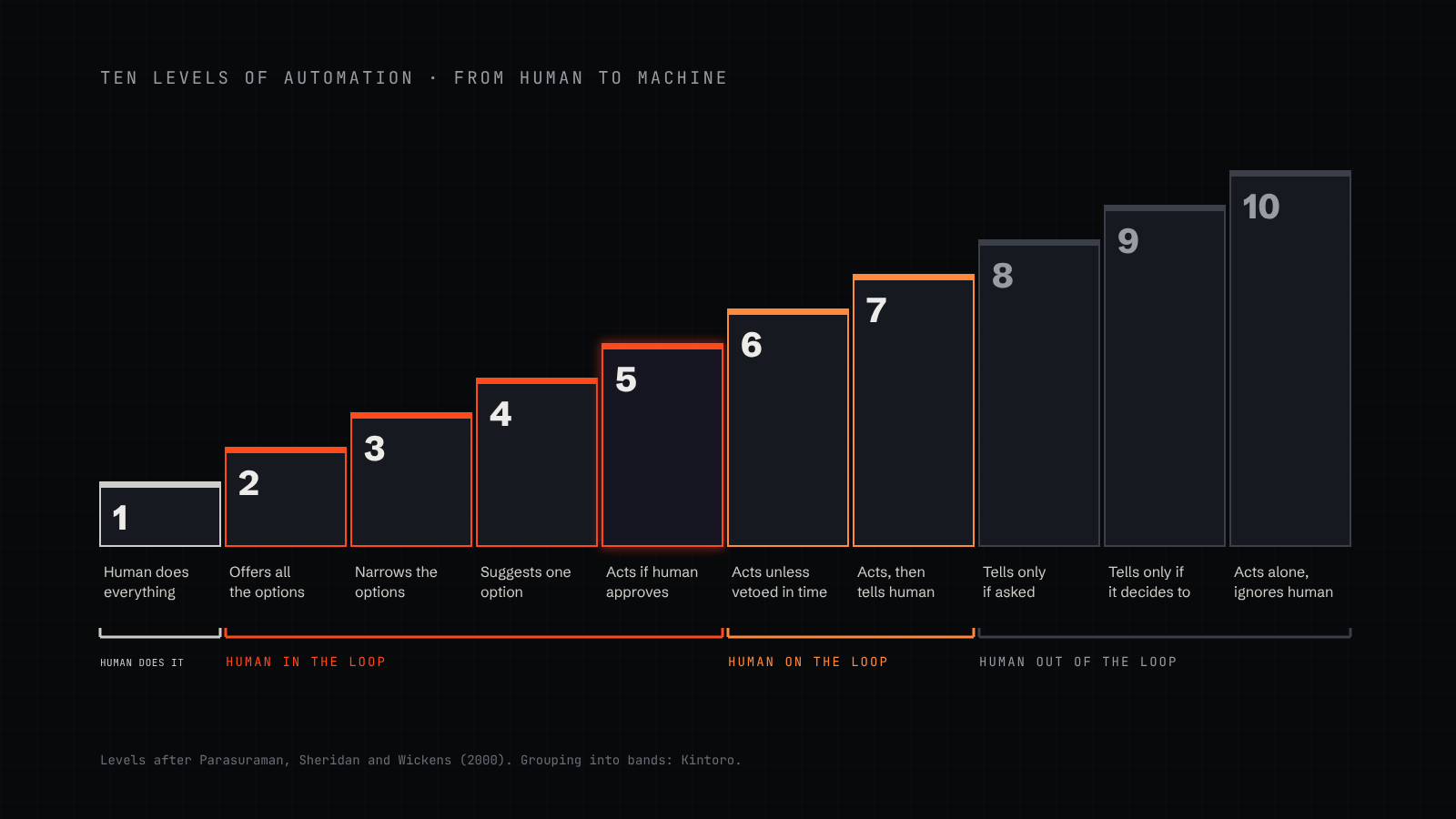
Even the military, where the phrase is most common, has moved away from it. The US Defense Department’s directive on autonomous weapons, first issued in 2012 and updated in 2023, deliberately does not require a human “in the loop”. It requires “appropriate levels of human judgment over the use of force”. The point is the judgment, not the click.
The point of a human in the loop is the judgment, not the click.Kintoro
Where We Stand: October 2026
01 · Measure · Anthropic · McKinsey · Gartner · 2025 to 2026
Most AI actions still have a human nearby. Fewer have a human paying attention.
Anthropic studied how people supervise AI agents across its public API and Claude Code, and published the results in February 2026. About 73% of tool calls appeared to have a human in the loop, an upper bound, since the method tended to overestimate human involvement. Only 0.8% of actions appeared irreversible, such as sending an email to a customer. As people gained experience, they let go: new Claude Code users ran with full auto-approve in about 20% of sessions, and users with 750 sessions did so in more than 40%. Experienced users also interrupted more often, about 9% of turns against 5%. They stopped approving each step and started watching the whole.
In companies, oversight is uneven. McKinsey found that 27% of organisations using generative AI have staff review all AI-generated content before it is used, and a similar share check 20% or less. Gartner warned in May 2026 that 40% of enterprises will demote or decommission autonomous agents by 2027 because of governance gaps that only appear after an incident, and that a common cause is treating oversight as binary: “either locked down or fully trusted”.
Who is watching, 2026
- ~73%of AI agent tool calls appear to have a human in the loop (an upper bound)Anthropic, Feb 2026
- 0.8%of agent actions appear irreversibleAnthropic, Feb 2026
- 27%of organisations using gen AI review all of its output before useMcKinsey, State of AI, Mar 2025
- 40%of enterprises will demote or decommission autonomous agents by 2027, Gartner predictsGartner, May 2026
Most AI actions are small and reversible. A few are not. The whole design problem is telling them apart.
The Rubber Stamp Problem
02 · Evidence · Anthropic · August 2026
97% approved. 13.6% caught.
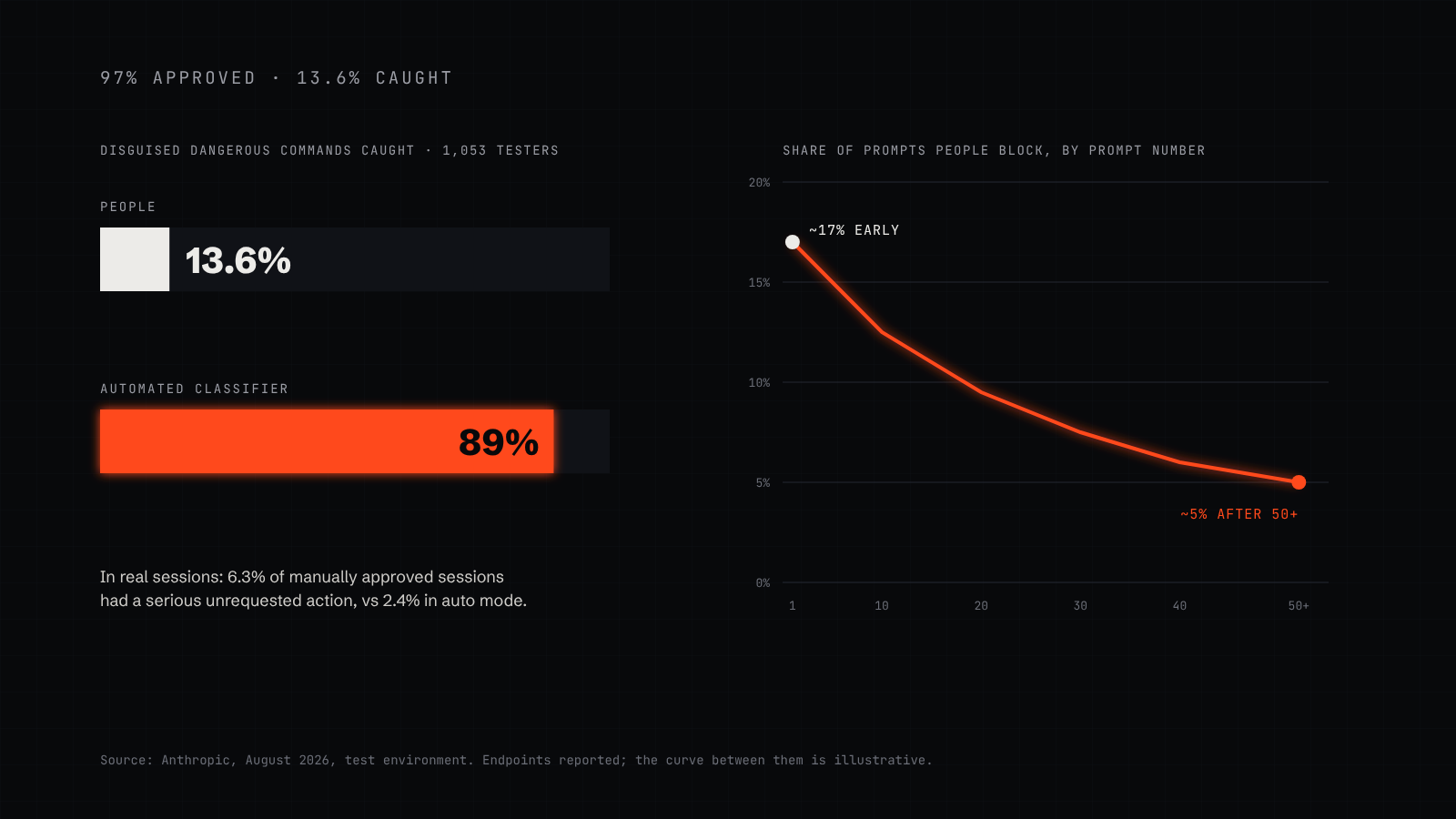
The sharpest data on approval comes from Anthropic, which in August 2026 made “auto mode” the default in Claude Code, replacing most permission prompts with an automated classifier. Its reasons were blunt. Users approved 97% of permission prompts. In a test with 1,053 paid participants, people caught 13.6% of disguised dangerous commands; the classifier caught 89%. Human catch rates fell as sessions went on, from about 17% early on to about 5% after 50 or more prompts.
In real sessions flagged in May and June 2026, 6.3% of manually approved sessions contained a serious action the user had not asked for, against 2.4% under auto mode. Anthropic is clear about the limits: the test ran outside participants’ own code, and classifiers do not remove risk. It still recommends a human review for high-stakes production changes.
03 · Evidence · Radiology · MIT · NTSB · 2019 to 2024
Automation bias is not a coding problem
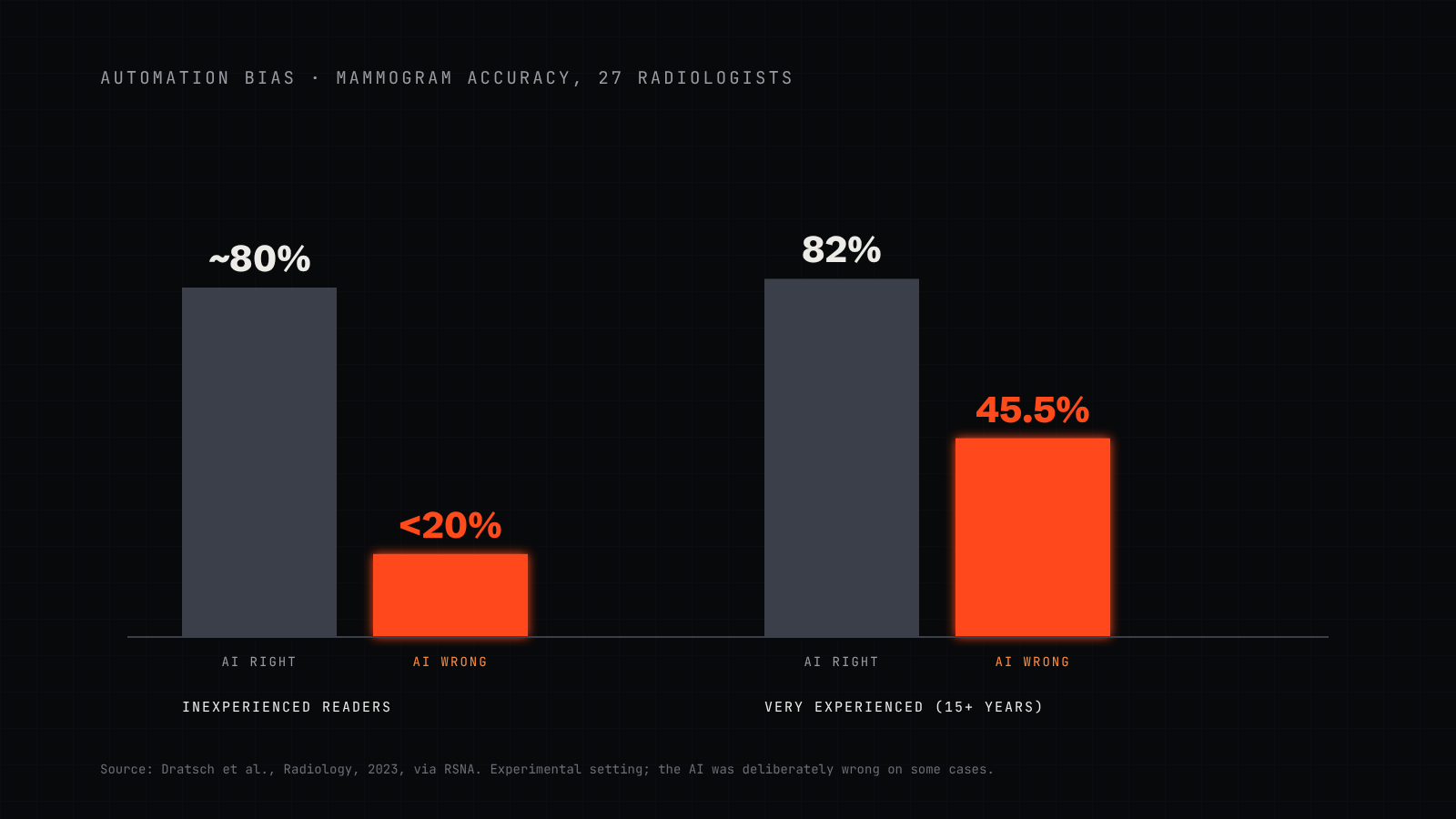
The pattern has a name: automation bias, the tendency to go along with a machine’s suggestion. In a 2023 study in Radiology, 27 radiologists read mammograms with an AI that sometimes gave the wrong category on purpose. When the AI was wrong, the accuracy of inexperienced readers fell from almost 80% to under 20%. Even radiologists with more than 15 years’ experience fell from 82% to 45.5%.
A 2024 meta-analysis in Nature Human Behaviour by Michelle Vaccaro, Abdullah Almaatouq and Thomas Malone at MIT reviewed 370 results from 106 experiments. On average, human and AI teams did better than humans alone but worse than the better of the two working alone. Combinations did worst on decision tasks, such as diagnosis or spotting fakes, and best on creative tasks, where people and AI bring different strengths.
The most tragic example is from the road. In March 2018, a self-driving test car operated by Uber struck and killed a pedestrian in Tempe, Arizona. The US National Transportation Safety Board found that the safety driver, the human in the loop, had spent about 34% of the trip looking at her phone. It also faulted Uber for failing to address “automation complacency”, the predictable drift of attention when a machine seems to have things in hand.
A loop where the human always says yes is not oversight. It is decoration.
Where People Actually Pay Attention
Buried in Anthropic’s data is the most useful finding for anyone designing a loop. Users rejected only 3% of individual permission requests, but they rejected 39% of the plans Claude proposed before starting work. People pay attention to intent, to what the agent is about to try and why. They do not pay attention to the 40th “may I run this command?” of the afternoon.
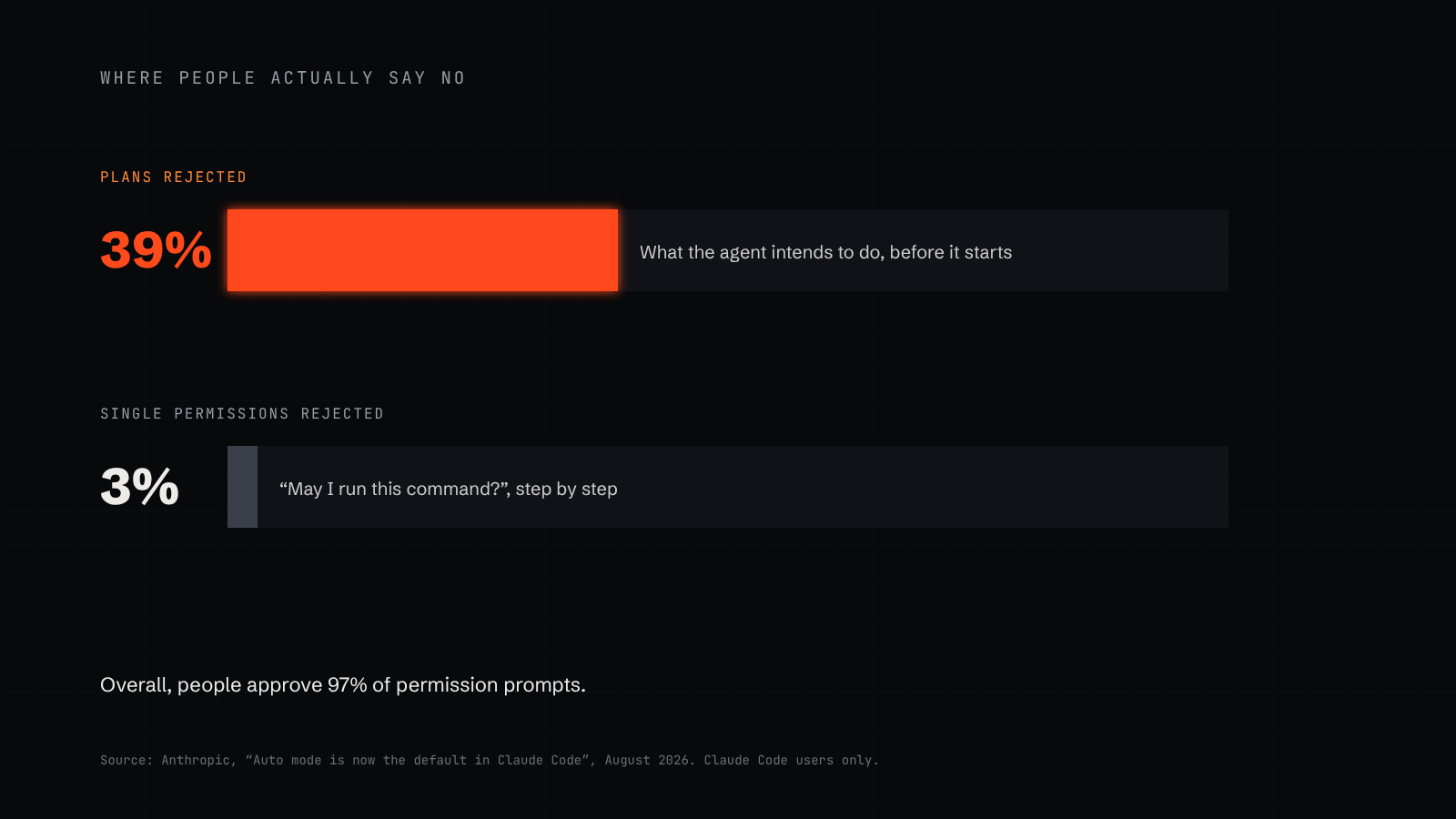
That matches fifty years of research on supervision. People are good at setting goals, spotting when something does not make sense, and handling the unusual case. They are bad at sustained vigilance over long runs of near-identical events. A good loop puts the human where human strengths are, and lets software do the vigilance.
It is also why every piMonk agent explains itself before it asks. When an agent in piSA drafts an outreach email, or Resolver in piCS drafts a reply to a customer, the person sees the draft and the reason for it, and can approve, edit, reject or pass it on. The question is never just “approve?”. It is “here is what I want to do, and why”.
When the Human Takes the Blame
A badly designed loop does not only fail to catch errors. It moves the blame. The researcher Madeleine Clare Elish calls this the “moral crumple zone”: when an automated system fails, responsibility is misattributed to the human operator who had limited control. Like the crumple zone of a car, the person absorbs the impact that protects the technology.
Australia’s Robodebt scheme is a cautionary case. From 2016 to 2019, the government raised welfare debts using income averaging that its Royal Commission later found produced inaccurate results and did not comply with the law. Every debt passed through a bureaucratic process with people in it. The Commission’s final report, in July 2023, found the checks and balances ineffective, and remarked on “how little interest there seems to have been in ensuring the Scheme’s legality”.
The law is learning to look past the click. In December 2023, the EU’s top court ruled in the SCHUFA case that a credit score counts as an automated decision under GDPR Article 22 when a lender “draws strongly” on it, even though a human formally makes the final call. In February 2024, a Canadian tribunal held Air Canada liable for a refund policy its chatbot invented, rejecting the argument that the chatbot was responsible for its own actions. And the EU AI Act’s Article 14 requires high-risk systems to let overseers understand the system’s limits, stay aware of automation bias, override its output and stop it with a “stop button”, with obligations for systems listed in Annex III applying from 2 December 2027.
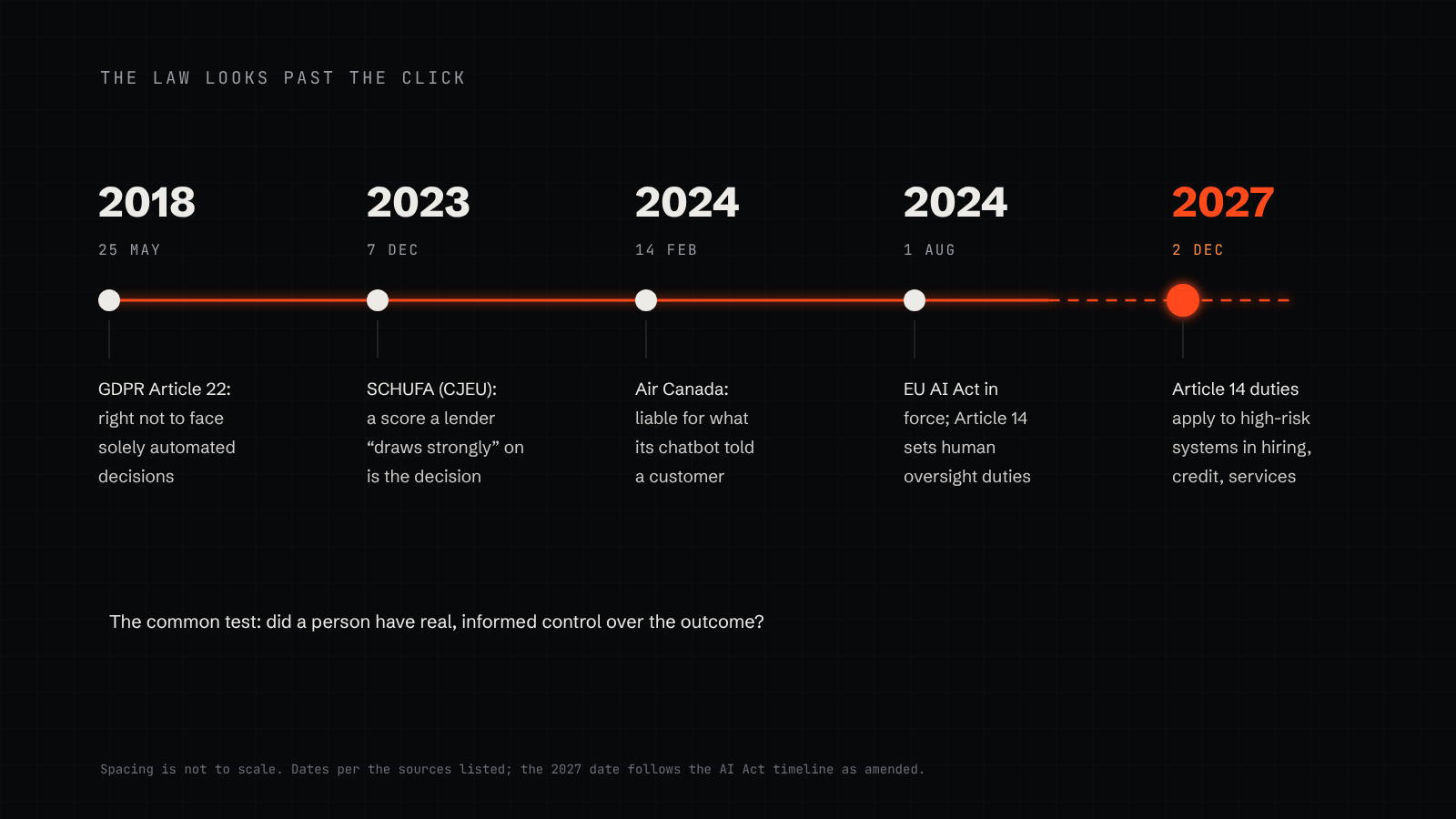
The law does not ask whether a human clicked. It asks whether a human could have changed the outcome.
What It Should Mean: The Four Positions
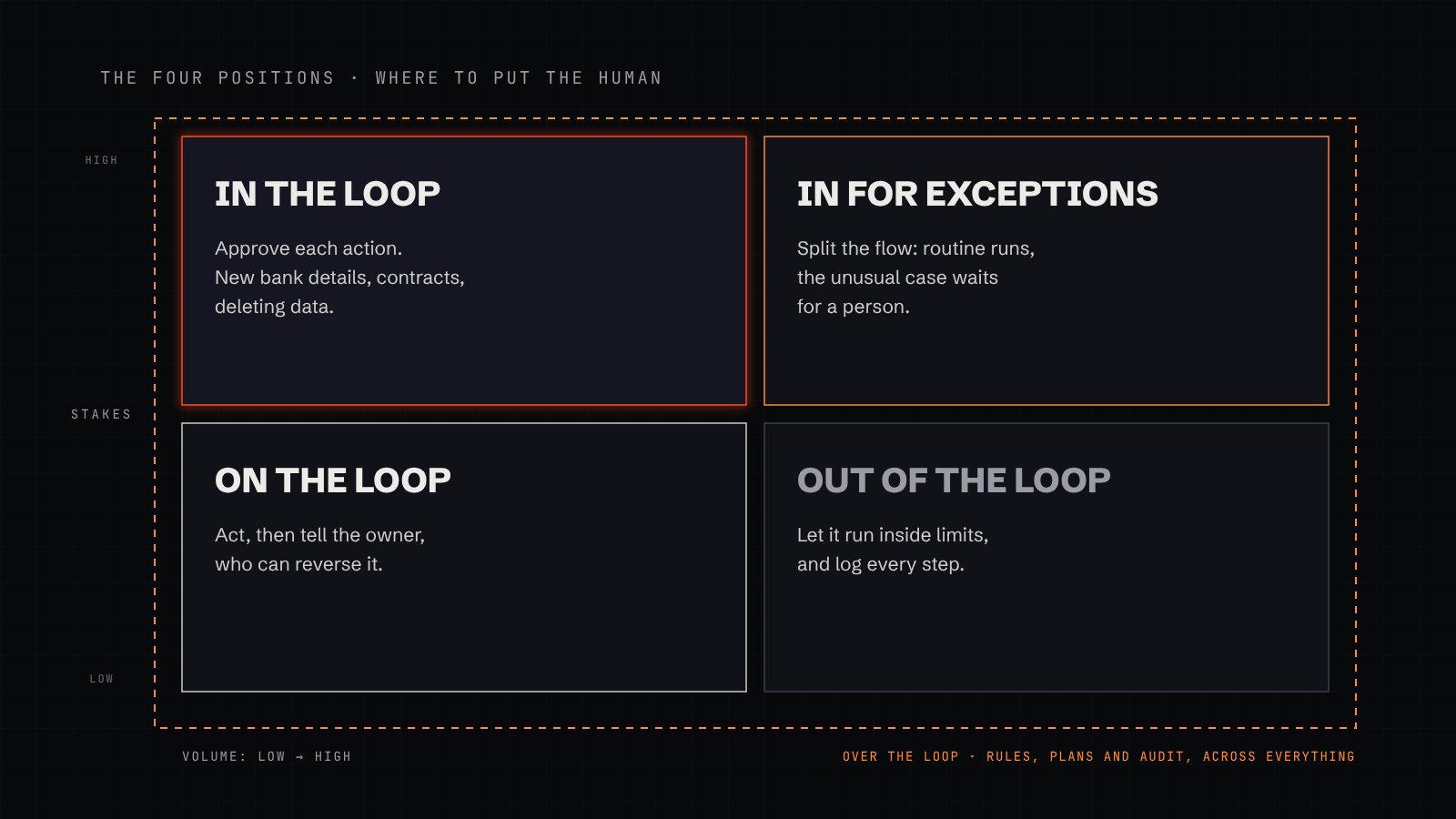
So what is the human in the loop? My answer, as a Kintoro framework, is that “in the loop” is only one of four positions a person can take, and good design uses all four.
- In the loop: approve the action. The agent cannot act until a person decides. Reserve this for actions that are irreversible, high-stakes or rare: paying a new bank account, signing a contract, deleting data, contacting a regulator. Few enough that each approval gets real attention.
- On the loop: watch and intervene. The agent acts, and a person monitors the flow and can stop or reverse it. Right for routine, reversible work at volume, with alerts that fire on the unusual, not the usual.
- Over the loop: set the rules and audit the outcomes. A person owns the system: sets its limits, approves its plans, reviews exceptions and samples its results. This is where most human judgment will sit by 2030.
- Out of the loop: let it run. For trivial, reversible actions inside tight limits, a human check adds cost and fatigue and no safety. Admit it, and spend the attention elsewhere.
This lines up with Gartner’s four autonomy levels for agents, published in May 2026: observe, advise, act with approval and act autonomously, each with its own governance. Gartner’s own warning about level three is the rubber stamp problem in one line: “approvals can degrade under time pressure or approval fatigue.”
Five design rules follow from the evidence:
- Ask about plans, not steps. People reject 39% of plans and 3% of permissions. Put the approval where the judgment is. In piOrbit, agents report on a project freely, but any change to the plan waits for approval.
- Keep an attention budget. If a person approves hundreds of items a day, the loop is broken. Cut approvals to the few that matter, and automate the vigilance. In piMonk, an action that is approved unchanged almost every time is a signal to move it down a tier.
- Make disagreement easy. Show the evidence, the uncertainty and what is unusual about this case. A reviewer who sees only “approve?” will approve. Approve, edit, reject and hand to a deputy should all be one click.
- Test the tester. Seed known errors into the review queue and measure how many are caught. If nobody ever overrides the AI, that is a warning sign, not a success. A record nobody can edit makes this possible.
- Match blame to control. Whoever designs the loop owns its failures. Never make the person with the least control the one who absorbs the blame. Every approval needs a named approver, never “someone senior”.
Don’t ask whether there is a human in the loop. Ask whether the human could have stopped it, and whether they would have known to.The central question
How We Build the Loop into piMonk
04 · Kintoro · piMonk · October 2026
Agents do the work. People keep the decisions.
I should declare an interest. At Kintoro we build piMonk, a suite of twelve business applications for growing mid-market companies, and every one of them is built on the idea in this feature. Not a human approving every click, but a human placed exactly where the business is committed.
The same loop runs in every piMonk app, in four steps. Set the rules: you decide what agents may do alone, per app and per action. Do the work: agents draft, sort, chase and report. Decide: a person decides anything that commits the business. Keep the record: every step is written down where nobody can edit it. Money, customers, prices and contracts wait for a person. And when an agent is unsure, it waits too.
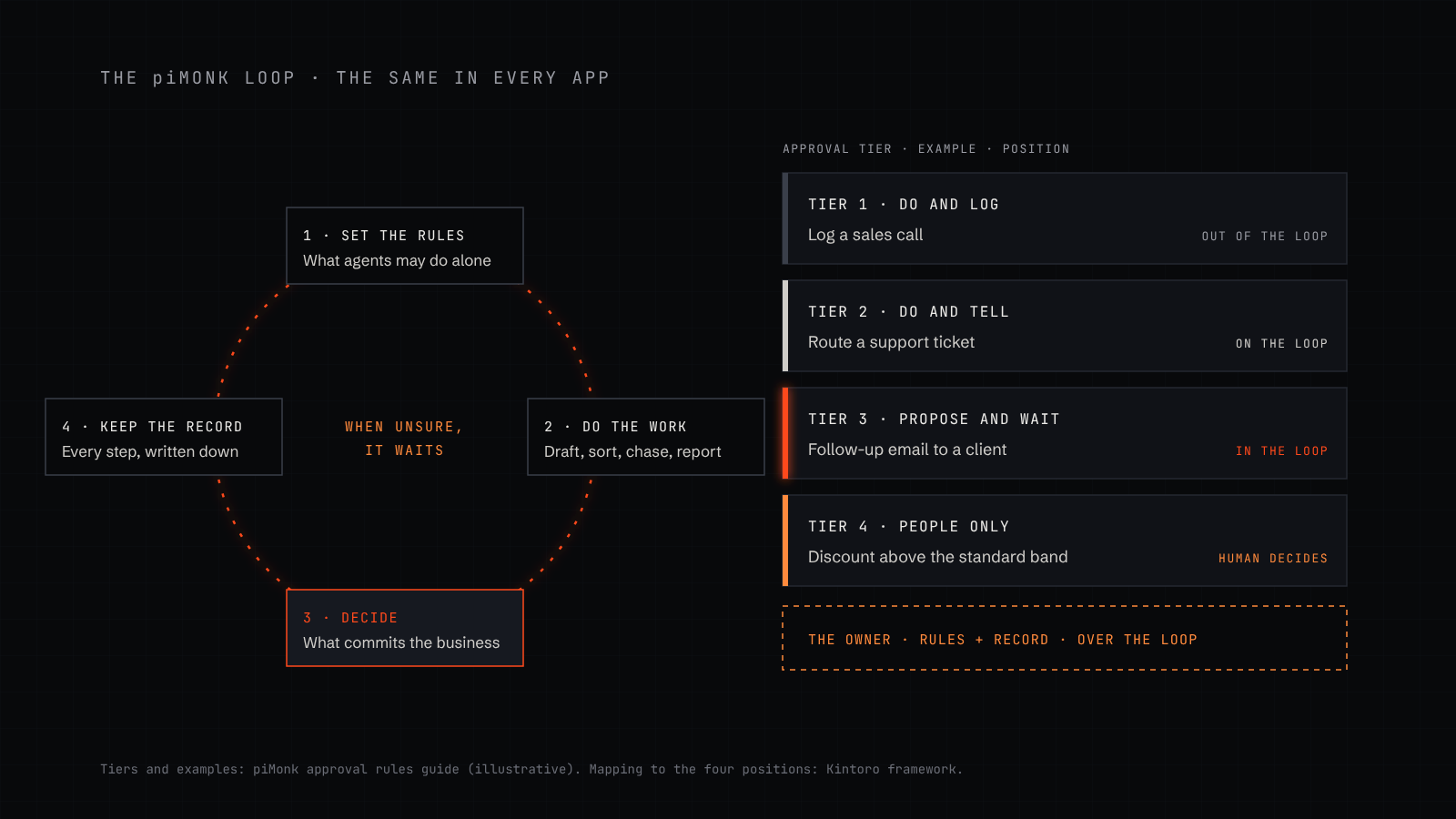
Every action an agent can take sits in one of four tiers, and each maps to a position from the previous section:
- Tier 1, do and log. The agent completes the action and records it, like logging a sales call. Out of the loop, but never out of the record.
- Tier 2, do and tell. The agent acts and tells the owner, who can reverse it, like routing a support ticket. On the loop.
- Tier 3, propose and wait. The agent prepares everything and a named person approves, edits or rejects it, like a follow-up email to a client. In the loop.
- Tier 4, people only. The agent gathers the information and a person acts, like a discount above the standard band or a change to a committed delivery date.
Above all four sits the owner, over the loop: writing the rules, reading the record and changing the tiers. Size and situation move an action up a tier. A routine customer reply might be tier 2, but the same reply to an unhappy customer is tier 3. And an unclear or missing rule never defaults to “go”. The action waits for a person. Our approvals service never guesses.
Across the suite, it looks like this. In piRevenue, our CRM, internal notes publish on their own but anything that reaches a customer needs a person. In piSA, research is automatic and every outbound message is a draft a person reviews. In piCS, agents take in and triage issues on their own, but replies to customers need approval. In piMark, drafting is automatic and one switch halts any channel at once. In piFin, our finance app, every payment, every write-off and every number that goes to the board waits for a person. In piSentinel, agents earn a trust score, and an agent below its score must ask first.
The machine decides the case. People decide the rule.Kintoro, “Judgement is the scarce resource”
The tiers are only half of it. The other half is fighting the rubber stamp. No rule goes live until it answers six questions: the exact action, its tier, a named approver, a time limit, who it escalates to, and who approves when the approver is away. Until then, it stays at tier 3 or 4. We suggest starting one tier stricter than feels necessary, then using the record to loosen it. An action approved unchanged almost every time moves down a tier, so approvals stay rare enough to mean something. One that is often edited needs better instructions for the agent, not more freedom. One that waits for days has the wrong approver. And every rejection gets reviewed with the team.
That is the honest answer to the 97% problem. You cannot fix approval fatigue by asking people to try harder. You fix it by asking them less often, about things that matter, with the reasons in front of them, and by checking the record to see whether their approvals still mean anything.
Five Checkpoints to 2030
This is how I expect human oversight to evolve, with each checkpoint marked as measured today, scheduled in law, forecast by analysts, or forecast by Kintoro.
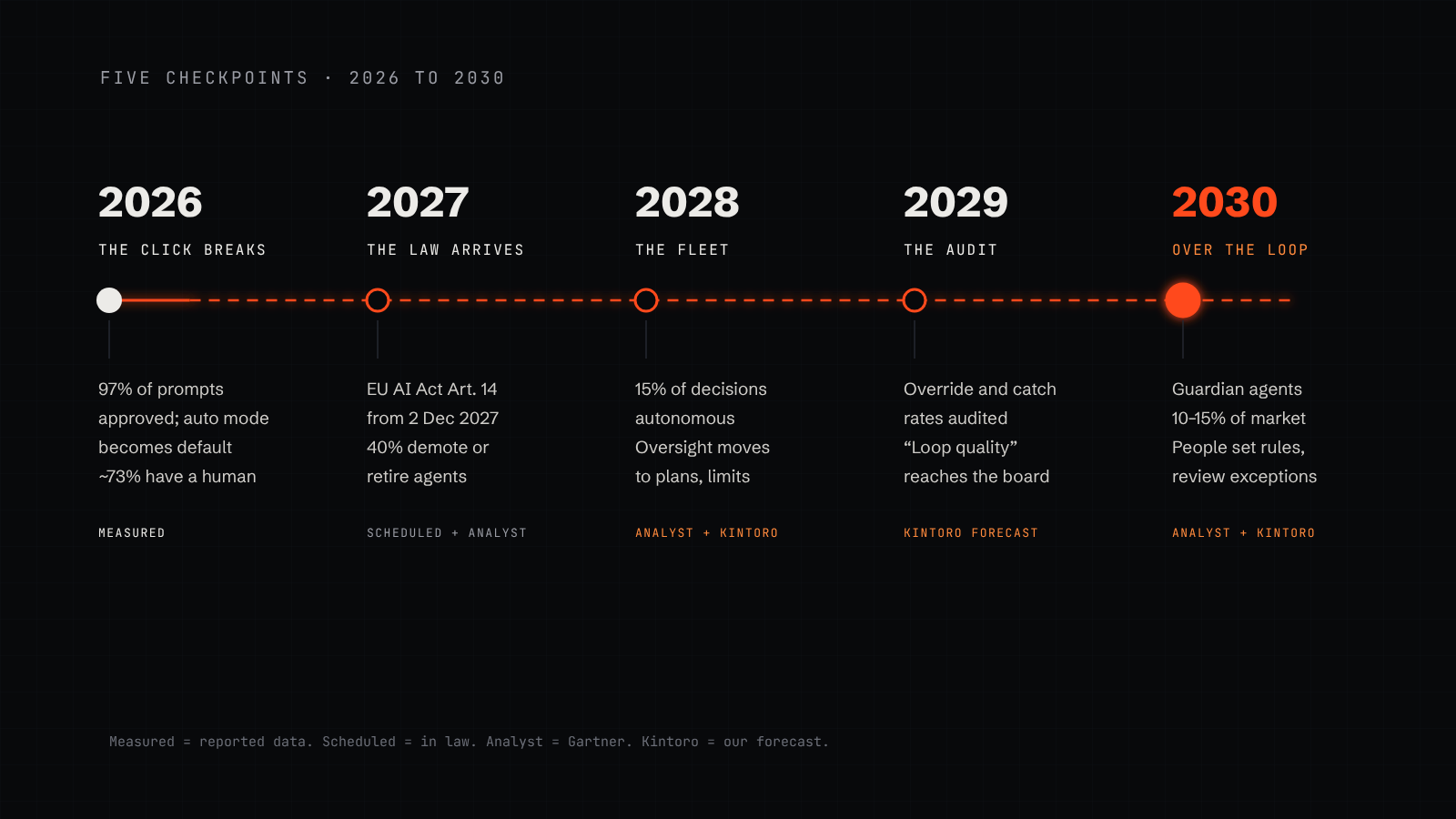
- 2026
The click breaks Measured
People approve 97% of Claude Code permission prompts, and auto mode becomes the default in August. About 73% of agent tool calls still appear to have a human in the loop. Gartner sets out four autonomy levels and warns that approvals degrade under fatigue.
- 2027
The law arrives Scheduled · Analyst forecast
The EU AI Act’s Article 14 oversight duties apply to high-risk systems in areas such as hiring, credit and essential services from 2 December 2027. Gartner expects 40% of enterprises to demote or decommission autonomous agents by the end of the year because of governance gaps.
- 2028
The fleet Analyst forecast · Kintoro forecast
Gartner predicts 15% of day-to-day work decisions will be made autonomously by agents, and 70% of AI applications will use multi-agent systems. My forecast: with agents outnumbering people, approving individual actions becomes impossible at scale. Oversight moves to plans, limits and exceptions.
- 2029
The audit Kintoro forecast
Regulators and auditors start asking for evidence that oversight works, not just that it exists: override rates, catch rates on seeded errors, the number of decisions each reviewer handles. “Loop quality” becomes a metric that boards see.
- 2030
Over the loop Analyst forecast · Kintoro forecast
Gartner expects guardian agents, AI that monitors and can block other AI, to take 10 to 15% of the agentic AI market. My forecast: most people supervise AI from over the loop, setting rules and reviewing exceptions, while “in the loop” is reserved for the small set of decisions that commit the business.
The Business Conclusion
So, what is the human in the loop? It is not a person clicking “approve”. It is a person with the information, the time, the authority and the incentive to change the outcome, placed exactly where their judgment matters. Anything less is a rubber stamp, and a rubber stamp is worse than nothing, because it makes everyone feel safe.
For a business leader, that becomes five moves over the next twelve months:
- Count your approvals. For every AI system, find out how many decisions each reviewer handles a day, and how often they say no. If the answer is “hundreds” and “almost never”, redesign.
- Classify every action by stakes and reversibility. Decide which go in the loop, on the loop, over the loop and out of it, and write it down.
- Move approvals up to plans. Have agents propose what they intend to do before they start, and review that, not every step.
- Seed and measure. Put known errors into review queues and track how many are caught. Report it alongside accuracy.
- Name an owner over every loop. One person accountable for each AI system’s design, limits and outcomes, with the authority to change them.
None of this requires slowing down. Done well, it lets agents do more, because the humans are watching the right things. If you would rather not build that machinery yourself, it is what piMonk gives you on day one: the tiers, the named approvers, the time limits, the record and the review, the same in every app.
A Decision You Can Stand Behind
Nobody really wants a human in the loop for its own sake. What people want is a decision they can stand behind: one where someone with the right knowledge looked at what mattered and could have said no.
At Kintoro, that is the whole of how we build piMonk. AI agents handle the routine work inside the systems that run the business. People keep control of the decisions that commit it. In the language of this feature, the agents run on and out of the loop for routine work, people stay in the loop for the money, the customers, the prices and the contracts, and the owner sits over the loop for all of it, with a record nobody can edit. You can start small: one team, one app, thirty days.
The future of oversight is fewer clicks and more judgment. Not a rubber stamp. A hand on the wheel when it counts.
Fewer clicks. More judgment.
Sources
- https://andrewclark.super.site/all-media/a-model-for-types-and-levels-of-human-interaction-with-automation,Raja Parasuraman, Thomas Sheridan and Christopher Wickens, “A Model for Types and Levels of Human Interaction with Automation”, IEEE Transactions on Systems, Man, and Cybernetics, Part A, vol. 30, no. 3, 2000 (summary)
- https://warontherocks.com/2025/05/AUTONOMOUS-WEAPON-SYSTEMS-NO-HUMAN-IN-THE-LOOP-REQUIRED-AND-OTHER-MYTHS-DISPELLED,War on the Rocks, “Autonomous Weapon Systems: No Human-in-the-Loop Required, and Other Myths Dispelled”, May 2025 (on DoD Directive 3000.09, updated 2023)
- https://www.esd.whs.mil/Portals/54/Documents/DD/issuances/dodd/300009p.PDF,US Department of Defense, Directive 3000.09, “Autonomy in Weapon Systems”, updated 25 January 2023
- https://www.anthropic.com/research/measuring-agent-autonomy,Anthropic, “Measuring AI agent autonomy in practice”, 18 February 2026
- https://www.mckinsey.com/capabilities/quantumblack/our-insights/the-state-of-ai-how-organizations-are-rewiring-to-capture-value,McKinsey & Company, “The state of AI: How organizations are rewiring to capture value”, 12 March 2025 (survey July 2024, 1,491 participants)
- https://www.gartner.com/en/newsroom/press-releases/2026-05-26-gartner-says-applying-uniform-governance-across-ai-agents-will-lead-to-enterprise-ai-agent-failure,Gartner, “Gartner Says Applying Uniform Governance Across AI Agents Will Lead to Enterprise AI Agent Failure”, 26 May 2026
- https://claude.com/blog/auto-mode-default-in-claude-code,Anthropic, “Auto mode is now the default in Claude Code”, 7 August 2026
- https://anthropic.com/engineering/claude-code-sandboxing,Anthropic Engineering, “Making Claude Code more secure and autonomous with sandboxing”, 20 October 2025
- https://www.rsna.org/news/2023/may/ai-bias-may-impair-accuracy,RSNA News, “AI bias may impair radiologist accuracy on mammogram”, 2 May 2023 (Dratsch et al., “Automation Bias in Mammography”, Radiology)
- https://mitsloan.mit.edu/node/48565,MIT Sloan, on Michelle Vaccaro, Abdullah Almaatouq and Thomas Malone, “When combinations of humans and AI are useful: A systematic review and meta-analysis”, Nature Human Behaviour, 28 October 2024
- https://siliconangle.com/2019/11/19/ntsb-report-fatal-uber-crash-lays-blame-safety-driver-policies/,SiliconANGLE, “NTSB report on fatal Uber crash lays blame on safety driver and policies”, 19 November 2019
- https://estsjournal.org/index.php/ests/article/view/260,Madeleine Clare Elish, “Moral Crumple Zones: Cautionary Tales in Human-Robot Interaction”, Engaging Science, Technology, and Society, vol. 5, 2019
- https://www.apra.gov.au/sites/default/files/2024-02/Robodebt%20Royal%20Commision%20-%20Overview%20of%20Final%20Report.pdf,Overview of the Final Report of the Royal Commission into the Robodebt Scheme, 7 July 2023 (summary published by APRA, February 2024)
- https://www.hunton.com/privacy-and-cybersecurity-law-blog/cjeu-rules-that-gdpr-prohibition-on-automated-decision-making-applies-to-credit-scoring,Hunton Andrews Kurth, “CJEU rules that GDPR prohibition on automated decision-making applies to credit scoring”, December 2023 (SCHUFA, 7 December 2023)
- https://www.americanbar.org/groups/business_law/resources/business-law-today/2024-february/bc-tribunal-confirms-companies-remain-liable-information-provided-ai-chatbot/,American Bar Association, Business Law Today, “BC Tribunal Confirms Companies Remain Liable for Information Provided by AI Chatbot”, February 2024 (Moffatt v. Air Canada, 14 February 2024)
- https://ai-act-service-desk.ec.europa.eu/en/ai-act/article-14,European Commission AI Act Service Desk, Article 14: Human oversight, Regulation (EU) 2024/1689
- https://fpf.org/blog/the-ai-act-implementation-timeline-what-changes-under-the-ai-omnibus/,Future of Privacy Forum, “The AI Act implementation timeline: What changes under the AI Omnibus?”, 2026
- https://technologymagazine.com/articles/gartner-how-agentic-ai-is-shaping-business-decision-making,Technology Magazine, “Gartner: How Agentic AI is Shaping Business Decision-Making” (15% of day-to-day decisions by 2028)
- https://www.gartner.com/en/newsroom/press-releases/2025-06-11-gartner-predicts-that-guardian-agents-will-capture-10-15-percent-of-the-agentic-ai-market-by-2030,Gartner, “Gartner Predicts that Guardian Agents will Capture 10–15% of the Agentic AI Market by 2030”, 11 June 2025
- https://kintoro.com/,Kintoro, kintoro.com: the piMonk suite, operating loop and “Judgement stays human” principle, accessed 24 October 2026
- https://pimonk.com/platform/agents/,piMonk, “Agents” platform page: what runs alone and what waits for a person in each app, accessed 24 October 2026
- https://pimonk.com/resources/guides/approval-rules/,piMonk, “Writing approval rules for agents” guide: the four tiers, six questions and review practice, accessed 24 October 2026
- https://pimonk.com/products/pifin/,piMonk, piFin product page, accessed 24 October 2026
- https://kintoro.com/perspectives/judgement-is-the-scarce-resource/,Kintoro Perspectives, “Judgement is the scarce resource”
See the idea working in piMonk
piMonk is the AI company we built on this thinking: agents do the work, people keep the decisions. Try the app this piece points to, or book a demo.
Book a demo