

Scenario · Monday, 6 March 2028 · A forecast, not a report
At 8:30 on a Monday, the chief operating officer of a mid-sized distributor opens her weekly decision review. It is not a list of meetings. It is a list of decisions.
Last week, agents made 4,812 routine decisions on their own: reorders, invoice matches, delivery slots. A sample of fifty was checked by people, and two were wrong. 212 consequential decisions, mostly credit limits and price changes, waited for a named person, and 37 were changed before they went out. The marketing team let agents run eleven campaign experiments, and kept the three that worked.
Only one item needs her today: whether to drop a supplier that has been late four times. The agents have modelled the options in an hour. The decision, and the explanation to the supplier, are hers.
The distributor, its chief operating officer and March 2028 are fictional. Everything else in this feature comes from research and reporting from 2023 to 2026. Where I forecast, I say so.
Every company deploying AI agents eventually hits the same question, usually in a meeting that goes badly. Should the agent be allowed to do this on its own? The marketing team wants agents to run campaigns end to end. HR wants to know if AI may screen candidates. Finance wants to know who is accountable when an agent posts a wrong entry.
Most companies answer these questions one tool at a time, and inconsistently. In June 2026, researchers at MIT’s Center for Information Systems Research published a better way to answer them: a single map of decisions, not tools. In September, MIT Sloan brought it to a wider audience as “a framework for determining when AI can make decisions.” It is the clearest description I have seen of what Kintoro calls “human in the loop”, and it deserves a close look.
The Matrix in Two Questions
01 · Research · MIT CISR · June 2026
How ambiguous is the decision? What happens if it is wrong?
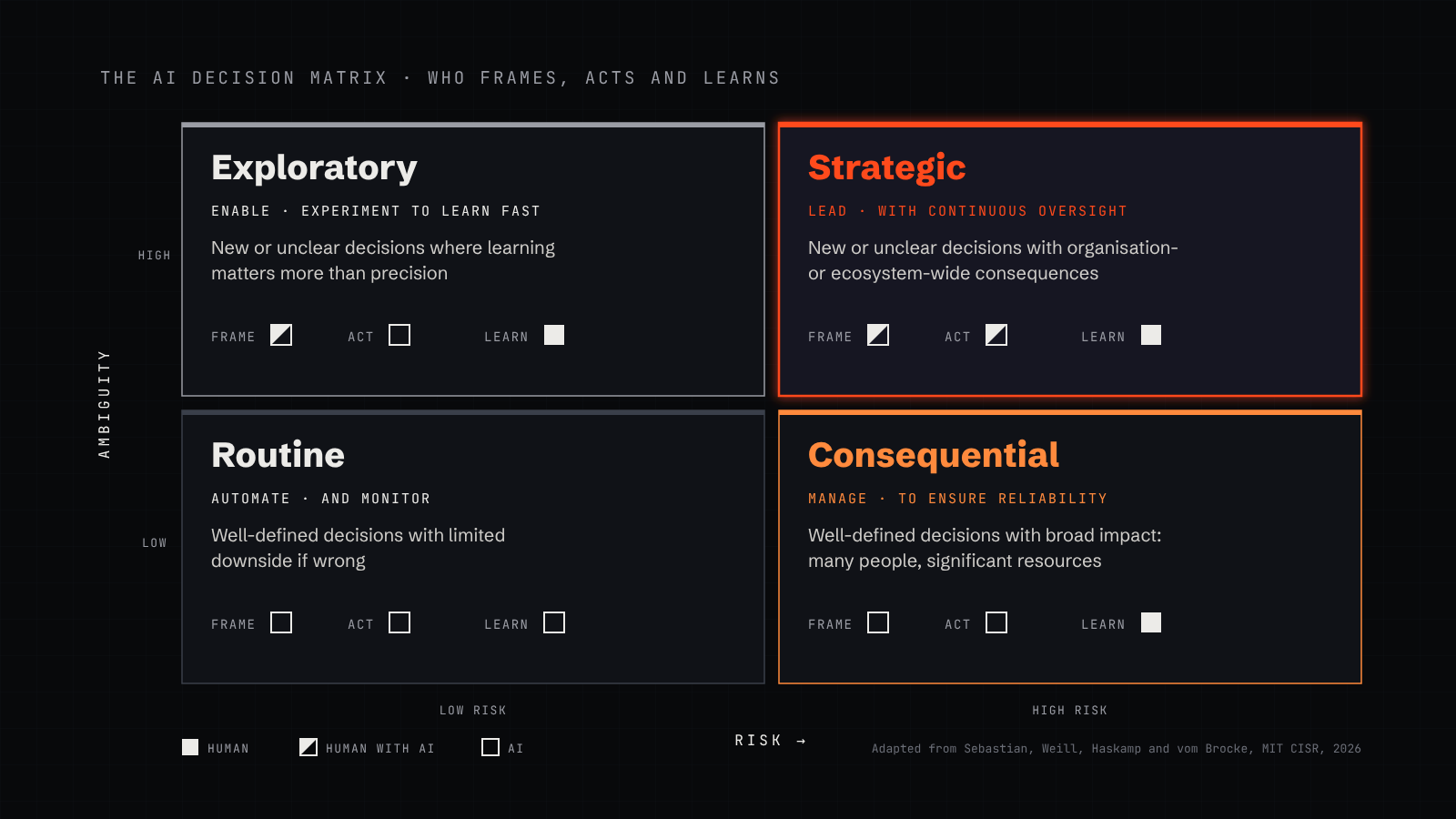
The AI Decision Matrix comes from Ina Sebastian, Peter Weill, Thomas Haskamp and Jan vom Brocke, based on 30 interviews with 27 executives at nine global companies in 2025 and 2026. It rates every decision on two dimensions.
Ambiguity “describes how clearly data determines the answer.” A low-ambiguity decision is repeatable: the data points to one answer. A high-ambiguity decision allows several reasonable interpretations. Risk “describes the consequences of getting a decision wrong.” A low-risk decision is reversible and small. A high-risk decision carries significant financial, operational or reputational cost.
Crossing the two gives four kinds of decision, and four approaches:
- Routine (low ambiguity, low risk): well-defined, limited downside if wrong. Automate and monitor.
- Consequential (low ambiguity, high risk): well-defined, but with broad impact on many people or significant resources. Manage to ensure reliability.
- Exploratory (high ambiguity, low risk): new or unclear, where learning matters more than precision. Enable experimentation to learn fast.
- Strategic (high ambiguity, high risk): new or unclear, with organisation-wide or ecosystem-wide consequences. Lead with continuous oversight.
A Decision Is Three Jobs, Not One
The matrix’s most useful idea is easy to miss. MIT treats a decision as a process with three components, and assigns each one separately.
Frame: define the problem, assumptions, stakeholders, constraints and what success looks like. Act: gather information, generate and evaluate options, authorise and execute. Learn: monitor outcomes, hold someone accountable, and update the decision system over time.
Look at how the matrix hands these out. In MIT’s graphic, Learn sits with a human in three of the four quadrants. Only routine decisions are fully automated, and even there a human process owner watches the patterns. Acting is where AI moves furthest: fully in routine, consequential and exploratory work. Framing is shared in the ambiguous quadrants. In routine and consequential work it is written down in advance, as rules and guardrails people set, so that at the moment of decision the agent works inside a frame people drew. As MIT Sloan puts it, “human oversight applies to all of them.”
AI can do most of the acting. People keep the framing and the learning.
Decision rights in numbers
- 27executives at nine global companies interviewed to build the matrixMIT CISR, Jun 2026
- 50+AI agents in operation at One New Zealand, the matrix’s main caseMIT Sloan, Sep 2026
- 13%of IT application leaders strongly agreed they had the right governance to manage agentsGartner, Sep 2025
- 15%of day-to-day work decisions forecast to be made autonomously by agentic AI by 2028Gartner forecast
One Company, All Four Quadrants
02 · Case · One New Zealand · 2025 to 2026
A telecom company that runs agents in every quadrant
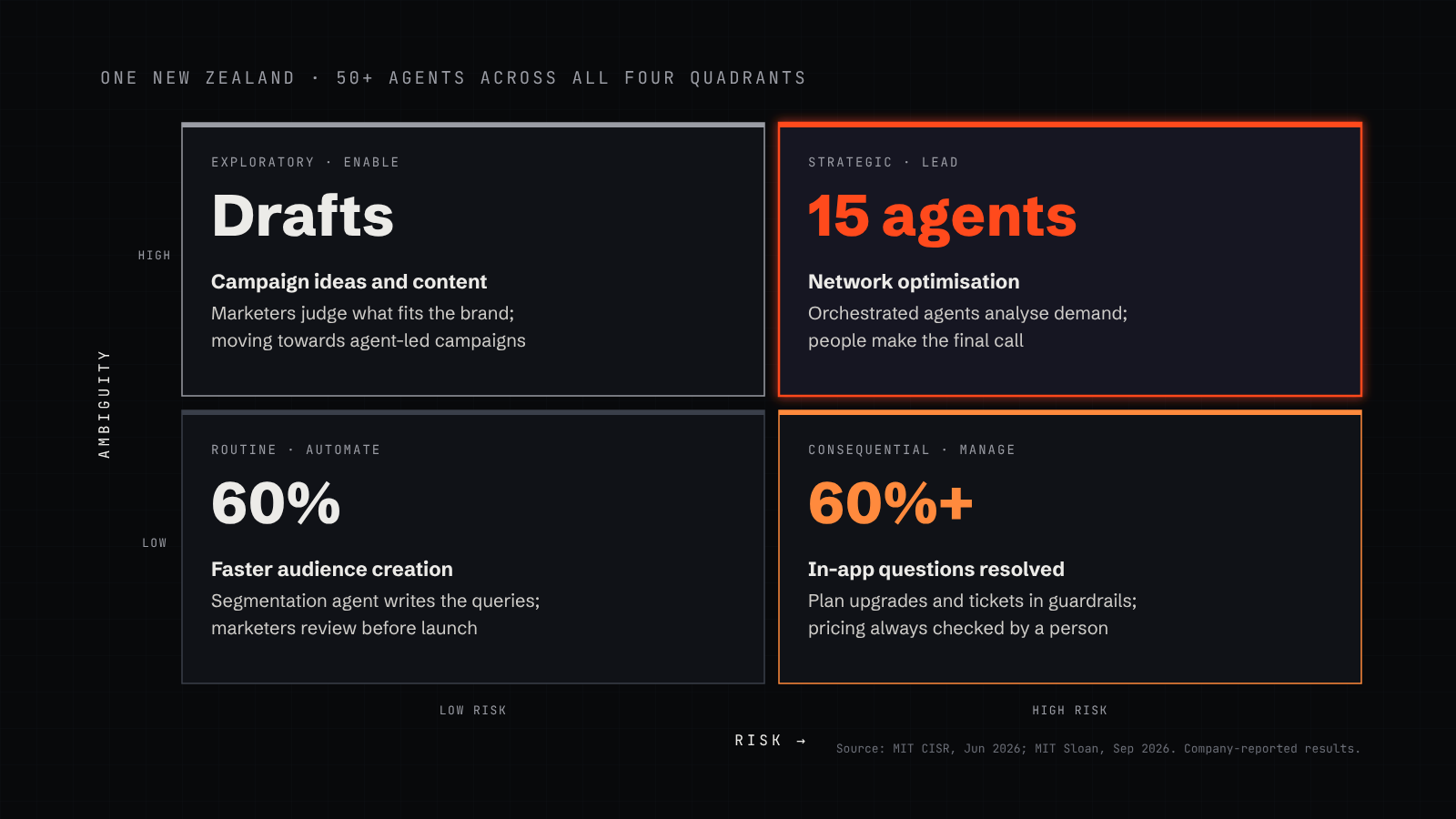
The researchers illustrate every quadrant with One New Zealand, a telecom provider with more than 50 AI agents in operation by early 2026. The results are the company’s own, as reported by MIT.
Routine. A customer segmentation agent turns marketers’ requests into database queries, cutting the time to build an audience by 60%. Marketers still review the audience before launch, and the agent’s autonomy grows as confidence builds.
Consequential. Agents resolve more than 60% of in-app customer questions, such as plan upgrades and support tickets, within clear guardrails. One rule frames everything: One NZ could “never get a price wrong for a customer.” Pricing keeps a human in the loop, and new agents roll out to small groups of customers first.
Exploratory. AI generates campaign ideas and content, and marketers judge what fits the brand. The team is now moving towards agent-led, end-to-end campaigns, which, the researchers warn, raises new governance questions as the work becomes higher risk.
Strategic. Fifteen task-based agents analyse network data, coordinated by orchestration agents, to balance demand and capacity. People make the final call, because the trade-offs between reliability, customer experience, cost and infrastructure are not a data question. Chief AI and Data Officer Summer Collins says AI can “stand up a team of what would have probably been thirty people” to support those decisions.
AI agents often start as very enthusiastic interns.Summer Collins, One New Zealand, via MIT CISR
What a Hybrid Organisation Looks Like
03 · Evidence · MIT CISR · McKinsey · Microsoft · Gartner · 2025 to 2026
Every agent has a named human owner
The matrix is not only a governance tool. It is an organisation design. One NZ backs it with four structural choices, and they are the most practical part of the research.
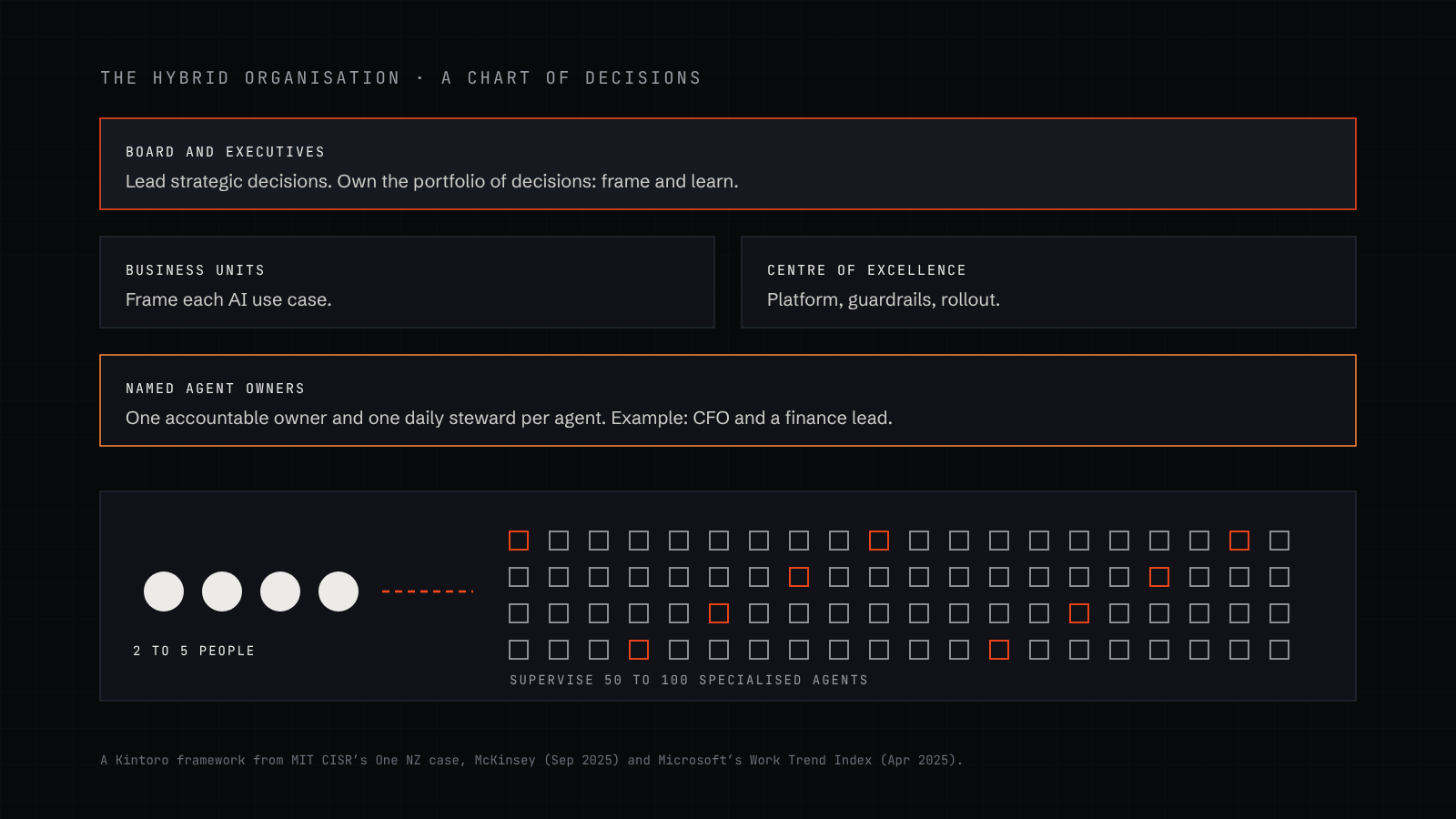
- The business frames. Business units own the framing of each AI use case, which keeps agents tied to business needs and domain knowledge.
- A centre of excellence builds. A central team owns data foundations, architecture, orchestration, a responsible AI policy, and phased rollouts through a standard “Trust Trail”.
- Every agent has a named owner. For a financial reconciliation agent, the chief financial officer is accountable, and an AI-savvy finance leader handles daily stewardship.
- Leaders manage a portfolio of decisions, not a collection of tools: how ambiguous is each decision, and what happens if it is wrong?
Others are describing the same shape. McKinsey’s “agentic organization” (September 2025) places people mainly “above the loop” to steer, and selectively “within the loop” where human contact matters, and says “a human team of two to five people can already supervise an agent factory of 50 to 100 specialized agents.” Microsoft’s 2025 Work Trend Index, a survey of 31,000 people, named the “agent boss”: “someone who builds, delegates to, and manages agents.” 28% of managers were considering hiring AI workforce managers to lead mixed teams of people and agents.
The warnings are just as consistent. Gartner predicted in June 2025 that more than 40% of agentic AI projects will be cancelled by the end of 2027, because of “escalating costs and unclear business value.” In a separate survey, only 13% of IT application leaders strongly agreed they had the right governance structures to manage agents, and only 15% were considering, piloting or deploying agents that need no human oversight at all. McKinsey adds a warning of its own: governance can become “a potential bottleneck to productivity.” Companies that send everything to a person will not get the benefits. Companies that send nothing will not keep their customers’ trust.
The hybrid organisation is not people plus agents. It is a clear answer, for every decision, to the question: who decides?
The Human in the Loop Has Limits
There is an uncomfortable truth underneath every “human in the loop” design, including ours. A person who checks an AI’s work can be pulled along by it.
In a 2023 study in the journal Radiology, 27 radiologists read mammograms with AI suggestions, some deliberately wrong. Inexperienced readers were right about 80% of the time when the AI was right, and below 20% of the time when it was wrong. Even radiologists with more than 15 years’ experience fell from 82% to 45.5%. That is automation bias: the human in the loop follows the machine.
A second risk is slower. In a 2025 study in The Lancet Gastroenterology & Hepatology, the rate at which experienced endoscopists found precancerous growths in colonoscopies without AI fell from 28.4% to 22.4% after AI assistance was introduced into their routine work. Skills that are not used fade.
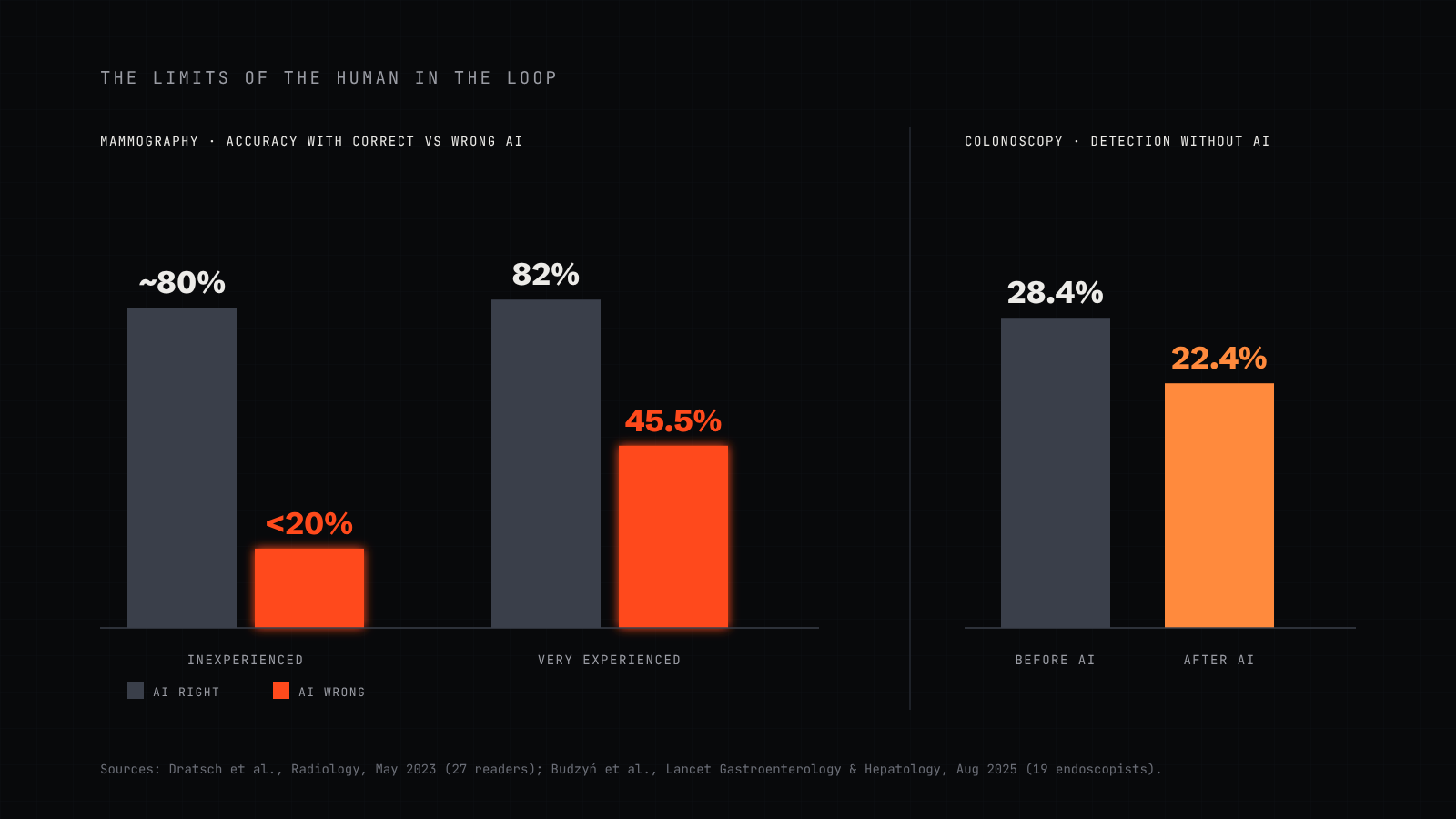
Neither study says people should step back. They say the loop must be designed. Four rules follow, as a Kintoro framework:
- Show the reason, not only the answer. A person asked to approve should see why the agent proposed it, so they judge the reasoning instead of trusting the result.
- Send people only what needs them. If every small step needs approval, approvals become a rubber stamp. Routine, reversible work should run alone and be sampled.
- Keep a record of every decision. Who proposed, who approved, what changed. Without it, learning, the third job of every decision, has nothing to work with.
- Keep people practised. Rotate reviewers, check a sample by hand, and watch for decisions that drift from one quadrant to another.
The question is no longer where AI can be used. It is who decides, at each step of each decision, and who answers for it.The central statement
The Law Is Drawing the Same Lines
Regulators have reached the same conclusion from the other direction. The EU AI Act treats AI used in hiring, credit scoring and similar decisions as “high-risk”, with obligations for human oversight. In May 2026, the European Parliament and Council agreed to delay those obligations for stand-alone high-risk systems from August 2026 to 2 December 2027, and for AI built into regulated products to 2 August 2028; Parliament approved the change in June.
The delay buys time. It does not change the direction. A company that has already sorted its decisions into the four quadrants, and can show who frames, acts and learns in each, will find compliance far easier than one that has to reconstruct who decided what.
How We Build It into piMonk
04 · Kintoro · piMonk · October 2026
Decision rights set per app and per action
I should declare an interest. At Kintoro we build piMonk, a suite of business applications for mid-market companies, on one rule: agents do the work, people keep the decisions. MIT’s matrix describes, better than we have, the logic we build on.
In piMonk, “you decide what runs alone, per app and per action.” The rules map closely onto the matrix. “Routine work that can be undone runs on its own.” “Anything that commits the business waits for a person.” “An unclear rule waits for a person. It never guesses.” Every action is recorded as “proposed, approved, edited or rejected”, and items waiting for approval show “the agent’s reason: why, not only what.”
Each app draws its own lines. In piRevenue, “a forecast note can post alone. Anything that reaches a customer waits.” In piMark, “drafting runs on its own,” and “one switch stops any channel instantly.” In piCS, intake and triage run alone, while “Resolver’s replies wait for a person.” In piOrbit, “nothing changes your plan without you.”
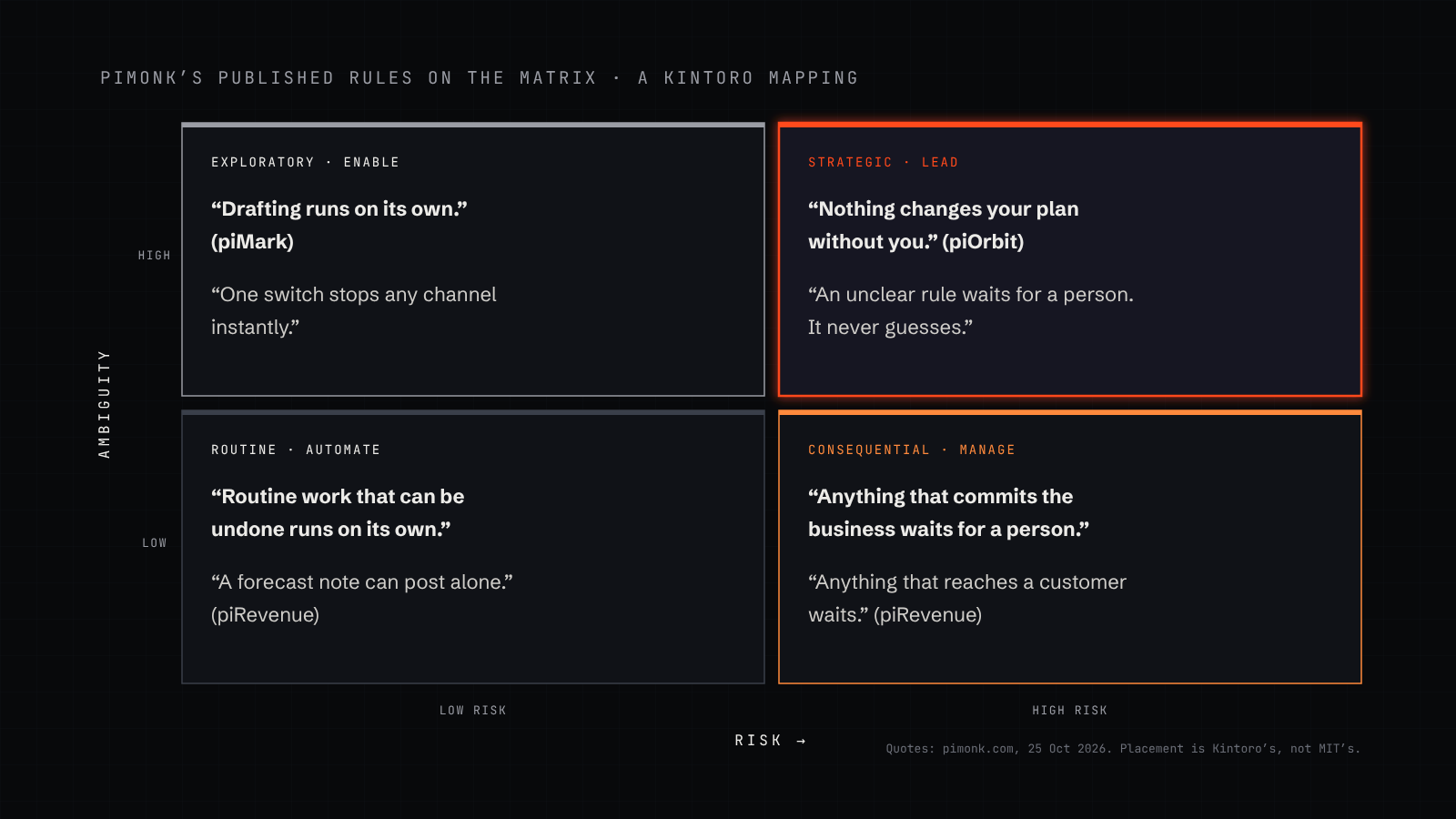
What is not finished, we say plainly. Several apps are still launching or on the roadmap into 2027. A shared business memory across apps is in build with no date. And we do not yet hold a SOC 2 or ISO 27001 audit.
Five Checkpoints to 2035
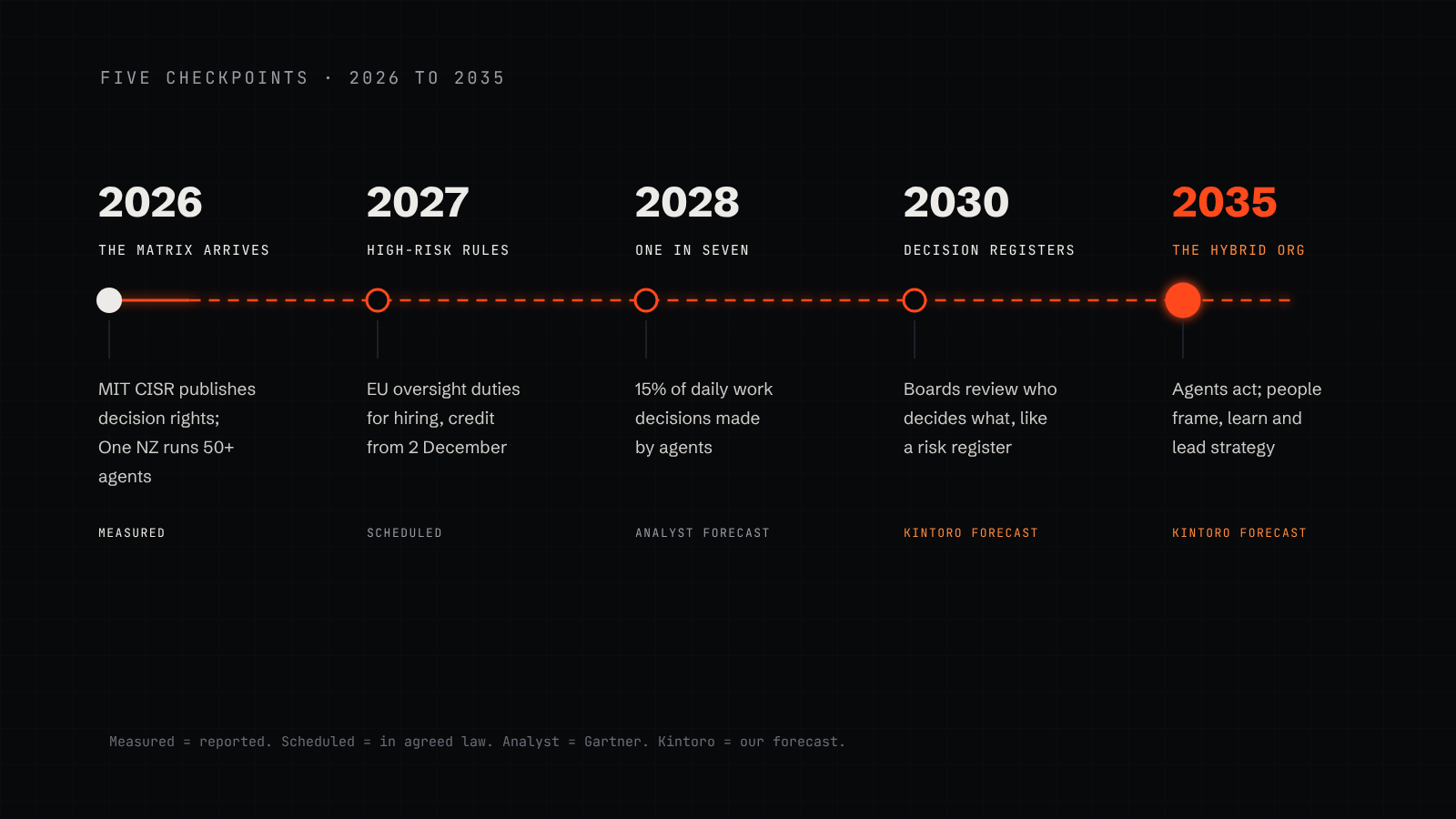
This is how I expect decision rights in hybrid organisations to develop, with each checkpoint marked as measured, scheduled, forecast by an analyst, or forecast by Kintoro.
- 2026
The matrix arrives Measured
MIT CISR publishes the AI Decision Matrix. One NZ runs more than 50 agents across all four quadrants. The EU agrees to delay high-risk AI obligations.
- 2027
High-risk rules apply Scheduled
From 2 December 2027, as agreed in 2026, EU obligations for stand-alone high-risk AI, such as hiring and credit, apply, including human oversight.
- 2028
One decision in seven Analyst forecast
Gartner forecasts that agentic AI will make at least 15% of day-to-day work decisions autonomously, up from almost none in 2024.
- 2030
Decision registers Kintoro forecast
My forecast: most mid-sized companies keep a decision register that maps each decision type to its quadrant, its owner and AI’s role, and boards review it like a risk register.
- 2035
The hybrid organisation Kintoro forecast
My forecast: agents act on most routine and consequential decisions. Framing, learning and strategic decisions remain human jobs, and become a larger share of what managers do.
The Business Conclusion
Stop asking where AI can be used. Start listing the decisions it shapes, and decide who owns each step.
For a business leader, that becomes five moves over the next twelve months:
- List your twenty most frequent decisions and place each one on the matrix: how ambiguous is it, and what happens if it is wrong?
- For each, write down who frames, who acts and who learns: a person, a person with AI, or AI.
- Give every agent a named human owner, and every consequential decision a named approver and a deputy.
- Automate routine work that can be undone, and check a sample. Do not make people approve what they cannot meaningfully check.
- Review the portfolio every quarter. Decisions move between quadrants, and so should their rights.
Then measure one number: how many of the decisions people approve do they actually change? If the answer is almost none, the loop has become a rubber stamp, and it is time to redraw it.
People Keep the Decisions
The fear about AI in organisations is that it will decide everything. The reality, in the best-run companies, is more interesting. AI does more and more of the acting. People do more of the framing, the judging and the learning, and answer for the result.
MIT’s matrix gives leaders a language for that division of labour. At Kintoro, it is the rule we build piMonk on: agents do the work, people keep the decisions, and every decision leaves a record of who made it.
The hybrid organisation is not one where machines replace managers. It is one where every manager knows exactly which decisions are theirs.
Agents do the work. People keep the decisions.
Sources
- https://cisr.mit.edu/publication/2026_0601_AIDecisionMatrix_SebastianWeillHaskampVomBrocke,Ina M. Sebastian, Peter Weill, Thomas Haskamp and Jan vom Brocke, “Designing Decision Rights for AI”, MIT CISR Research Briefing, 18 June 2026
- https://mitsloan.mit.edu/node/52664,Beth Stackpole, “A framework for determining when AI can make decisions”, MIT Sloan Ideas Made to Matter, 22 September 2026
- https://dspace.mit.edu/handle/1721.1/175164,Ina M. Sebastian and Peter Weill, “Decision Rights for AI”, MIT CISR Talking Points, 18 June 2026
- https://www.mckinsey.com/capabilities/people-and-organizational-performance/our-insights/the-agentic-organization-contours-of-the-next-paradigm-for-the-ai-era,McKinsey, “The agentic organization: Contours of the next paradigm for the AI era”, 26 September 2025
- https://www.constellationr.com/insights/news/microsoft-human-ai-agent-ratios-will-be-critical-success-new-roles-emerge,Constellation Research, on Microsoft’s 2025 Work Trend Index, 23 April 2025
- https://www.gartner.com/en/newsroom/press-releases/2025-06-25-gartner-predicts-over-40-percent-of-agentic-ai-projects-will-be-canceled-by-end-of-2027,Gartner, “Gartner Predicts Over 40% of Agentic AI Projects Will Be Canceled by End of 2027”, 25 June 2025
- https://www.gartner.com/en/newsroom/press-releases/2025-09-30-gartner-survey-finds-just-15-percent-of-it-application-leaders-are-considering-piloting-or-deploying-fully-autonomous-ai-agents,Gartner, survey of IT application leaders on AI agents, 30 September 2025
- https://www.wftv.com/news/local/agentic-ai-will-handle-15-work-decisions-by-2028-gartner-predicts/VCD3YBGQK5CUBNBMCIKUW6TI5I/,WFTV, on Gartner’s forecast that agentic AI will make 15% of day-to-day work decisions by 2028, 30 September 2026
- https://www.rsna.org/news/2023/may/ai-bias-may-impair-accuracy,RSNA News, on Dratsch et al., “Automation Bias in Mammography”, Radiology, 2 May 2023
- https://ascopost.com/news/august-2025/routine-ai-assistance-may-lead-to-loss-of-skills-in-endoscopists-study-shows/,The ASCO Post, on Budzyń et al., endoscopist deskilling after AI exposure, The Lancet Gastroenterology & Hepatology, August 2025
- https://datamatters.sidley.com/2026/06/22/eu-lawmakers-reach-provisional-agreement-to-delay-key-eu-ai-act-obligations/,Sidley Data Matters, “EU Lawmakers Reach Provisional Agreement to Delay Key EU AI Act Obligations”, 22 June 2026
- https://pimonk.com/platform/agents/,piMonk, Agents and approvals page, accessed 25 October 2026
- https://pimonk.com/,piMonk home page, accessed 25 October 2026
See the idea working in piMonk
piMonk is the AI company we built on this thinking: agents do the work, people keep the decisions. Try the app this piece points to, or book a demo.
Book a demo