

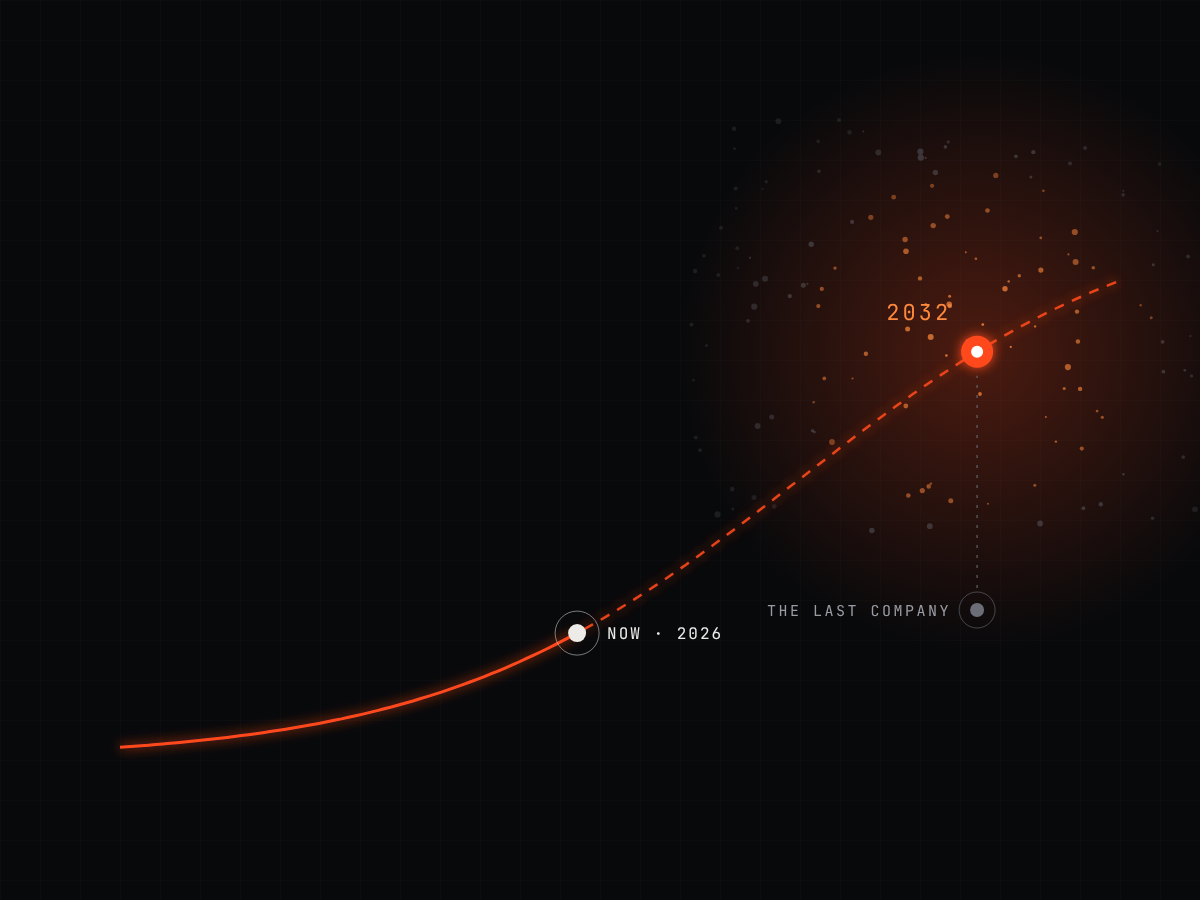
Scenario · Monday, 6 September 2032 · A forecast, not a report
At 7:40 on a Monday morning, the finance director of a mid-size industrial distributor opens a short email. The company has lost its third large contract this year. The customer was polite about it. The winning bid arrived in four minutes, priced to the cent against live freight and stock data. Ours took three days and two spreadsheets.
Across town, the competitor’s agents spent the weekend reconciling six thousand supplier invoices, chasing late payments and rerouting three containers around a port closure. Eleven decisions were waiting for its managers that morning. None of the screens mentioned AI. It had stopped being a thing anyone said.
In 2026, our distributor had decided to wait until AI “matured”. It did. Now the company is adopting, last in its market, and discovering that the software is the easy part. Its rivals spent six years redesigning how work flows, who decides what, and how people manage machines. That cannot be bought in a quarter.
That company is a forecast. Everything else in this feature is built from what can be measured today, in October 2026, and from the historical record of how general-purpose technologies spread. Where I forecast, I say so.
Ask a room of executives whether their company uses AI, and almost every hand goes up. Ask whether it has changed the profit and loss, and most hands come down.
That gap is the whole story of the next six years. It is also where the last company to adopt AI will be decided, because the companies that close it first will not be the ones that bought the most AI. They will be the ones that rebuilt themselves around it.
Where We Stand: October 2026
01 · Measure · McKinsey · Ramp · US Census Bureau · 2026
Everyone uses it. Few are changed by it.
The adoption number you hear depends on what you count. In McKinsey’s 2026 State of AI survey, fielded in May and June across 1,719 respondents in 97 countries, nearly nine in ten organisations use AI regularly in at least one business function. Ramp, which tracks the corporate spending of US businesses on its platform, found that 55.9% paid for an AI product in September 2026, up 12 points in a year. Anthropic led OpenAI on that measure, 43.8% to 40.6%.
The US Census Bureau asks a harder question. Its Business Trends and Outlook Survey, revised last November to cover AI use “in any business function”, put the national rate at 19.8% of firms in early May 2026. Firms with 250 or more employees were at 37%, retailers at about 14%. A Census working paper on the same survey found that most adopters use AI in three or fewer functions, and that two in three use it to help with tasks rather than replace them.
Then there is the only measure a board really cares about. McKinsey found that 37% of respondents attribute any EBIT impact to AI, essentially unchanged from a year earlier. Its “AI high performers”, who attribute 5% or more of EBIT to AI, are about 6% of respondents. Also flat.
Who is ahead, 2026
- 37%of US firms with 250 or more employees use AI, against under 20% of the smallestUS Census Bureau BTOS, May 2026
- 39.7%of US information-sector firms use AI; retailers are at about 14%US Census Bureau BTOS, May 2026
- 40%of large organisations are scaling AI agents in at least one function, up from 27%McKinsey, State of AI 2026
- +12 ptsrise in a year in US businesses paying for AI, to 55.9%Ramp AI Index, September 2026
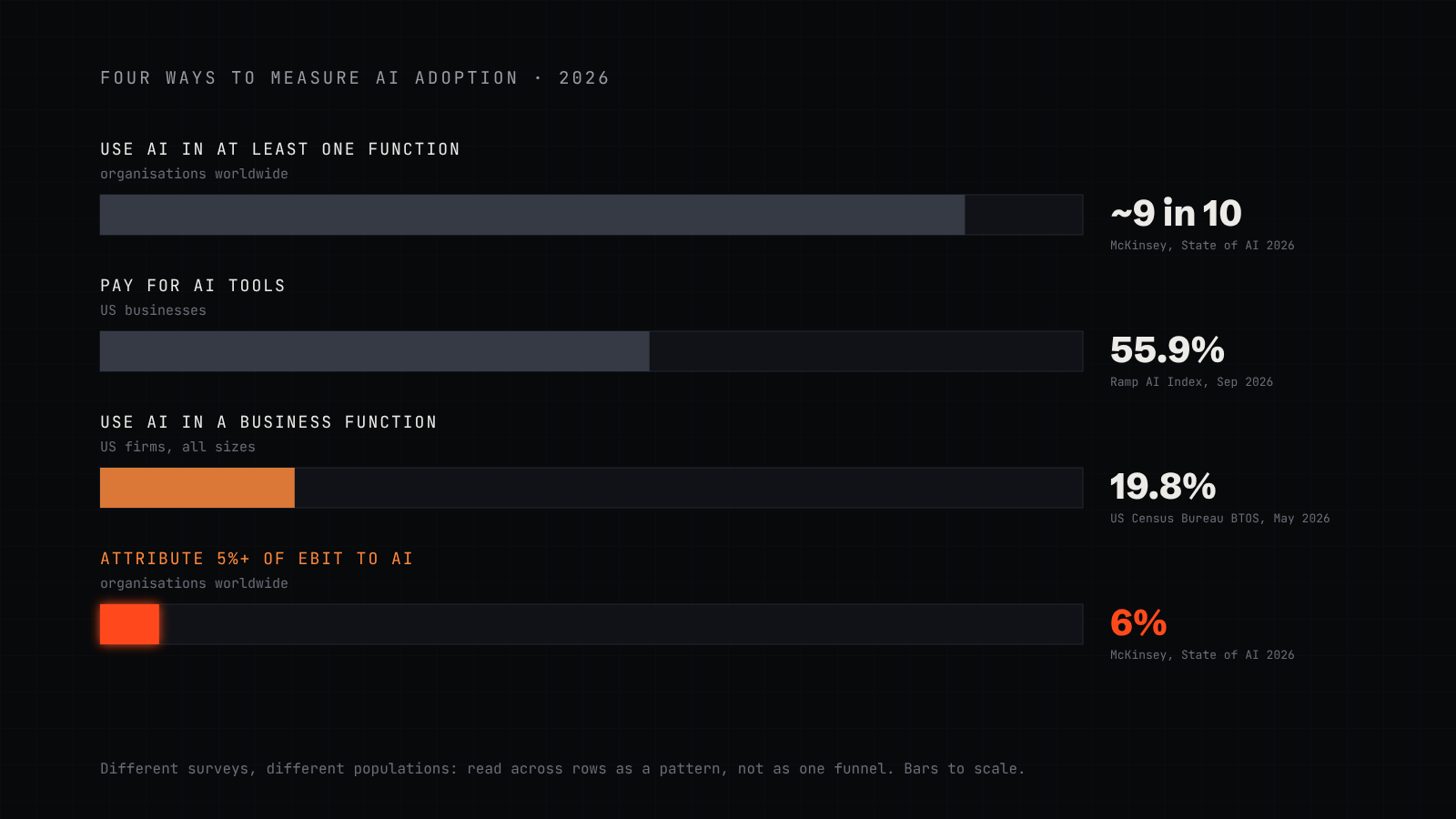
AI has been adopted the way most gym memberships are adopted: paid for widely, used seriously by a few.
Usage is a statistic. Value is a redesign.
Where AI Sits on the S-Curve
Every general-purpose technology spreads along an S-curve: slow, then sudden, then saturated. The sociologist Everett Rogers split any population of adopters into innovators (2.5%), early adopters (13.5%), the early majority (34%), the late majority (34%) and laggards (16%). The steepest, most valuable stretch of the curve is the passage through the two majorities.
Put today’s numbers on that curve and the picture is clear. On spending, AI tools are already deep into the early majority. On genuine use inside business functions, at about one firm in five, AI has just crossed from early adopters into the early majority, past the point the strategist Geoffrey Moore called “the chasm”. On value, at 6%, it is still with the innovators.
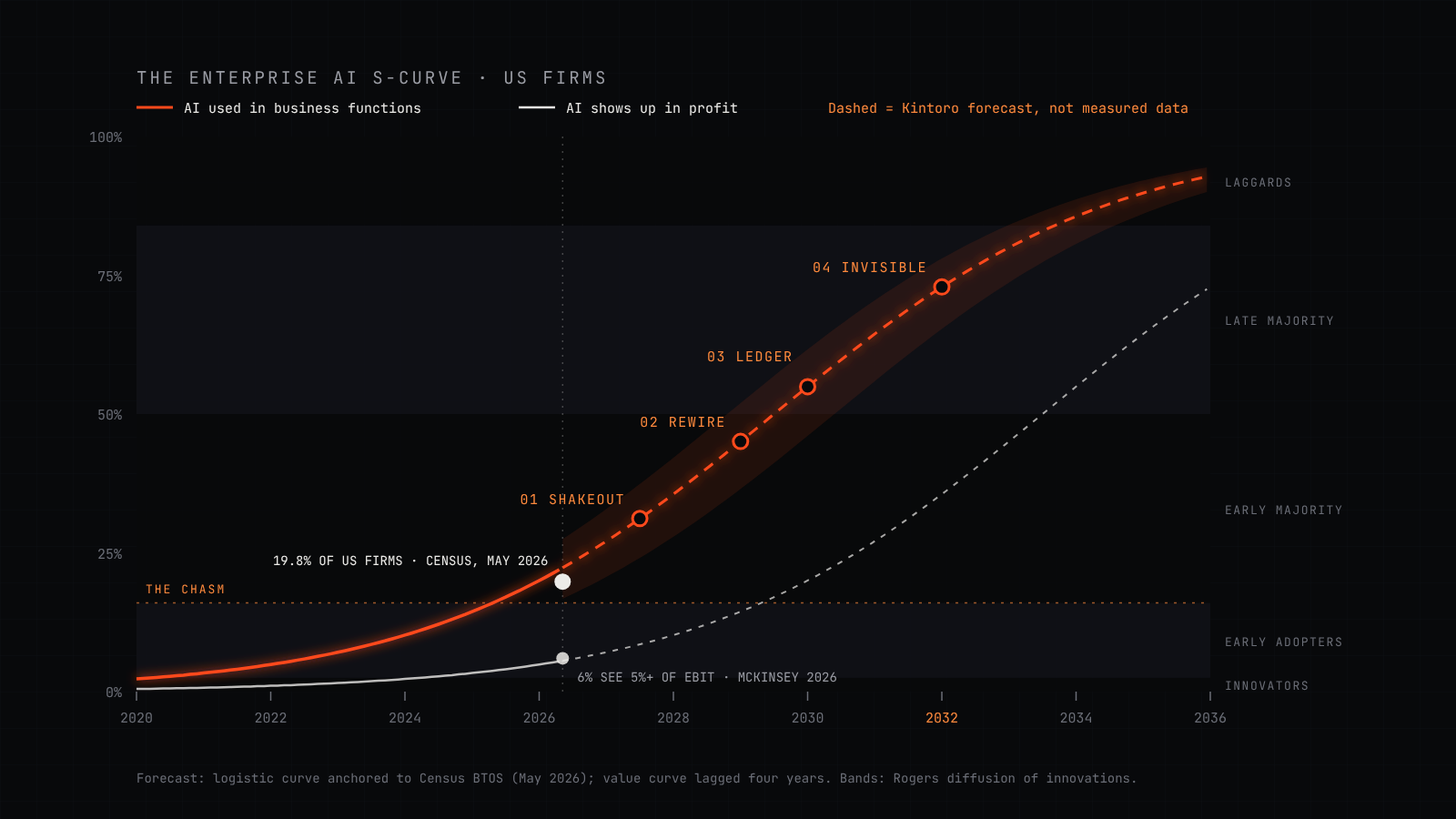
My forecast, clearly marked as one: firm-level AI use follows a logistic curve that passes the halfway mark around 2029 to 2030 and reaches roughly three in four US firms by 2032. Weighted by employment, it will be higher, because big firms move first; the Census paper already puts employment-weighted adoption at 32%. By 2032, nearly everyone working at a mid-size or large company will work alongside AI every day. The curve for value trails the curve for use by three to five years, reaching perhaps one firm in three by 2032.
That leaves the laggards. If the forecast holds, around one firm in four will still be outside the curve in 2032. Some will be tiny businesses that never needed it. Some will be the last company in a market where everyone else rebuilt.
02 · History · 1882 to 1929 · Paul David · Warren Devine
The dynamo took forty years. Its lesson took longer.
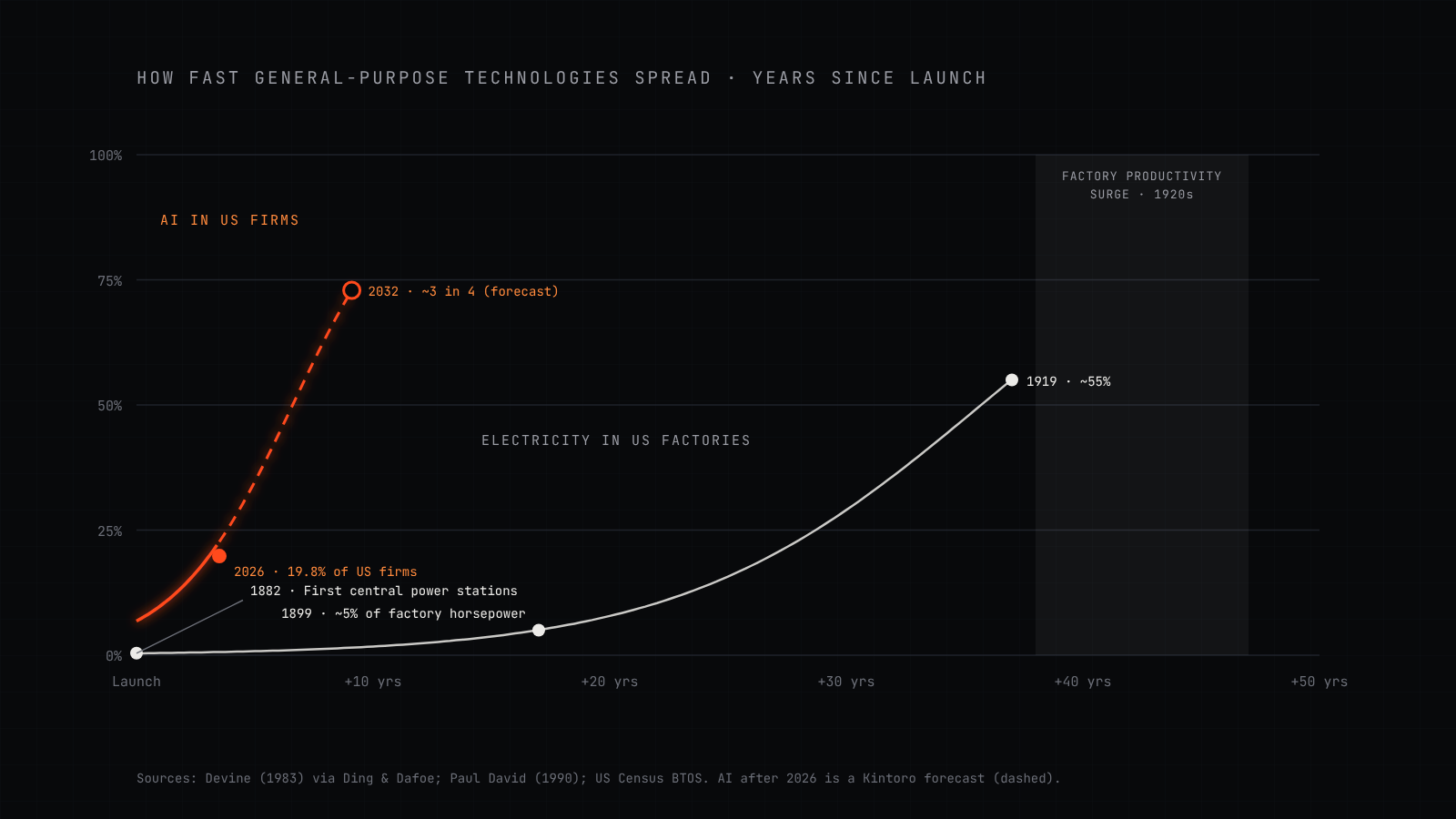
We have been here before. The first central power stations opened in New York and London in the early 1880s. By 1899, electric motors supplied slightly less than 5% of the installed horsepower in US manufacturing. By 1919, they supplied about 55%. Yet factory productivity barely moved until the 1920s, when US manufacturing productivity grew by more than 5% a year.
The economic historian Paul David explained why. Early factories swapped a steam engine for a large electric motor and kept the same shafts, belts and multi-storey layout. The gains arrived only when a new generation of managers redesigned the factory itself: single-storey buildings, a motor at every machine, work flowing along a line. The technology was ready decades before the organisation was.
The modern version of the argument is the “productivity J-curve” of Erik Brynjolfsson, Daniel Rock and Chad Syverson. When a general-purpose technology arrives, firms pour money into invisible complements, such as new processes, data, training and reorganisation, that do not show up as output. Measured productivity dips before it rises.
AI is moving far faster than the dynamo. Researchers at the St. Louis Fed found that 39% of Americans aged 18 to 64 had used generative AI by August 2024, less than two years after ChatGPT launched, a faster uptake than either the personal computer or the internet. But the redesign of the factory floor, which this time means workflows, decision rights and roles, does not go faster just because the software does.
Electricity stopped being news when the factory was redesigned. AI will too.Kintoro
Why Value Lags Use
At the level of the individual task, the productivity evidence is real. In a study of 5,179 customer support agents, Brynjolfsson, Danielle Li and Lindsey Raymond found that an AI assistant raised issues resolved per hour by 14% on average, and by 34% for novice workers. In a Harvard and Boston Consulting Group experiment, consultants using GPT-4 completed 12.2% more tasks, 25.1% faster, at more than 40% higher quality, on tasks inside the AI’s capabilities. On a task just outside them, they were 19 percentage points less likely to get the right answer.
What AI does to the task, and to the P&L
- 14%more customer issues resolved per hour; 34% for novicesBrynjolfsson, Li and Raymond, NBER
- 25.1%faster work by consultants on tasks inside AI’s capabilityHarvard Business School and BCG
- 80%of respondents report better personal productivity from AIMcKinsey, State of AI 2026
- 37%attribute any EBIT impact to AI, flat on last yearMcKinsey, State of AI 2026
That last pair is the puzzle. People feel more productive: in McKinsey’s survey, 80% report better personal productivity and half say AI improves their decisions. Yet barely a third see it in EBIT. Productivity is personal before it is financial. An hour saved by an employee becomes profit only when someone redesigns the process so the hour goes somewhere useful, or the work no longer needs doing at all.
Economists disagree about how big the prize is. Goldman Sachs estimated in 2023 that generative AI could lift global GDP by about 7% over a decade, and US labour productivity growth by about 1.5 percentage points a year, once widely adopted. MIT’s Daron Acemoglu is far more cautious: roughly 0.7% total productivity over ten years, because only about 5% of tasks can be profitably handed to AI in that window. The Penn Wharton Budget Model sits between them, and makes a striking call: AI’s boost to US productivity growth peaks in 2032, then fades as the gain becomes part of the baseline.
If Penn Wharton is right, 2032 is the year AI stops being new and starts being normal. The year the last company runs out of time.
Five Checkpoints to 2032
The path from here to there will not be a smooth line. These are the checkpoints I expect, with each one marked: measured today, scheduled in law, forecast by analysts, or forecast by Kintoro.
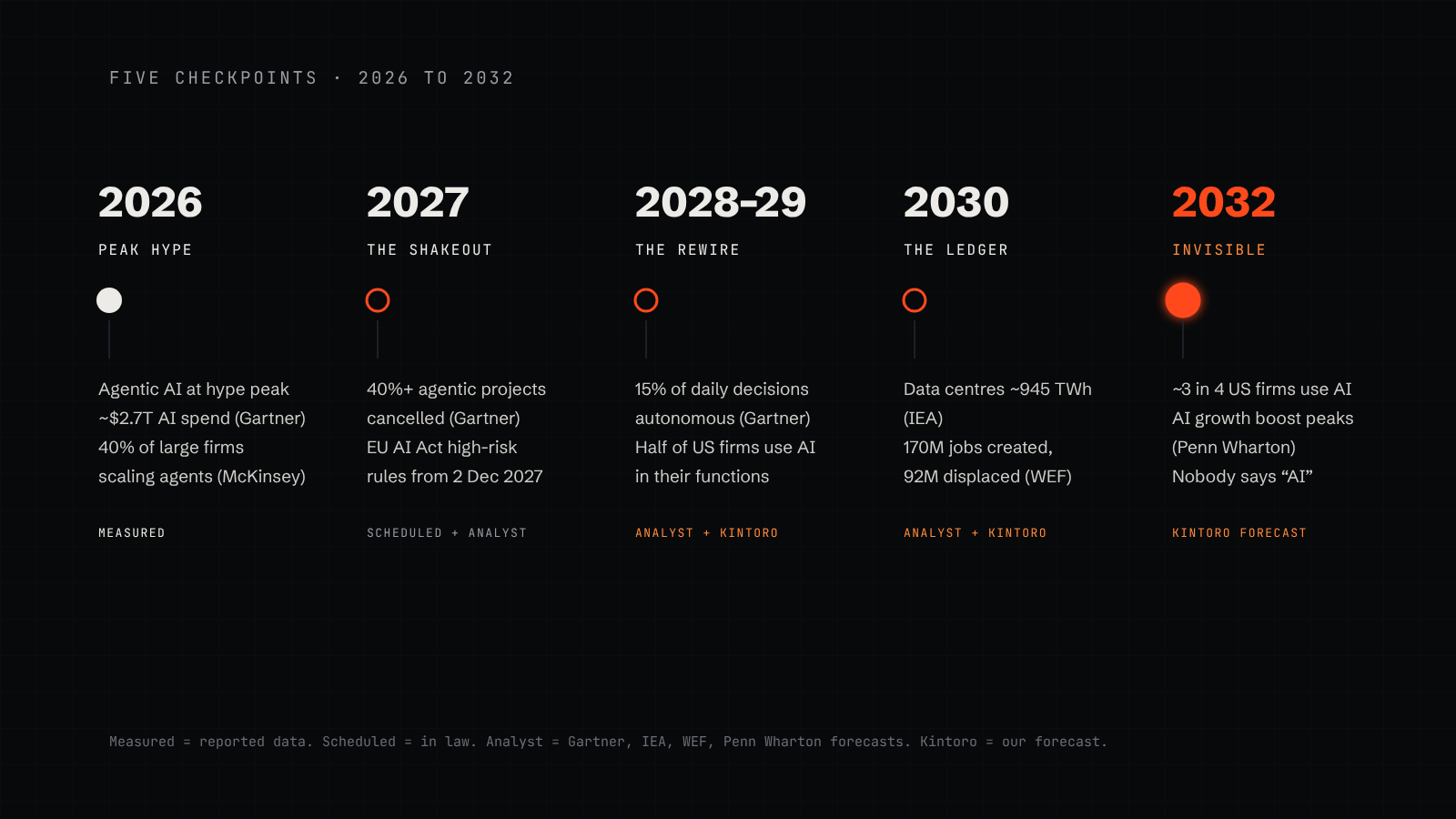
- 2026
The peak of expectations Measured
Gartner placed agentic AI at the Peak of Inflated Expectations in its first Hype Cycle for Agentic AI in April 2026, and expects 40% of enterprise applications to include task-specific agents by the end of the year, up from under 5% in 2025. It forecasts worldwide AI spending of about $2.7 trillion this year, more than half of it infrastructure. McKinsey found 40% of large organisations already scaling agents in at least one function.
- 2027
The shakeout Scheduled · Analyst forecast
Gartner expects more than 40% of agentic AI projects to be cancelled by the end of 2027, citing cost, unclear value and weak risk controls. The EU AI Act’s obligations for high-risk systems listed in Annex III, such as hiring, credit and access to essential services, now apply from 2 December 2027, after the Digital Omnibus delayed them. My read: this is the trough, and the healthiest thing that can happen to enterprise AI. The pilots that survive will have an owner, a measured outcome and an audit trail.
- 2028–29
The rewire Analyst forecast · Kintoro forecast
Gartner predicts that by 2028, 15% of day-to-day work decisions will be made autonomously by agentic AI, and a third of enterprise software applications will include it. AI rules for products covered by EU safety law follow on 2 August 2028. My forecast: around 2029, half of US firms use AI inside business functions, not just at the side of them. This is the factory being redesigned.
- 2030
The ledger Analyst forecast · Kintoro forecast
The International Energy Agency expects data centres to use about 945 TWh of electricity, more than double 2024. Employers surveyed by the World Economic Forum expect 170 million jobs to be created and 92 million displaced worldwide by 2030. My forecast: AI shows up in national productivity statistics, and about one firm in five can point to a material share of profit.
- 2032
Invisible Kintoro forecast
About three in four US firms, and nearly all mid-size and large ones, run core processes with agents. Procurement stops listing AI as a category, the way nobody buys “electric” equipment. Penn Wharton’s model puts AI’s contribution to productivity growth at its peak. The last companies to adopt are still paying for the redesign their rivals finished years earlier.
The Hybrid Enterprise
The workplace of 2032 will not be people replaced by agents. It will be people who manage agents. Microsoft’s 2025 Work Trend Index called this the “Frontier Firm” and coined the “agent boss”: the employee who builds, delegates to and manages AI agents. Leaders surveyed expected their teams to be training agents (41%) and managing them (36%) within five years. Microsoft proposed a new management measure, the human-agent ratio: how many agents a role needs, and how many people those agents need.
The early data shows how the split is forming. Anthropic’s Economic Index found in September 2025 that 77% of business use of Claude through its API followed automation patterns, where a whole task is delegated, against about half of consumer use. Businesses are handing over tasks, not just asking for help. Job cuts are still rare: the Census paper found AI-driven employment reductions at 2% of adopting firms. McKinsey found that 39% of respondents expect AI to reduce headcount in the next year, up from 32%, but only 14% saw it happen last year.
The pressure will land unevenly. Stanford’s 2026 AI Index reports that employment of software developers aged 22 to 25 has fallen nearly 20% since 2024. The World Economic Forum’s employers expect a net gain in jobs by 2030, but with 39% of core skills changing.
Decision-making is where the hybrid enterprise will be defined. If Gartner is right that 15% of day-to-day decisions are made autonomously by 2028, the other 85% still sit with people. The design question for every company is which 15%, and how that line moves.
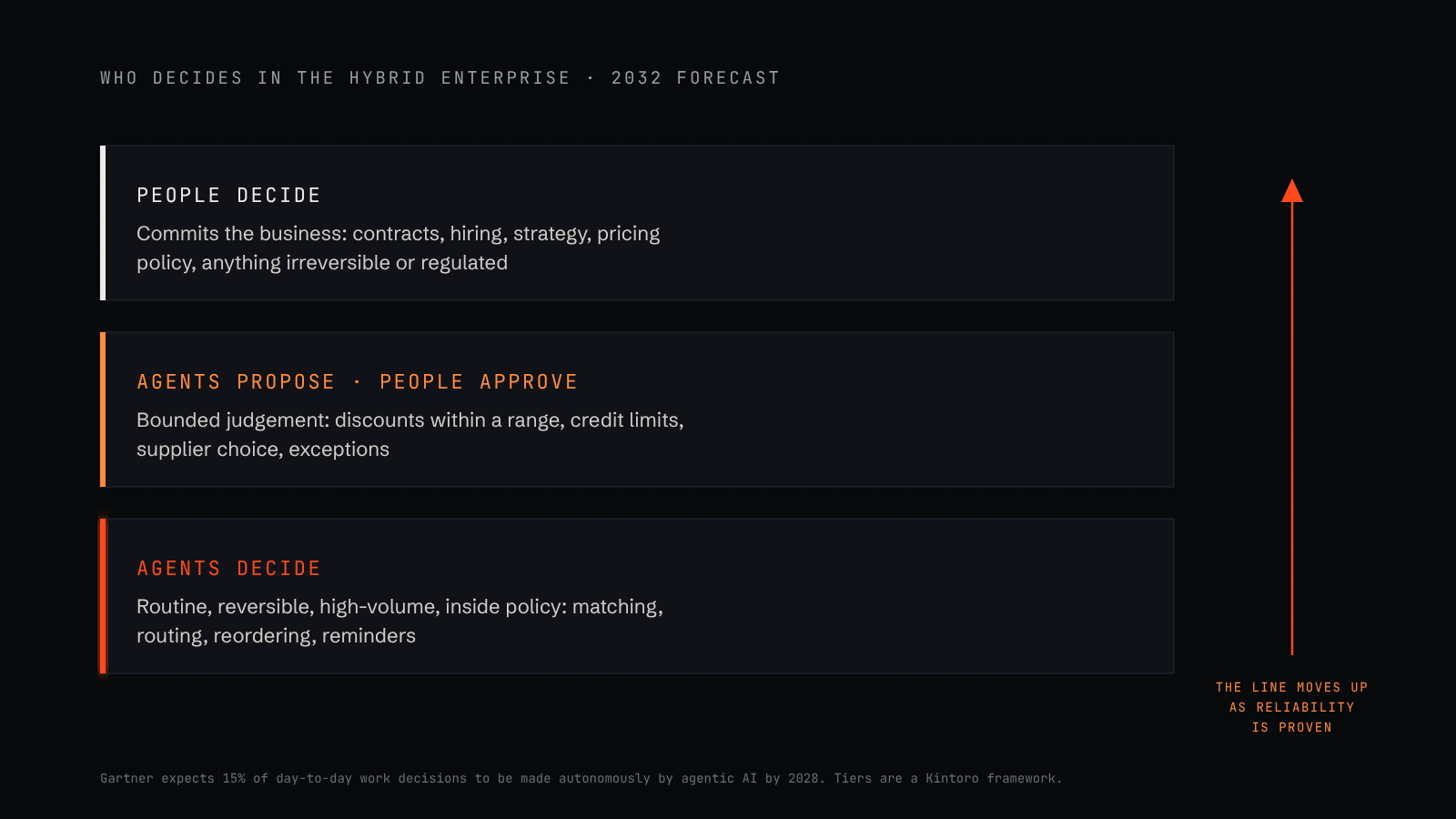
In 2032, the most important document in a company will not be its AI strategy. It will be its map of who, or what, is allowed to decide.
By 2032, the AI won’t be the story. The org chart will.Kintoro
How the Technology Gets There
Three technical curves will decide how fast that line moves, and one physical limit will decide how far.
01 · Curve 01 · METR · 2025 to 2026
The length of work an agent can take on
The research group METR measures the length of task, in skilled-human working time, that an AI model can complete. In its January 2026 update, that “time horizon” had doubled roughly every four months since 2023, faster than the seven-month pace it first reported. Claude Opus 4.6, released in February, was estimated at about 12 hours at 50% success, the first model to clear a full working day.
The number that matters to a business is the other one. At 80% success, the same model’s horizon was about 70 minutes.
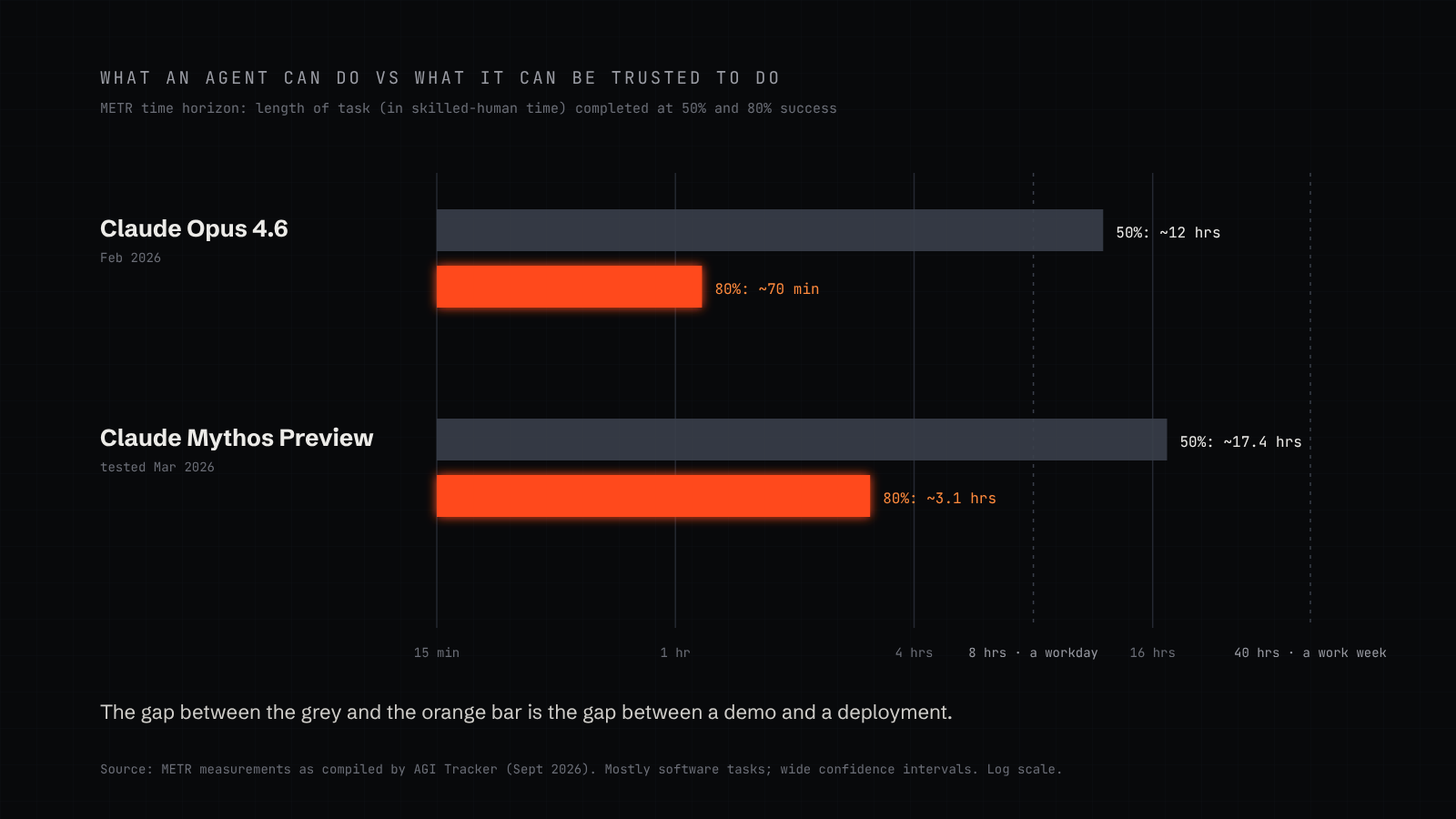
METR is careful about its limits. Its tasks are mostly software, self-contained and automatically scored; real work is messier, and visual computer-use tasks show far shorter horizons. But if the 80% horizon keeps doubling at even the slower historical pace, an agent that can reliably handle a full week of routine work arrives before the end of the decade. That, more than any benchmark headline, is what turns “agents propose” into “agents decide”.
02 · Curve 02 · Epoch AI · Gartner · Futurum
The cost of intelligence
Epoch AI found that the price of reaching a fixed level of model performance has been falling between 9 and 900 times a year, depending on the task; about 40 times a year for GPT-4-level performance on PhD-level science questions. The token is getting cheaper. The bill is getting bigger: Gartner expects total AI spending to rise from about $2.7 trillion this year to $3.6 trillion in 2027, and Microsoft, Alphabet, Amazon, Meta and Oracle plan around $660 to $690 billion of capital spending in 2026 alone. Cheaper intelligence gets used for more things. About one in five McKinsey respondents already say operating costs, including tokens, constrain their AI use.
03 · Curve 03 · Linux Foundation · 2025 to 2026
The plumbing
An agent is only as useful as the systems it can reach. In 2025, the two protocols that let agents talk to tools and to each other, Anthropic’s Model Context Protocol and Google’s Agent2Agent, both moved under the neutral governance of the Linux Foundation. Open standards mean an agent can work across the finance system, the CRM and the warehouse without a custom bridge for each. By 2032, systems of record become systems of action: the ledger does not just store the invoice, it chases it.
The physical limit is power. The International Energy Agency estimates that data centres used about 415 TWh in 2024, roughly 1.5% of the world’s electricity, heading for about 945 TWh by 2030. Microsoft has cited Azure demand it cannot serve because of power constraints. For the rest of the decade, compute will be rationed by electricity as much as by chips.
The headline number is what an agent can do. The business number is what it can be trusted to do, at a price that beats a person, on systems it can actually reach.
What Has to Line Up
Complete adoption will not come from any single curve. It needs six conditions to arrive together.
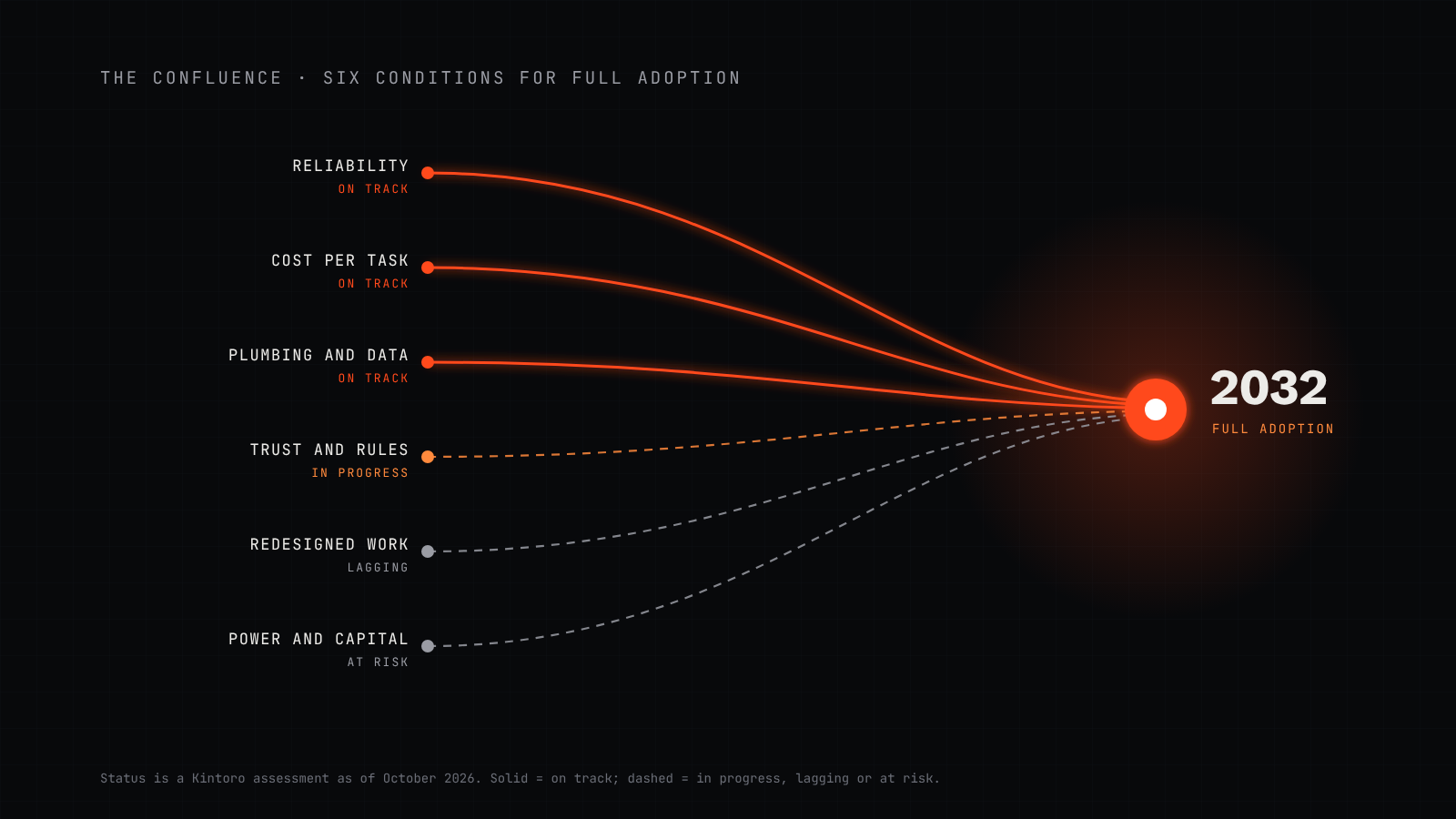
- Reliability. Agents that succeed nearly every time on long, messy tasks, not half the time on tidy ones.
- Cost per task. Routine work cheap enough that an agent is the obvious way to do it.
- Plumbing and data. Open standards and clean, permissioned data inside the systems of record.
- Trust and rules. Audit trails, liability and regulation settled enough that a finance director will sign off.
- Redesigned work. Processes, roles and decision rights rebuilt around agents: the factory-floor moment.
- Power and capital. Enough electricity, and enough revenue to justify the build-out.
The first three are on track. The last three are where the risk sits. Futurum estimated in February that pure-play AI vendors would earn under $35 billion in 2026 against roughly $690 billion of hyperscaler capital spending. If revenue does not catch up, a correction could slow the curve for a year or two, the way the dot-com bust slowed the internet without stopping it. Redesigned work is the slowest condition of all, and the only one entirely within a company’s control.
AI was ready before the companies were. It still is.
The Price of Being Last
Waiting has a respectable case. Late adopters skip the failed pilots, the 40% of agentic projects Gartner expects to be cancelled. They buy cheaper, better technology: at 40 times cheaper a year, patience looks like prudence.
But this is a general-purpose technology, and the J-curve punishes waiting in four ways the price of software does not capture.
- The redesign cannot be bought. The complements that turn AI into profit, such as rebuilt workflows, clean data and decision maps, take years to build and do not come in the box.
- Learning compounds. Every quarter an early mover runs agents, it builds test cases, context and judgement about what to trust. A late mover starts that count at zero.
- People move to where the agents are. The managers who know how to run a human-agent team will build careers at companies that already have them.
- The cost gap becomes a price gap. When a rival’s cost to quote, invoice or serve falls, it does not stay a margin advantage for long. It becomes a lower price the laggard must match.
The answer is not to be first. The firms that rushed in 2024 and 2025 paid for many of those cancelled pilots. The answer is to adopt the technology steadily and start the redesign early, because the technology will keep getting cheaper and the redesign will not.
In 2032, nobody will ask whether your company uses AI. They will ask whether it was rebuilt around it.The central question
The Business Conclusion
So: it is 2032. Where do we stand? My answer, as a forecast, is that AI will be everywhere and mentioned almost nowhere. About three in four firms, and nearly every mid-size and large one, will run core processes with agents. Agents will take a meaningful share of routine decisions. People will keep the ones that commit the business. The winners will not be the companies that adopted AI first. They will be the ones that redesigned first.
For a business leader, that turns into five moves over the next eighteen months:
- Measure value, not usage. Pick three processes and track cost, cycle time and error rate before and after AI.
- Write your decision map. List the decisions your business makes and mark which an agent may take, may propose, or may never touch.
- Fix the plumbing. Clean data in your systems of record, connected through open standards rather than one vendor’s lock.
- Redesign one workflow end to end. Not an assistant bolted onto the old process, but a new process built around agents.
- Give every agent an owner. Each one needs a person accountable for it, a set of test cases and an audit trail, the way every employee has a manager.
None of these requires waiting for the technology to mature. All of them get harder the longer you wait.
Nobody Says “Electric” Either
No company today describes itself as an electric business. Electricity is in everything, so it is mentioned nowhere. AI is on the same path, travelling faster.
At Kintoro, that is how we build piMonk: AI agents handle routine work inside the systems that run the business, while people keep control of the decisions that commit it. The aim is not a product that shouts about AI. It is one where AI is placed so well that nobody needs to say the word.
The last company to adopt AI will not be the one that refused it. It will be the one that kept waiting for it to be finished.
Don’t wait for AI to be finished. It never will be.
Sources
- https://www.mckinsey.com/capabilities/quantumblack/our-insights/the-state-of-ai,McKinsey & Company, “The state of AI in 2026”, 25 August 2026 (survey fielded 4 May to 8 June 2026, 1,719 respondents)
- https://ramp.com/data/ai-index,Ramp AI Index, September 2026 data, accessed 24 October 2026
- https://fred.stlouisfed.org/blog/2026/10/which-businesses-are-using-ai-technology,Diego Mendez-Carbajo, “Which businesses are using AI technology?”, FRED Blog, Federal Reserve Bank of St. Louis, 19 October 2026
- https://www.census.gov/library/stories/2026/05/ai-use-businesses.html,US Census Bureau, “Large Firms With at Least 20 Employees Biggest AI Users”, May 2026 (Business Trends and Outlook Survey)
- https://www.nber.org/papers/w35141,Bonney, Breaux, Dinlersoz, Foster, Haltiwanger and Pande, “The Microstructure of AI Diffusion”, NBER Working Paper 35141, April 2026
- https://c3.unu.edu/blog/2026-stanford-ai-index-report-takeaways,UNU Campus Computing Centre, “What the 2026 Stanford AI Index Report Tells Us About the State of AI”, 2026 (summary of Stanford HAI, AI Index 2026)
- https://arxiv.org/pdf/2106.04338,Jeffrey Ding and Allan Dafoe (citing Warren Devine, Journal of Economic History, 1983), “Engines of Power: Electricity, AI, and General-Purpose Military Transformations”, arXiv, June 2021
- https://www.historynewsnetwork.org/article/paul-david-it-took-decades-for-the-economic-impact,History News Network, “Paul David: It took decades for the economic impact of the dynamo to be felt”
- https://www.nber.org/papers/w25148,Erik Brynjolfsson, Daniel Rock and Chad Syverson, “The Productivity J-Curve: How Intangibles Complement General Purpose Technologies”, NBER Working Paper 25148
- https://www.frbsf.org/research-and-insights/publications/system-research-st-louis-fed/2024/10/the-rapid-adoption-of-generative-ai/,Alexander Bick, Adam Blandin and David Deming, “The Rapid Adoption of Generative AI”, Federal Reserve Bank of St. Louis, October 2024
- https://www.nber.org/papers/w31161,Erik Brynjolfsson, Danielle Li and Lindsey Raymond, “Generative AI at Work”, NBER Working Paper 31161
- https://www.hbs.edu/faculty/Pages/item.aspx?num=64700,Fabrizio Dell’Acqua et al., “Navigating the Jagged Technological Frontier”, Harvard Business School Working Paper 24-013, September 2023
- https://www.bnnbloomberg.ca/goldman-says-ai-will-spur-us-productivity-jump-global-growth-1.1901016,BNN Bloomberg, “Goldman says AI will spur US productivity jump, global growth”, March 2023
- https://mitsloan.mit.edu/node/48902,MIT Sloan, “A new look at the economics of AI” (Daron Acemoglu, “The Simple Macroeconomics of AI”), 21 January 2025
- https://budgetmodel.wharton.upenn.edu/issues/2025/9/8/projected-impact-of-generative-ai-on-future-productivity-growth,Penn Wharton Budget Model, “The Projected Impact of Generative AI on Future Productivity Growth”, 8 September 2025
- https://www.nocode.tech/article/gartners-2026-hype-cycle-agentic-ai,NoCode.Tech, on Gartner’s first Hype Cycle for Agentic AI, 2 April 2026 (secondary report)
- https://gartner.com/en/newsroom/press-releases/2025-08-26-gartner-predicts-40-percent-of-enterprise-apps-will-feature-task-specific-ai-agents-by-2026-up-from-less-than-5-percent-in-2025,Gartner, “Gartner Predicts 40% of Enterprise Apps Will Feature Task-Specific AI Agents by 2026”, 26 August 2025
- https://gartner.com/en/newsroom/press-releases/2026-09-16-gartner-forecasts-worldwide-ai-spending-to-grow-49-point-5-percent-in-2026,Gartner, “Gartner Forecasts Worldwide AI Spending to Grow 49.5% in 2026”, 16 September 2026
- https://www.gartner.com/en/newsroom/press-releases/2025-06-25-gartner-predicts-over-40-percent-of-agentic-ai-projects-will-be-canceled-by-end-of-2027,Gartner, “Gartner Predicts Over 40% of Agentic AI Projects Will Be Canceled by End of 2027”, 25 June 2025
- https://technologymagazine.com/articles/gartner-how-agentic-ai-is-shaping-business-decision-making,Technology Magazine, “Gartner: How Agentic AI is Shaping Business Decision-Making” (Top Strategic Technology Trends for 2025)
- https://fpf.org/blog/the-ai-act-implementation-timeline-what-changes-under-the-ai-omnibus/,Future of Privacy Forum, “The AI Act implementation timeline: What changes under the AI Omnibus?”, 2026
- https://www.linuxfoundation.org/press/linux-foundation-announces-the-formation-of-the-agentic-ai-foundation,Linux Foundation, formation of the Agentic AI Foundation (Model Context Protocol contribution), December 2025
- https://www.linuxfoundation.org/press/linux-foundation-launches-the-agent2agent-protocol-project-to-enable-secure-intelligent-communication-between-ai-agents,Linux Foundation, launch of the Agent2Agent protocol project, June 2025
- https://www.iea.org/reports/energy-and-ai/executive-summary,International Energy Agency, “Energy and AI”, executive summary, April 2025
- https://www.weforum.org/publications/the-future-of-jobs-report-2025/,World Economic Forum, “The Future of Jobs Report 2025”, January 2025
- https://blogs.microsoft.com/blog/2025/04/23/the-2025-annual-work-trend-index-the-frontier-firm-is-born/,Microsoft, “The 2025 Annual Work Trend Index: The Frontier Firm is born”, 23 April 2025
- https://www.ernestchiang.com/en/posts/2025/the-geography-of-ai-anthropic-economic-index/,Ernest Chiang, summary of Anthropic Economic Index report of 15 September 2025 (77% automation in business API use)
- https://technologyreview.com/2026/02/05/1132254/this-is-the-most-misunderstood-graph-in-ai,MIT Technology Review, “This is the most misunderstood graph in AI”, 5 February 2026 (on METR time horizons)
- https://agitracker.io/blog/metr-time-horizons-2026/,AGI Tracker, “The 10x-a-year clock: what METR’s AI time horizons really show”, 23 September 2026
- https://epoch.ai/data-insights/llm-inference-price-trends,Epoch AI, “LLM inference prices have fallen rapidly but unequally across tasks”, 12 March 2025
- https://futurumgroup.com/insights/ai-capex-2026-the-690b-infrastructure-sprint/,Nick Patience, “AI Capex 2026: The $690B Infrastructure Sprint”, Futurum, 12 February 2026
See the idea working in piMonk
piMonk is the AI company we built on this thinking: agents do the work, people keep the decisions. Try the app this piece points to, or book a demo.
Book a demo