

Scenario · Tuesday, 7 March 2028 · A forecast, not a report
Before the quarterly strategy meeting, the chief operating officer of a 600-person distribution company opens one screen: yesterday’s model router log. 1.4 million requests. Almost all were answered by small models the company runs on its own data: invoices matched, orders checked, customer emails drafted, stock forecasts updated. Each cost a fraction of a cent, and none of the data left the building.
Eleven requests went further. The router sent them to a frontier model, under a contract that forbids the provider from learning from them: a market-entry analysis for Poland, a reading of a new EU rule on packaging, a stress test of next year’s pricing, a first look at a company the board might buy. Two years ago, each of those would have been a consulting engagement measured in weeks and six figures.
None of the eleven answers decided anything. They are on the meeting agenda as options, with sources and assumptions shown. At 10:00, nine people around a table will choose. The machines did the work. The people keep the decision, and the relationship with every customer they will call afterwards.
The company and its morning are fictional, and so is March 2028. Everything else in this feature comes from what Satya Nadella has said this year, from research and analyst forecasts, and from how enterprises are already buying AI and consulting. Where I forecast, I say so.
Every enterprise technology war has the same opening move. The biggest vendors offer to do everything, and the customer worries about becoming dependent. Mainframes, databases, ERP and cloud all went this way. AI is next, and this time the fight has two armies.
On one side are the frontier models from OpenAI, Anthropic, Google and others: enormous, expensive and astonishingly capable. On the other are small, specialised models, many of them open-weight, that a company can run cheaply and train on its own data. The prize is the enterprise, and the question is which work goes where. My answer is that most work will go small, a little will go to the frontier, and the real power will sit with whoever controls the routing between them.
What Satya Nadella Actually Said
01 · Record · Microsoft earnings call · SN Scratchpad · June to July 2026
“Any model at any given time is swappable”
Microsoft’s chief executive has made the same argument three times this summer, each time more sharply. On Microsoft’s fourth-quarter earnings call on 29 July 2026, asked about open and closed models, he said: “You’ve got to keep your harness separate from the model. That means any given model at any given time is swappable.” In his prepared remarks he added: “Every customer wants the right model for each task based on quality, latency, cost, and compliance.” And he predicted “a mix of open weights, closed weights.”
Two weeks earlier, in an essay on his personal blog titled “The Reverse Information Paradox”, he warned that companies risk paying for intelligence twice: once in money, and again in the knowledge they hand over through prompts, agent traces and corrections. His advice was to keep “the orchestration layer decoupled from any single model” and to build “a real trust boundary” around a company’s data. “In consuming intelligence, you are creating intelligence,” he wrote. “And what you create should belong to you.”
In June, speaking with Yash Patil of Applied Compute, he went further, predicting “as many models in the world as firms in the world”. “You can always buy a tool, you can even outsource a task or even a job, but you can’t outsource your learning,” he said. “If you outsource your learning, then why exist?”
Nadella did not use the word “router”. But the layer he describes, sitting between a company’s work and many models and choosing among them by quality, cost and compliance, is what the industry calls a model router or AI gateway. Microsoft already sells one. Its Foundry model router picks a model for each prompt in real time, across OpenAI, Anthropic, xAI, DeepSeek, Meta and other models, in “balanced”, “quality” or “cost” mode. Microsoft says the number of its customers building with models from multiple providers has grown fivefold.
Nadella’s message to every enterprise: rent the intelligence, but never rent your learning.
The war in numbers
- 3×more use of small, task-specific models than general-purpose LLMs that Gartner predicts by 2027Gartner, Apr 2025
- 10–30×cheaper to serve a 7B small model than a 70–175B large one, in latency, energy and computeNVIDIA Research, Jun 2025
- ~30%of tokens on OpenRouter going to open-weight models by late 2025OpenRouter and a16z, Dec 2025
- 5×growth in Microsoft customers building with models from multiple providersMicrosoft earnings call, Jul 2026
The Two Armies
02 · Evidence · Menlo Ventures · Bloomberg · Gartner · NVIDIA · OpenRouter · 2025 to 2026
Frontier wins the revenue. Small wins the volume.
The frontier army is winning the money. Menlo Ventures estimated enterprise spending on generative AI at $37 billion in 2025, more than triple the year before, with Anthropic holding about 40% of enterprise model spending, OpenAI 27% and Google 21%. Open-source models’ share of enterprise workloads fell to 11%. In August, Bloomberg reported that Anthropic’s annualised revenue had passed $65 billion, sevenfold in a year. And the frontier labs are moving up into the enterprise itself: OpenAI launched its Frontier platform for enterprise agents in February, with forward-deployed engineers, and then a Frontier Alliance with McKinsey, BCG, Accenture and Capgemini.
The small army is winning the volume. Gartner predicted in April 2025 that by 2027 organisations will use small, task-specific models at least three times as much as general-purpose ones, citing accuracy on business tasks, speed and cost. NVIDIA researchers argued in June 2025 that small models could handle 60 to 80% of the agent tasks currently sent to large ones, at 10 to 30 times lower cost. On OpenRouter, which routes traffic across hundreds of models, open-weight models reached roughly a third of all tokens by late 2025.
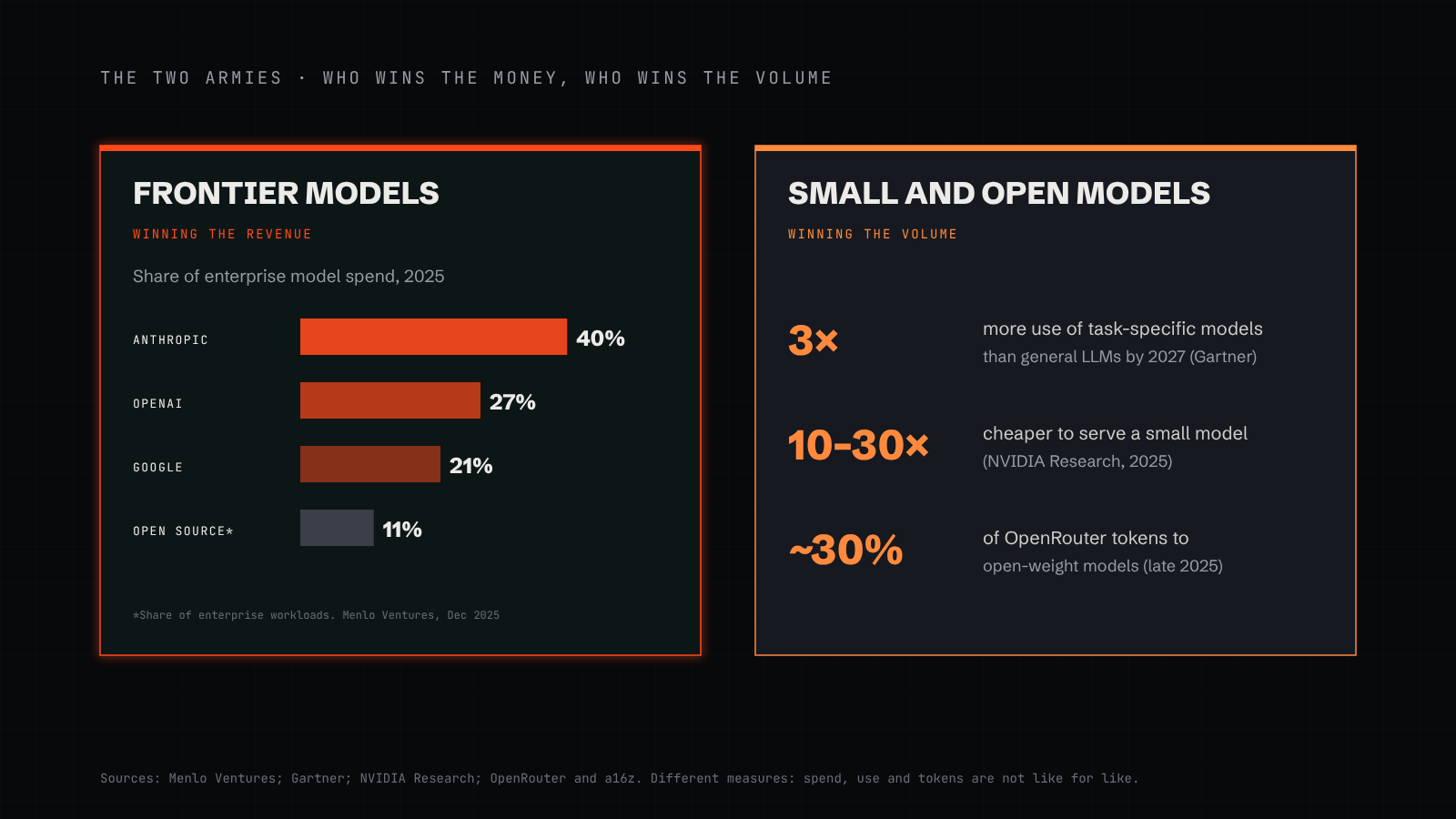
The gap between those two pictures is the war. In June, CNBC reported Glean’s chief executive, Arvind Jain, saying that about 95% of enterprise AI usage still runs on the most expensive frontier models, while Cognition’s Scott Wu said companies could get five to ten times better cost efficiency on routine work with smaller models. Every percentage point that moves from the first number to the second is revenue that leaves the frontier labs.
Every percentage point of routine work that moves to small models is revenue that leaves the frontier labs.Kintoro
The Router in the Middle
A model router does one simple thing. For each request, it decides which model should answer: the cheapest one that is good enough, the one allowed to see this data, or the most capable one available when the question is hard. Researchers at LMSYS showed in 2024 that a trained router could cut costs by over 85% on one benchmark while keeping 95% of GPT-4’s performance. IDC expects 70% of enterprises actively using AI to adopt a multi-model approach by 2028. Gartner calls the practice “inference tiering”.
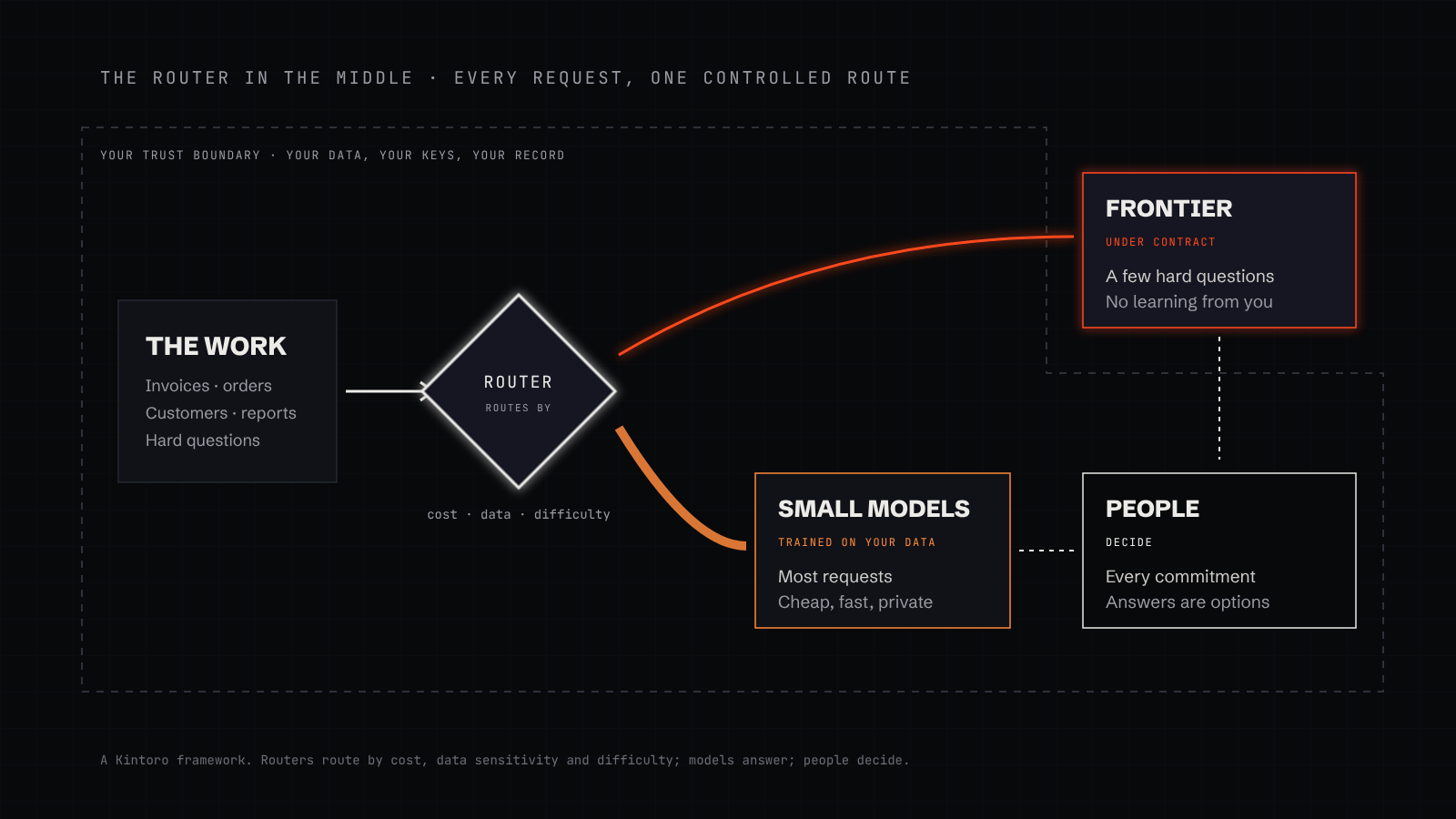
The router is where Nadella’s three concerns meet. It controls cost, by sending routine work to cheap models. It controls compliance, by keeping sensitive data on models inside the company’s walls. And it controls dependence, because a company that can switch models with a configuration change is never hostage to one supplier. Whoever owns the router owns the customer relationship with AI, which is why cloud providers, gateways and the labs themselves all want to own it.
Whoever owns the router owns the enterprise relationship with AI. Make sure it is you.
The Last Moats
03 · Evidence · Nadella · Edelman · Modern Data Company · 2026
Relationships, trust and data
If anyone can rent the same frontier intelligence by the token, intelligence stops being an advantage. What remains are the three things no model provider can sell you.
- Customer relationships. The history, context and goodwill built over years with real customers. A model can draft the email. It cannot be the person the customer has trusted for a decade.
- Trust. Trust in technology companies fell three points worldwide going into 2026, according to the Edelman Trust Barometer. Companies that use AI visibly, explainably and with people accountable will hold trust that their competitors lose.
- Data and learning. Nadella’s point exactly: a company’s records, traces and corrections are what make a model good at its business. A recent survey of more than 540 enterprise data leaders by The Modern Data Company found only 8.4% say their data is trustworthy enough for AI in production, and 65.1% say AI-enabled decisions must be explainable, traceable and defensible. The moat exists, but most companies have not dug it yet.
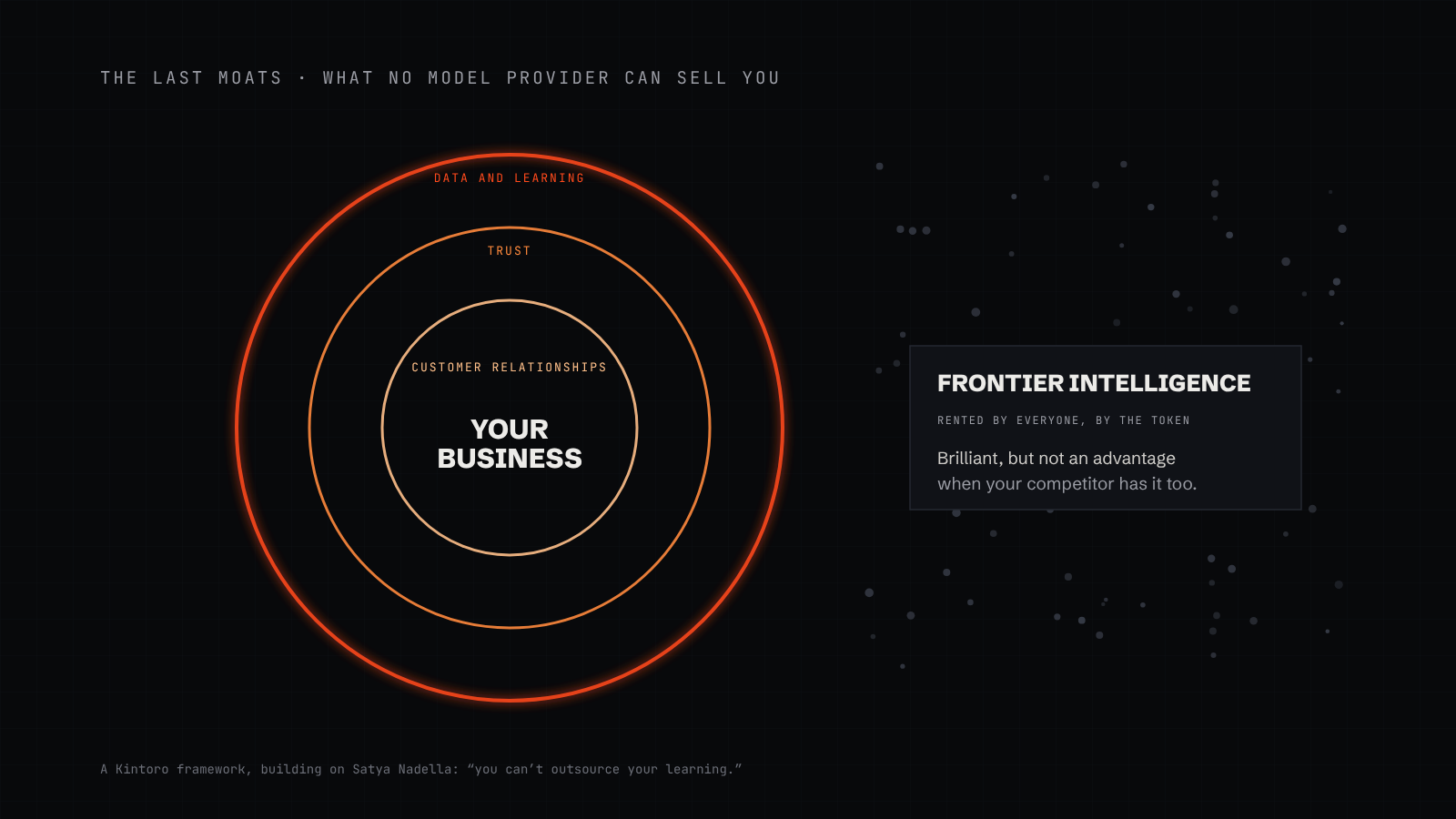
This is why small models matter beyond cost. A small model trained on a company’s own data, running inside its own walls, is the moat made operational. A frontier model is a brilliant outsider. You call it for the questions where an outsider’s breadth helps, and you keep it away from the things that make you you.
What Goes to the Frontier?
04 · Evidence · Financial Times · TechCrunch · HBR · 2026
The consultant test
Here is a useful rule for deciding what to send to a frontier model: route to the frontier the work you would once have hired outside consultants to do. Consultants are paid for breadth, pattern recognition across many companies, and the ability to reason about problems your own data has never seen. That is exactly what frontier models are best at, and what small models trained on your own history are worst at.
The consulting market already feels it. The Financial Times reported in August that clients will spend about $420 billion on technology consultants in 2026, but are pushing back hard: UniCredit cut external consulting spending by 24% in the first half, SharkNinja’s chief executive said the company is “definitely spending less with consultants”, and Commerzbank’s head of AI said consultants “learn more from us than we learn from them”. Start-ups such as DiligenceSquared offer commercial due diligence with AI agents for about $50,000, against $500,000 to $1 million for a traditional engagement, with senior human consultants checking the results. The consultants are adapting too: McKinsey’s chief executive, Bob Sternfels, told Harvard Business Review in January that the firm’s workforce was 40,000 people and 20,000 agents.
As a Kintoro framework, these are the five kinds of work I expect enterprises to route to frontier models:
- Strategy without precedent. Entering a new market, launching a new business line, responding to a competitor’s move. Your data describes your past; these questions are about a future it has not seen.
- Deals and due diligence. Assessing an acquisition, a partner or an investment, where the work is reading widely and fast about someone else’s business.
- Regulation and complex law. Interpreting new rules across jurisdictions, drafting a response to a regulator, reviewing an unusual contract. Breadth and careful reasoning matter more than volume.
- Transformation design. Redesigning an operating model, a system architecture or a pricing structure, where the frontier model brings patterns from thousands of other companies.
- Scenarios and stress tests. Planning for a crisis, a negotiation or a downturn, where you want an outsider to argue with your assumptions.
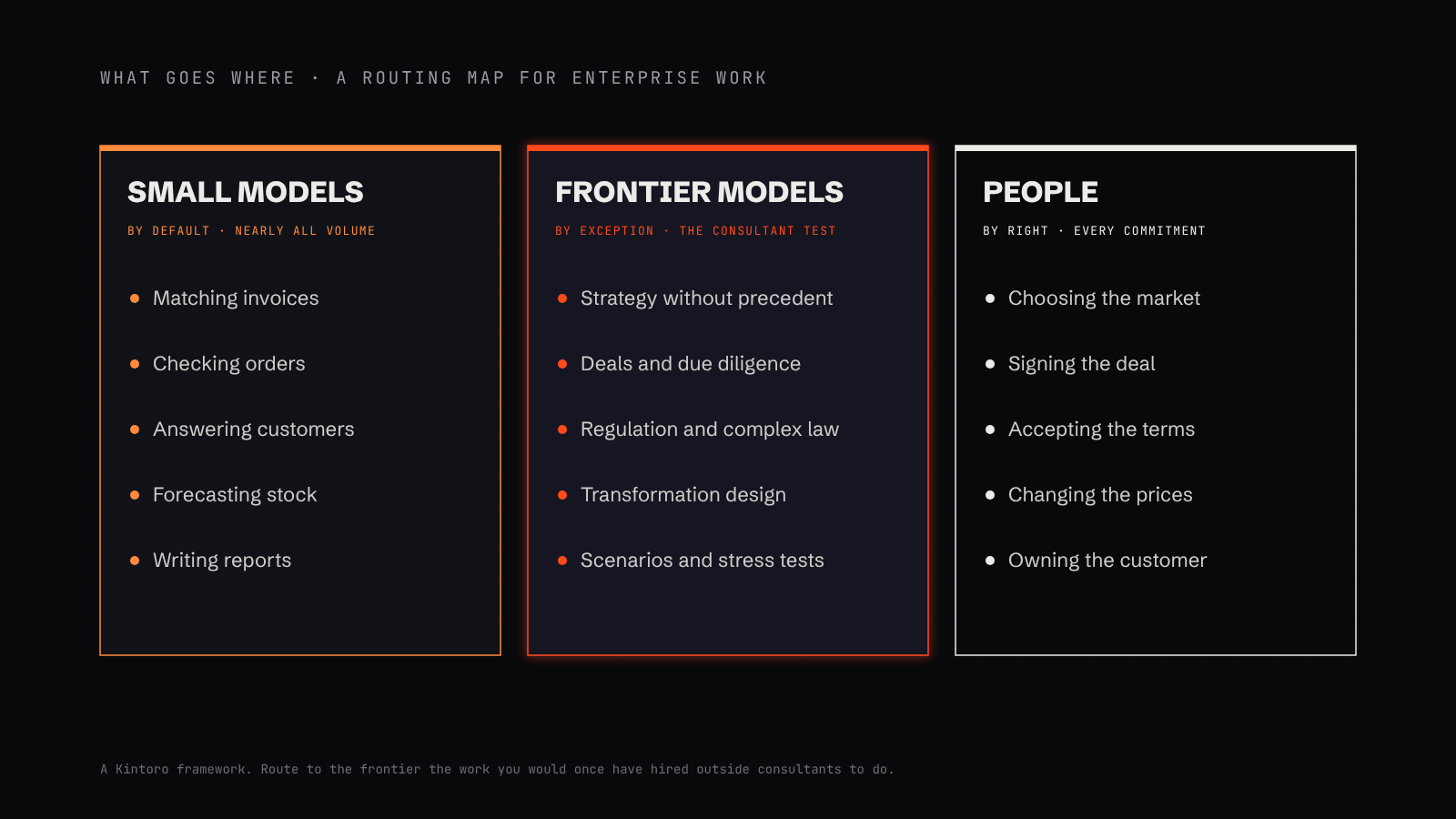
Everything else, which is nearly everything, stays inside: matching invoices, checking orders, answering customers, forecasting stock, writing reports, enforcing policy. That work runs millions of times, depends on your own data, and is where small models are cheaper, faster and safer.
And one category goes to neither. Choosing the market, signing the deal, accepting the regulator’s terms, changing the prices: those are decisions, and they stay with accountable people. The frontier model replaces the consultant’s analysis. It does not replace the client’s judgment.
The routine work goes to small models you own. The rare, hard questions go to the frontier. The decisions stay with people.The central statement
How We Build It into piMonk
05 · Kintoro · piMonk · October 2026
One controlled route. Small models first.
I should declare an interest. At Kintoro we build piMonk, a suite of twelve business applications for mid-market companies, and we made this bet before writing this feature. piMonk runs on servers we own, including machines built to run AI models. Every request to a model goes through one internal model gateway, with a key and a budget for each app, routing either to small models on our own GPU servers or to frontier models.
Small models handle routine, high-volume work; large models handle work that needs deeper reasoning. Our own estimates, published on our infrastructure page in September, put the cost of 1,000 agent actions at about $1 on small models trained for one job, about $2.30 on a mix of 80% small and 20% large models, and about $13 on large general models alone. Some data never goes out at all: piSA, our sales assistant, uses only our own models, so no outside company sees a prospect’s data.
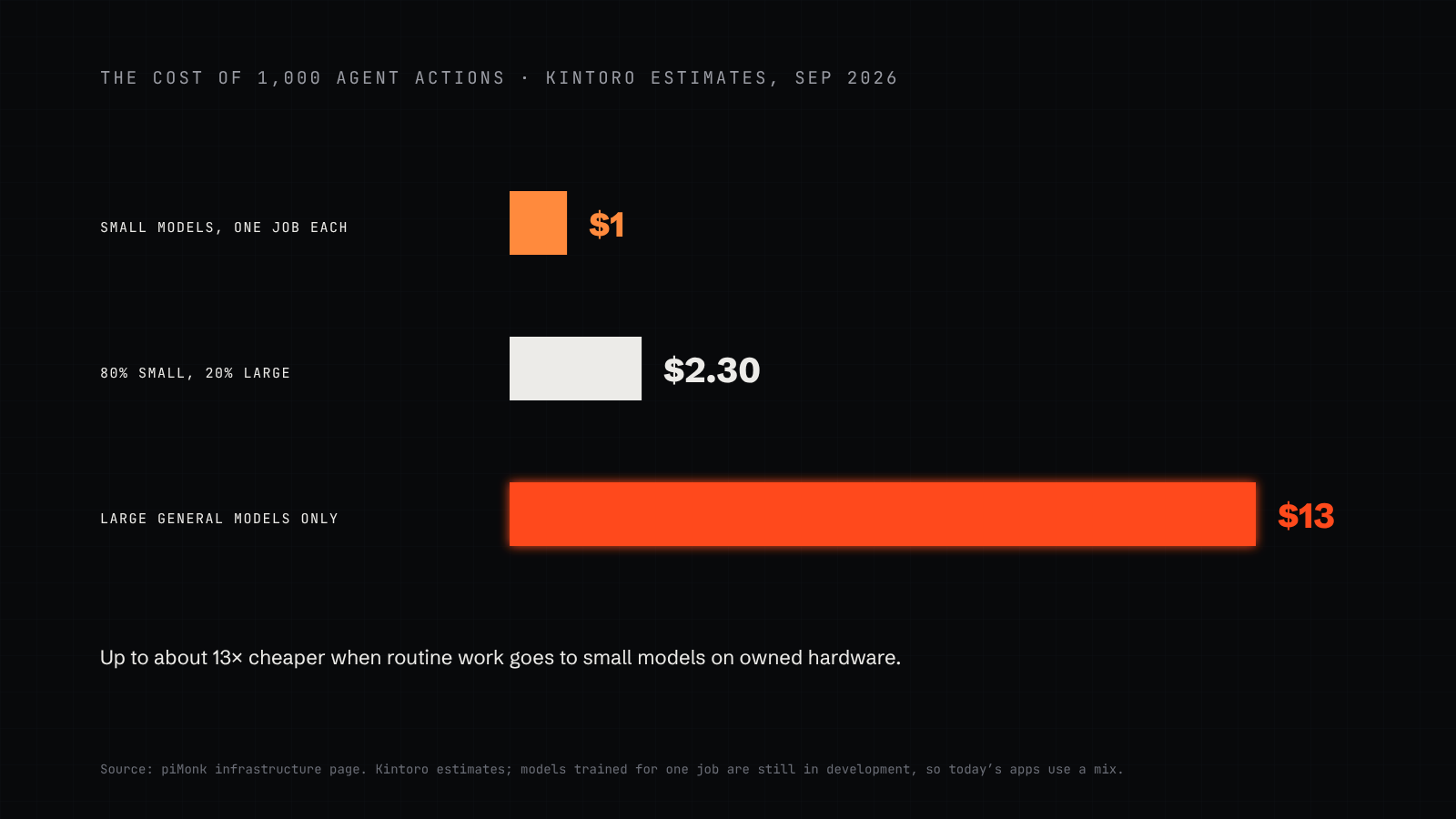
Our trust page puts the moat in four words each: “You own your data.” “Nobody else learns from it. It trains your agents only.” And above all, “People decide. Anything uncertain waits.” I should also be clear about what is not finished. Small models trained for one job are still in development, so today’s apps use a mix. Customers cannot yet choose the region their data lives in. We say both on our own pages.
Five Checkpoints to 2030
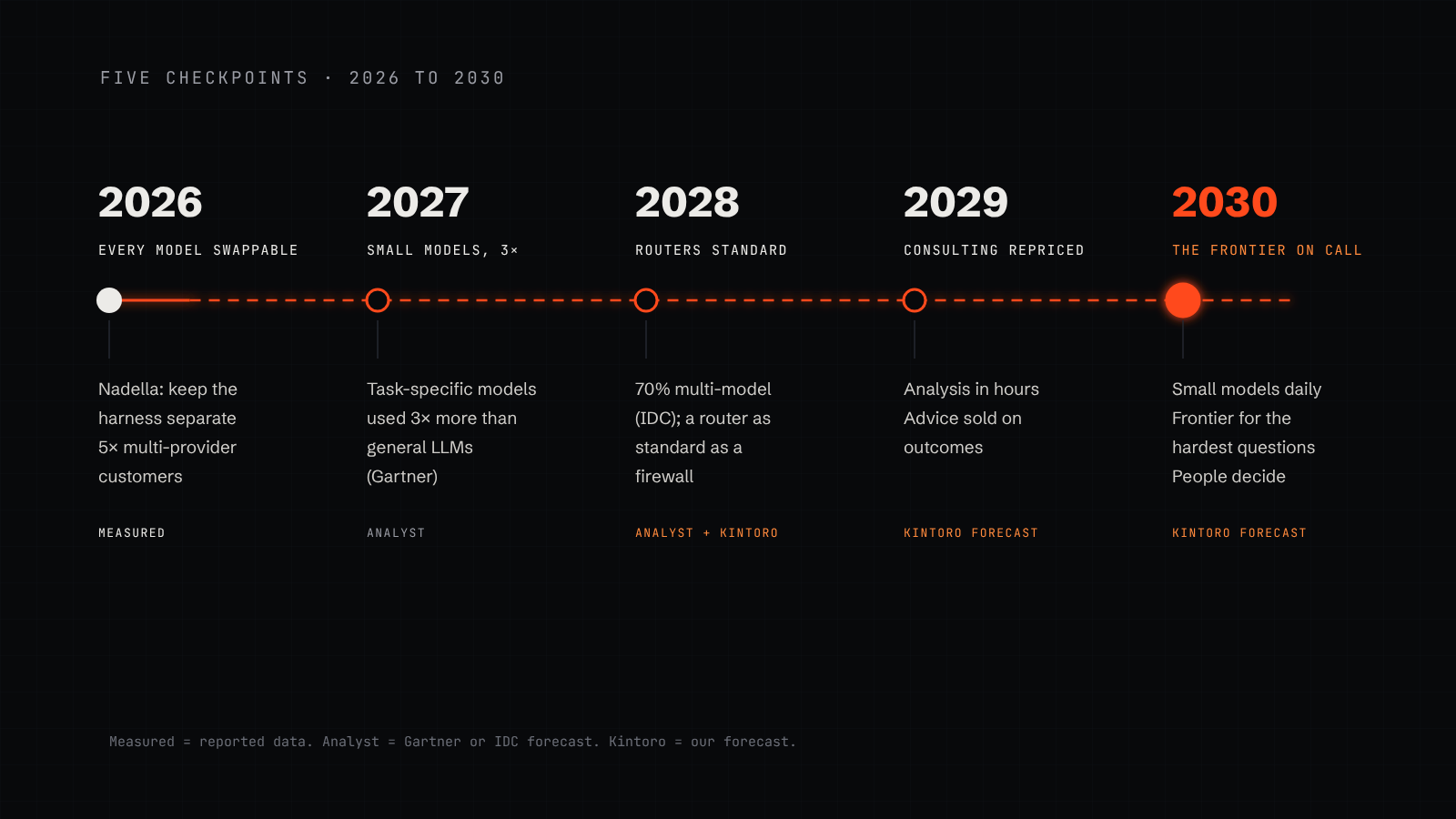
This is how I expect the war to unfold, with each checkpoint marked as measured, forecast by analysts, or forecast by Kintoro.
- 2026
Every model is swappable Measured
Nadella tells investors that any model must be swappable and that customers want the right model for each task. Microsoft’s customers building with multiple model providers grow fivefold. Frontier labs pass tens of billions in revenue, while about 95% of enterprise AI usage still runs on frontier models, according to Glean.
- 2027
Small models, three times over Analyst forecast
Gartner expects organisations to use small, task-specific models at least three times as much as general-purpose models.
- 2028
The router becomes standard Analyst forecast · Kintoro forecast
IDC expects 70% of enterprises actively using AI to take a multi-model approach. My forecast: a model router becomes as standard in a mid-market company’s technology as a firewall, and most requests never reach a frontier model.
- 2029
Consulting is repriced Kintoro forecast
My forecast: much of the analysis consultants used to sell by the hour is done by frontier models in hours, and the consulting that survives is sold on outcomes, advice to leaders and the human work of change.
- 2030
The frontier on call Kintoro forecast
My forecast: enterprises treat frontier models like a panel of top advisers, called through the router for the hardest questions, while small models they own do the daily work and people make every decision that commits the business.
The Business Conclusion
For a mid-market company, this war is good news. You do not need to pick a winner. You need to stay free to use both, and to keep what makes you valuable inside your own walls.
For a business leader, that becomes five moves over the next twelve months:
- Map your AI work by volume and difficulty. Most of it will be routine and high-volume: that is small-model work.
- Put a router or gateway in the middle, under your control, so every model is swappable and every request has a budget and a record.
- Write a frontier policy: which questions may go out, with what data, under contracts that forbid providers from learning from your usage.
- Clean and label your own data, because that is what makes your small models good, and it is the moat nobody can rent.
- Test your consulting spend. For each engagement, ask which part is analysis a frontier model could do, and which part is judgment, relationships and change that needs people.
Then keep the decisions. A company that lets the router send the work to the right model, and keeps every commitment with a named person, gets the best of both armies without surrendering to either.
Small by Default, Frontier by Exception
The frontier labs will keep building astonishing models, and enterprises should use them. But the enterprise war will not be won by the biggest model. It will be won by companies that use intelligence without giving away their learning.
Nadella put it best: you can outsource a task, even a job, but not your learning. At Kintoro, that is how we build piMonk: small models on our own servers for the daily work, frontier models through one controlled route for the hard questions, and people deciding everything that commits the business.
Small by default. Frontier by exception. People by right.
Small by default. Frontier by exception. People by right.
Sources
- https://www.fool.com/earnings/call-transcripts/2026/08/07/microsoft-msft-q4-2026-earnings-call-transcript/,Microsoft FY2026 fourth-quarter earnings call transcript, 29 July 2026 (via The Motley Fool; official transcript at microsoft.com/investor)
- https://snscratchpad.com/posts/reverse-information-paradox/,Satya Nadella, “The Reverse Information Paradox”, SN Scratchpad, 12 July 2026
- https://techcrunch.com/2026/07/13/satya-nadella-has-issued-a-shocking-warning-to-companies-using-ai/,TechCrunch, Julie Bort, on Nadella’s essay, 13 July 2026
- https://tech.yahoo.com/ai/copilot/articles/microsofts-satya-nadella-says-every-084101935.html,Yahoo Tech, “Microsoft’s Satya Nadella says every company should build its own AI model”, 27 June 2026
- https://techcrunch.com/2026/07/29/microsoft-is-openly-competing-with-openai-anthropic-more-than-ever/,TechCrunch, “Microsoft is openly competing with OpenAI, Anthropic more than ever”, 29 July 2026
- https://learn.microsoft.com/azure/foundry/openai/how-to/model-router,Microsoft Learn, “Model router” documentation, last updated 10 September 2026
- https://www.gartner.com/en/newsroom/press-releases/2025-04-09-gartner-predicts-by-2027-organizations-will-use-small-task-specific-ai-models-three-times-more-than-general-purpose-large-language-models,Gartner, small task-specific AI models prediction, 9 April 2025
- https://ppc.land/nvidia-research-challenges-57-billion-ai-infrastructure-strategy-with-small-language-models/,PPC Land, on NVIDIA Research, “Small Language Models are the Future of Agentic AI” (Belcak et al., June 2025), 4 August 2025
- https://openrouter.ai/state-of-ai,OpenRouter and a16z, “State of AI 2025”, December 2025
- https://menlovc.com/perspective/2025-the-state-of-generative-AI-in-the-enterprise/,Menlo Ventures, “2025: The State of Generative AI in the Enterprise”, 9 December 2025
- https://the-decoder.com/anthropic-increases-revenue-sevenfold-hits-annualized-rate-above-65-billion/,The Decoder, on Bloomberg’s report of Anthropic’s annualised revenue, 18 August 2026
- https://www.pymnts.com/news/artificial-intelligence/2026/openai-targets-enterprise-market-with-new-ai-agent-platform/,PYMNTS, on OpenAI’s Frontier enterprise platform, February 2026
- https://finance.yahoo.com/news/openai-deepens-partnerships-consulting-giants-133507621.html,Reuters via Yahoo Finance, on OpenAI’s Frontier Alliance with McKinsey, BCG, Accenture and Capgemini, 23 February 2026
- https://letsdatascience.com/news/model-routing-squeezes-openai-and-anthropic-revenue-3e0f827a,Let’s Data Science, summarising CNBC, “Model routing is a fix for AI overspending. That’s a problem for OpenAI and Anthropic”, 5 June 2026
- https://lmsys.org/blog/2024-07-01-routellm/,LMSYS, “RouteLLM: An Open-Source Framework for Cost-Effective LLM Routing”, 1 July 2024
- https://biz.heraldcorp.com/article/10861105,The Herald Business, on multi-model routing, citing IDC and Gartner, 3 September 2026
- https://semafor.com/article/02/11/2026/trust-in-tech-companies-dropped-globally-in-2026-report,Semafor, on the 2026 Edelman Trust Barometer, 11 February 2026
- https://itbrief.com.au/story/ai-agents-outpace-trust-in-enterprise-data-survey-finds,IT Brief, on The Modern Data Company’s survey of enterprise data leaders, 21 August 2026
- https://www.irishtimes.com/business/2026/08/31/consultants-head-for-a-showdown-with-their-own-clients/,Financial Times via The Irish Times, “Consultants head for a showdown with their own clients as AI upends industry”, 31 August 2026
- https://techcrunch.com/2026/03/05/diligencesquared-uses-ai-voice-agents-to-make-ma-research-affordable/,TechCrunch, Marina Temkin, on DiligenceSquared, 5 March 2026
- https://www.hcamag.com/nz/news/general/mckinsey-trials-ai-led-job-interviews-as-20000-ai-agents-reshape-its-workforce/562019,HCAMag, on Bob Sternfels’ HBR interview: 40,000 people and 20,000 agents, 15 January 2026
- https://pimonk.com/platform/infrastructure/,piMonk, Private AI infrastructure page, including Kintoro cost estimates (September 2026), accessed 25 October 2026
- https://pimonk.com/platform/architecture/,piMonk, Architecture page, accessed 25 October 2026
- https://pimonk.com/trust/,piMonk, Trust centre, accessed 25 October 2026
See the idea working in piMonk
piMonk is the AI company we built on this thinking: agents do the work, people keep the decisions. Try the app this piece points to, or book a demo.
Book a demo