

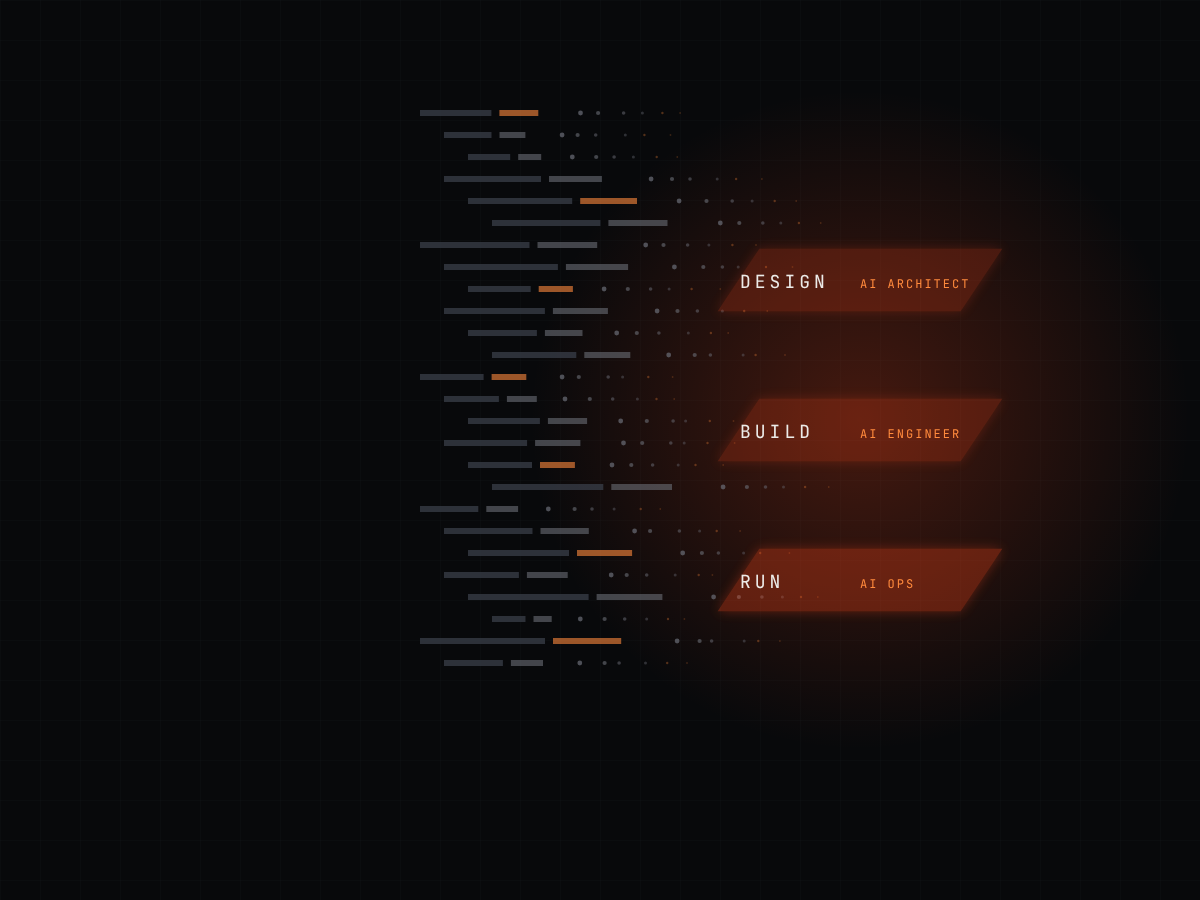
Scenario · Tuesday, 12 March 2030 · A forecast, not a report
At 9:00, a six-person product team at a mid-market distributor reviews what happened overnight. Its coding agents opened 41 changes to the order system. Thirty-six passed every test and were merged. Five were held back for a human to look at.
Ana, the team’s AI architect, spends the morning on one question: whether the new returns agent should be allowed to issue refunds above €500 on its own. The answer is no, and she writes the rule into the system. Tom, an AI engineer, rewrites the agent’s instructions and adds forty new test cases. Mei, who runs AI Ops, traces a jump in model costs to a single runaway workflow and switches it to a cheaper model before lunch.
Nobody on the team wrote much code that day. All three of them are software engineers.
The team is fictional, and so is 2030. Everything else in this feature is built from what can be measured today, in October 2026, and from the history of how software jobs have been renamed before. Where I forecast, I say so.
For seventy years, the job of a software engineer has been described by its output: code. In 2026, that description stopped working.
At Google, AI now generates about three-quarters of new code. At Anthropic, its chief financial officer says the figure is above 90%. Yet the US Bureau of Labor Statistics still expects software developer jobs to grow by 10% over the next decade. Both things are true, because the job was never really the code. AI is now making that visible, and new titles are forming around what remains: the AI architect, the AI engineer and AI Ops.
Where We Stand: October 2026
01 · Measure · Stack Overflow · Google DORA · company statements · 2025 to 2026
Everyone codes with AI. Almost nobody trusts it alone.
Google’s DORA research team found in 2025 that 90% of software professionals use AI at work, with the median user spending about two hours a day with it. Stack Overflow’s 2026 Developer Survey, published this month with more than 30,000 responses from 169 countries, found 66% using coding assistants or agents and 26.2% running automated agent workflows. Seven in ten turn to an AI agent first when they hit a technical problem.
Trust has not kept up. Nearly half of Stack Overflow’s respondents trust AI when they can check its work. Only 6.6% would trust it with an important decision. In DORA’s survey, 30% trusted AI-generated output a little or not at all.
Inside the companies building AI, the share of code it writes has climbed fast. Google reported about 25% of new code in October 2024, about half by autumn 2025 and about 75% in April 2026. Microsoft’s chief executive put it at “maybe 20 to 30 percent” in some projects in April 2025. These numbers are not directly comparable: some count new code, some all code and some only certain projects. The direction is not in doubt.
Software, written with AI, 2026
- 90%of software professionals use AI at work; median about two hours a dayGoogle DORA, 2025
- 66%of developers use coding assistants or agents; 26.2% run automated agent workflowsStack Overflow Developer Survey, Oct 2026
- ~75%of new code at Google is AI-generated, up from about 25% in October 2024Company statement, April 2026
- 6.6%of developers would trust AI with an important decisionStack Overflow Developer Survey, Oct 2026
02 · Market · Indeed · LinkedIn · BLS · Stanford · 2026
The job market is splitting by level, not disappearing
The hiring data shows the same split from another angle. Indeed Hiring Lab found that in the first quarter of 2026, 69.3% of US software development postings were for senior roles and just 4.5% for entry-level ones. Stanford’s 2026 AI Index reports that employment of US software developers aged 22 to 25 has fallen nearly 20% since 2024, while older developers kept growing.
At the same time, LinkedIn named AI engineer the fastest-growing job in the US in January 2026. The Financial Times reported that postings for forward-deployed engineers, who build AI systems inside customers’ businesses, rose more than 800% in the first nine months of 2025. And the BLS projects that computer programmer jobs, the narrowest code-writing role, will fall 7% from 2025 to 2035 as AI automates routine programming, while software developer jobs grow 10%.
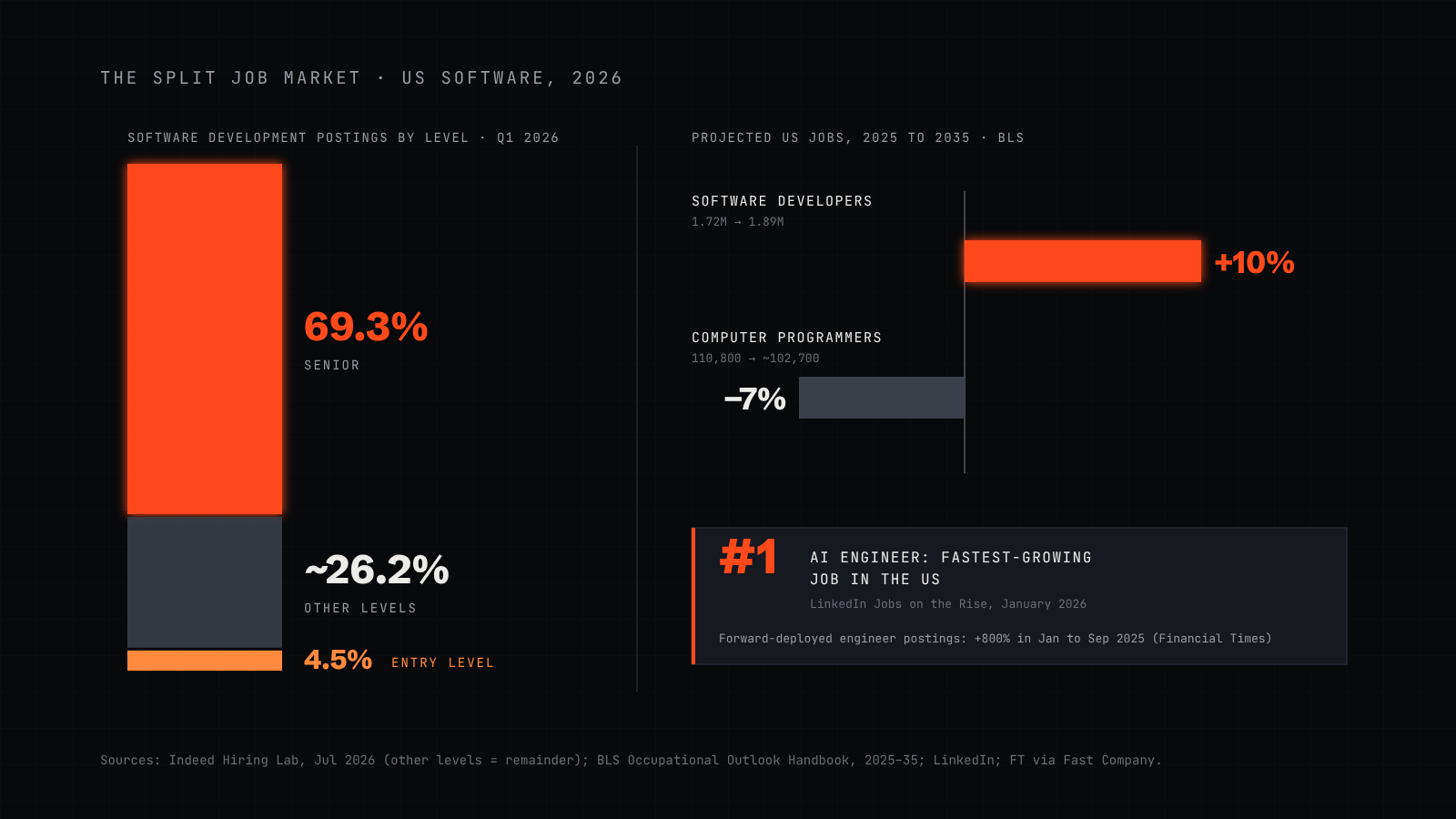
The market is not paying less for software. It is paying for a different part of it.
Code got cheap. Correctness didn’t.
Every Era Renamed the Job
This is not the first time the software job has been renamed. In the 1950s, “programmers” translated flowcharts into machine instructions, often on punched cards. In 1968, a NATO conference in Garmisch popularised the term “software engineering”, because building large systems needed discipline, not just coding. The web brought the web developer; the cloud brought DevOps around 2009 and Google’s site reliability engineering, which began in 2003 and went public in a 2016 book. In 2012, Harvard Business Review called data scientist “the sexiest job of the 21st century”. By the late 2010s, MLOps had appeared to run machine learning in production.
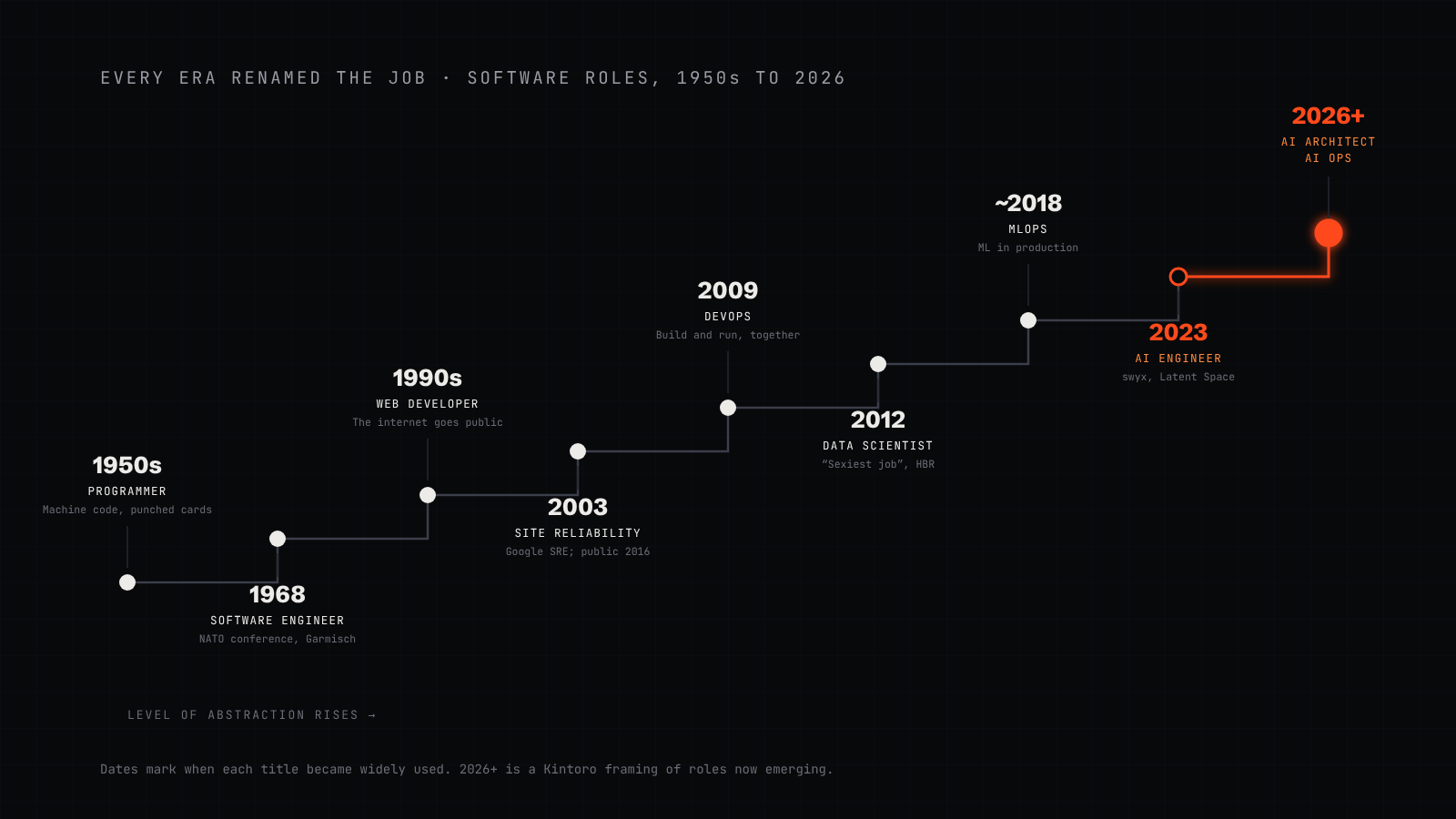
Each wave moved the work up a level. Engineers stopped managing memory by hand, then stopped racking servers, then stopped configuring them. Each time, people predicted fewer software jobs. Each time, cheaper software created more demand for it, and the number of jobs grew.
The “AI engineer” got its name in June 2023, when Shawn Wang, known as swyx, published “The Rise of the AI Engineer”. His argument was that work that once needed a research team could now be done by a software engineer with an API key. Gartner followed in October 2024, calling the AI engineer “a new breed of software professional” who combines software development, data science and machine learning. In a Gartner survey of 300 US and UK organisations, 56% of software engineering leaders had already named AI and machine learning engineer the most in-demand role for 2024.
Every generation of software engineers was told the machines would replace them. Every generation got promoted instead.Kintoro
What the Three Roles Actually Mean
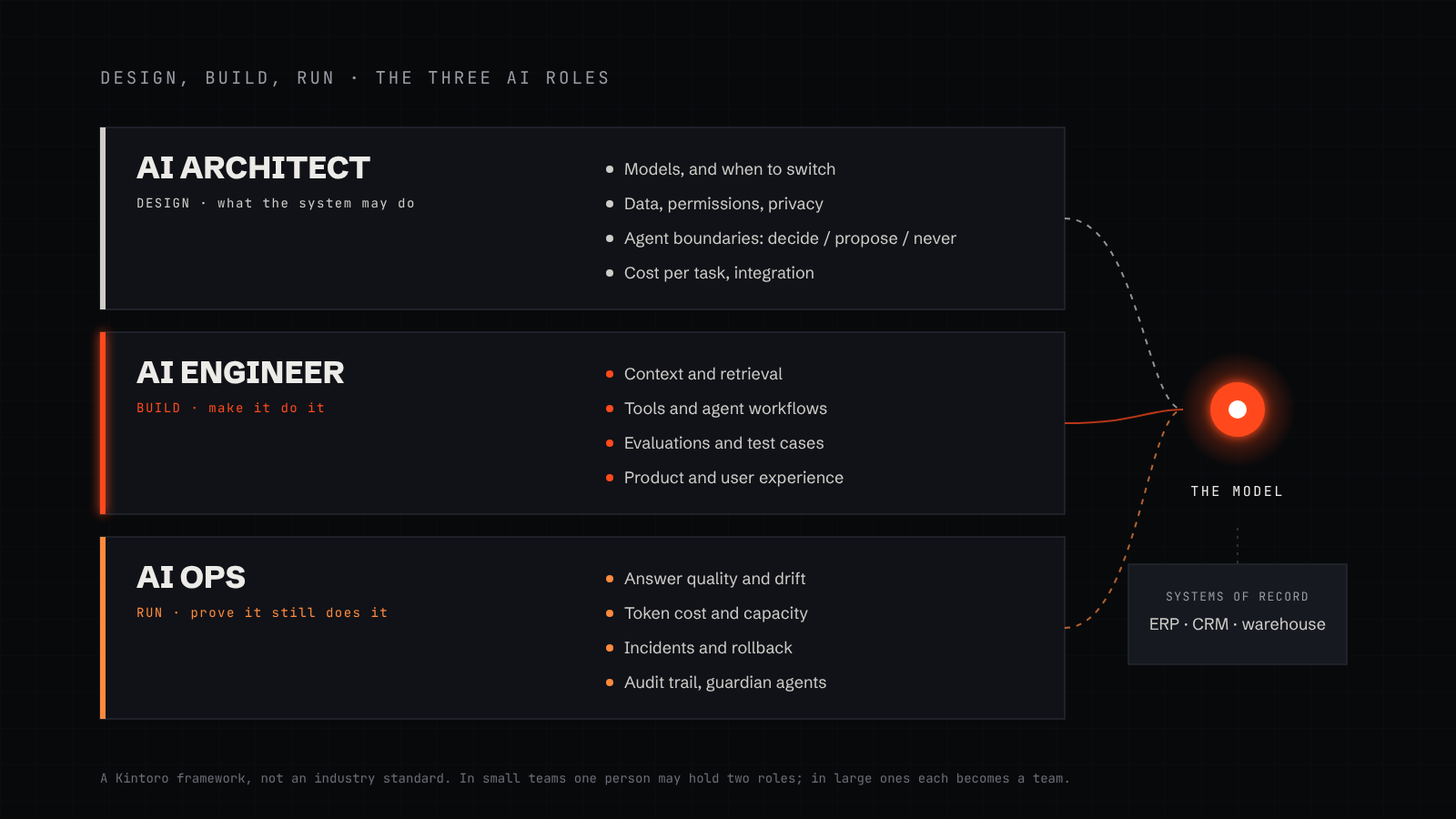
The new titles are used loosely, and they overlap. Here is how I would define them, as a Kintoro framework rather than an industry standard. Think of any AI system as three layers wrapped around a model: someone designs it, someone builds it and someone runs it.
A · Role 01 · Evolves from solutions architect, enterprise architect, tech lead
The AI architect: designs the system and its boundaries
What it is: the person who decides how an AI system fits into the business. Which models to use, and when to switch. Where the data lives and who may see it. Which actions an agent may take on its own, which need a human to approve, and which it may never touch. How much each task may cost. How it connects to the finance system, the CRM and the warehouse. What it is not: a diagram-drawer who never ships. The architect owns the decisions that are expensive to reverse.
Why it matters now: the system around the model is where most of the risk sits. Gartner predicts that 70% of AI applications will use multi-agent systems by 2028. Each extra agent multiplies the number of decisions about permissions, data and failure. In Feature 03, we called this the decision map. The AI architect is the person who draws it.
E · Role 02 · Evolves from backend, full-stack and product engineer
The AI engineer: builds with models, context, tools and evaluations
What it is: a software engineer whose raw materials include models. AI engineers build the product: the retrieval that gives a model the right context, the tools it can call, the agent workflows, and above all the evaluations, the test cases that prove the system works. LinkedIn lists RAG, LangChain and PyTorch among the top skills. What it is not: a machine learning engineer, who trains models, or a prompt engineer. Prompt writing is a small part of the job, and is rarely a job title on its own anymore.
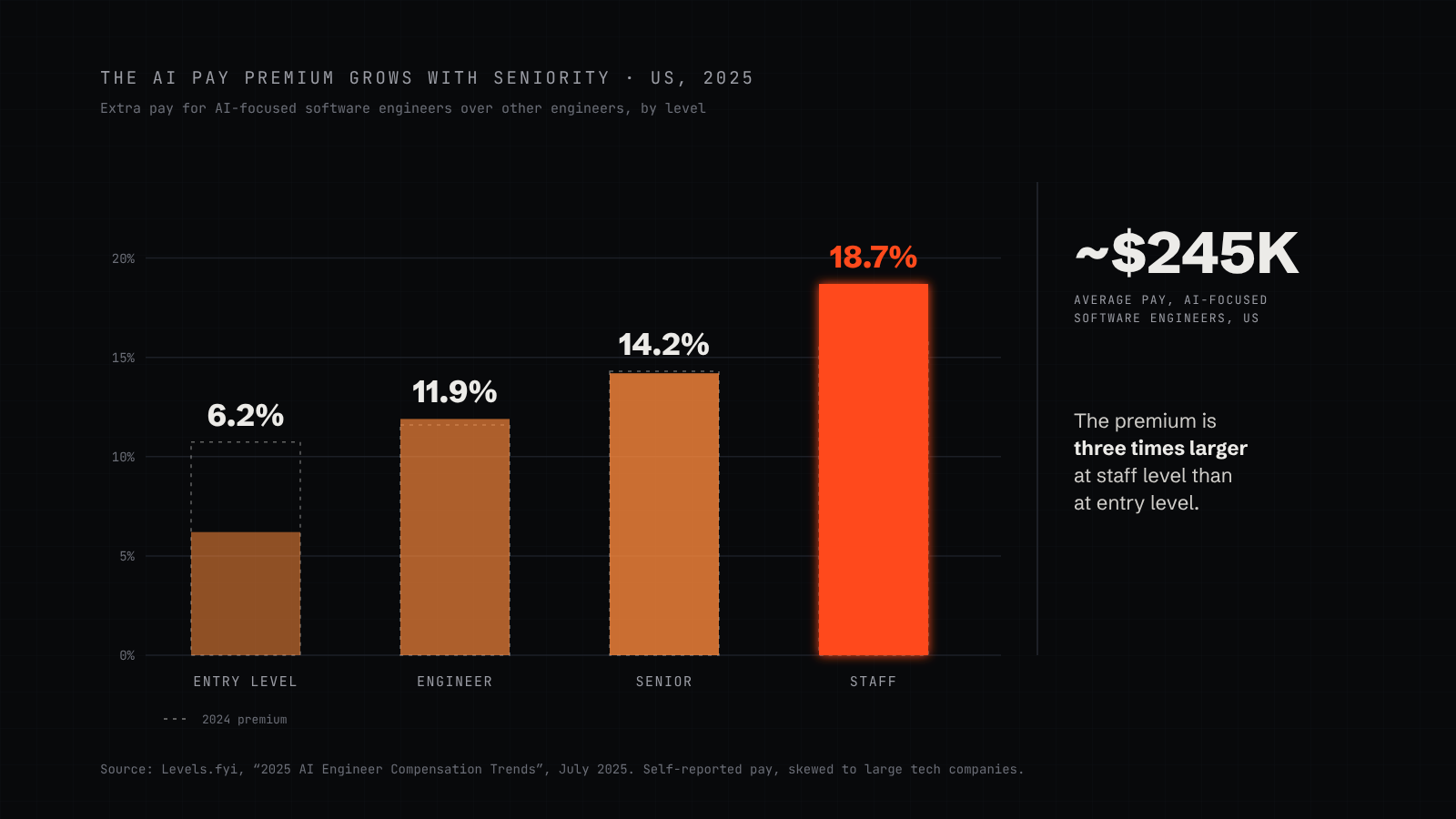
Why it matters now: the AI engineer is where most software developers are heading. Gartner expects generative AI to require 80% of the engineering workforce to upskill through 2027. The premium for making the move is real but not huge at entry level: Levels.fyi found AI-focused engineers earned 6.2% more than other engineers at entry level in 2025, rising to 18.7% at staff level.
O · Role 03 · Evolves from DevOps, SRE, MLOps, QA and IT operations
AI Ops: runs, measures and governs AI in production
What it is: the people who keep AI systems working, affordable and honest after launch. They watch quality, not just uptime: whether answers are still right, whether an agent is drifting, whether a model update broke something. They manage the token bill, the incident response and the audit trail. A naming warning: since 2016 to 2017, Gartner has used “AIOps” to mean using AI to run IT operations. The new AI Ops is the reverse, operations for AI. By 2030 the two meanings merge, because AI systems will increasingly be run with the help of other AI systems.
Why it matters now: trust is the bottleneck, and AI Ops is how trust gets earned. Gartner predicts that “guardian agents”, AI that monitors and can block other AI, will make up 10 to 15% of the agentic AI market by 2030. In Europe, the AI Act’s obligations for high-risk systems, including logging and human oversight, apply from 2 December 2027. Someone has to produce the evidence. That someone is AI Ops.
The architect decides what the system may do. The engineer makes it do it. AI Ops proves it is still doing it.
What the Work Becomes
The best view of where all three roles are heading comes from inside an AI lab. In December 2025, Anthropic published a study of its own engineers: a survey of 132 engineers and researchers, 53 interviews, and about 200,000 internal Claude Code sessions. Staff reported using Claude in about 59% of their work, up from 28% a year earlier, and a self-reported productivity gain of about 50%. Merged pull requests per engineer per day rose 67% after Claude Code was rolled out.
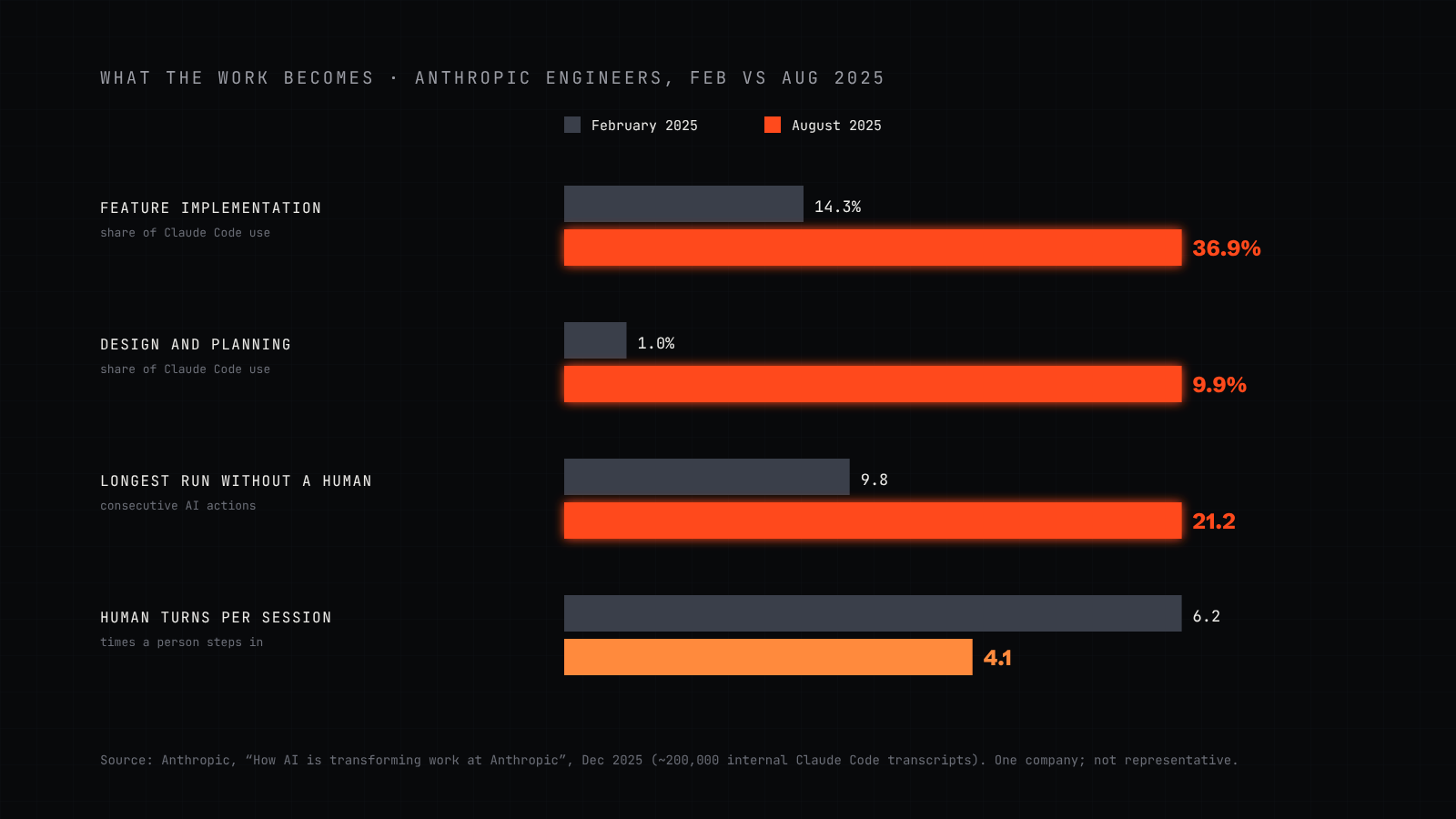
The shape of the work changed more than the volume. Between February and August 2025, the share of Claude Code use for implementing features rose from 14.3% to 36.9%, and for design and planning from 1.0% to 9.9%. The longest run of actions the AI took without a human rose from about 10 to 21, while human turns per session fell by a third. One engineer estimated their own work had shifted “70%+” towards reviewing and revising code rather than writing it.
There is a warning in the same study. Most staff said they could fully delegate only 0 to 20% of their work, and several worried about what Anthropic’s researchers called a “paradox of supervision”: checking an AI’s work needs exactly the deep coding skill that people may stop practising. The research group METR adds another caution. Its 2025 trial found experienced open-source developers were 19% slower with AI tools. Its February 2026 update said speed-ups now seem likely, but that its data had become unreliable, partly because developers refused to work without AI.
Writing code is becoming the easy part. Knowing what to build, and proving it works, is the job.
More Skill, or Less?
For the narrow task of writing code, AI lowers the skill needed. A beginner with an agent can produce in an afternoon what took a team a week in 2020. For the job of software engineering, the bar is going up. Each of the three roles demands what used to be senior skills: systems thinking, security, cost awareness, the ability to write a good test and the judgment to reject a plausible but wrong answer.
That is why the hiring data tilts towards seniority, and why the Levels.fyi premium is largest at staff level. It is also why Gartner expects smaller teams: it says 60% of organisations will shrink their software engineering teams by 2029, into units of perhaps two to six people with at least one “AI-native” engineer. The number of teams may stay the same or grow, because demand for software keeps rising.
My forecast, clearly marked as one: by 2030, “can you code?” becomes a screening question, like “can you type?”. The questions that decide hiring become “can you design a system an agent can safely work in?”, “can you prove it works?” and “can you run it at a cost the business can afford?”. Those map onto the three roles.
In 2030, nobody will ask an engineer how much code they wrote. They will ask what their agents shipped, and how they know it works.The central question
Five Checkpoints to 2030
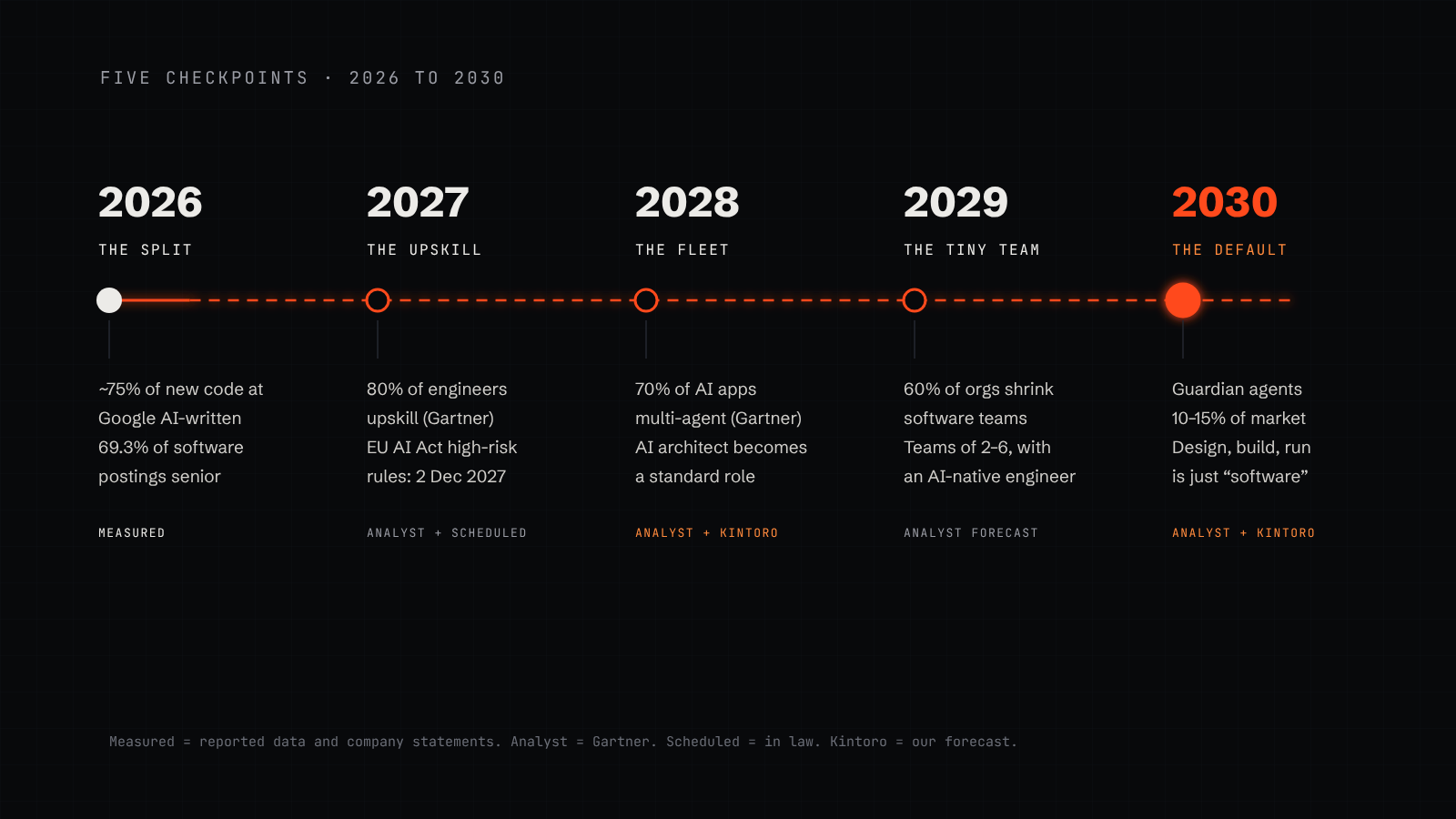
This is the path I expect, with each checkpoint marked as measured today, forecast by analysts, or forecast by Kintoro.
- 2026
The split Measured
AI generates about 75% of new code at Google and more than 90% at Anthropic, by company statements. 90% of software professionals use AI. AI engineer is the fastest-growing US job on LinkedIn, and 69.3% of software postings are senior. Only 6.6% of developers trust AI with important decisions.
- 2027
The upskill Analyst forecast · Scheduled · Kintoro forecast
Gartner’s window for 80% of engineers to upskill closes. The EU AI Act’s high-risk obligations apply from 2 December 2027, turning AI Ops into a compliance function as well as a technical one. My forecast: most job ads for backend developers list AI engineering skills, and “AI engineer” starts to fade as a separate title.
- 2028
The fleet Analyst forecast · Kintoro forecast
Gartner expects 70% of AI applications to use multi-agent systems. Companies run fleets of agents, not single assistants, and the AI architect becomes a standard role in any company with more than a handful. My forecast: agent observability and evaluation become as routine as application monitoring is today.
- 2029
The tiny team Analyst forecast
Gartner expects 60% of organisations to have shrunk their software engineering teams, into units of two to six people with at least one AI-native engineer, product skills built in and designers for “agent experience”. The number of teams holds or grows.
- 2030
The default Analyst forecast · Kintoro forecast
Guardian agents make up 10 to 15% of the agentic AI market, Gartner predicts. My forecast: architect, engineer and AI Ops are no longer “AI” roles. They are simply how software teams are organised, and “AI engineer” sounds as dated as “web developer”.
The Career Map
For people already in software, the three roles are not a cliff. They are the next step from jobs that exist today.
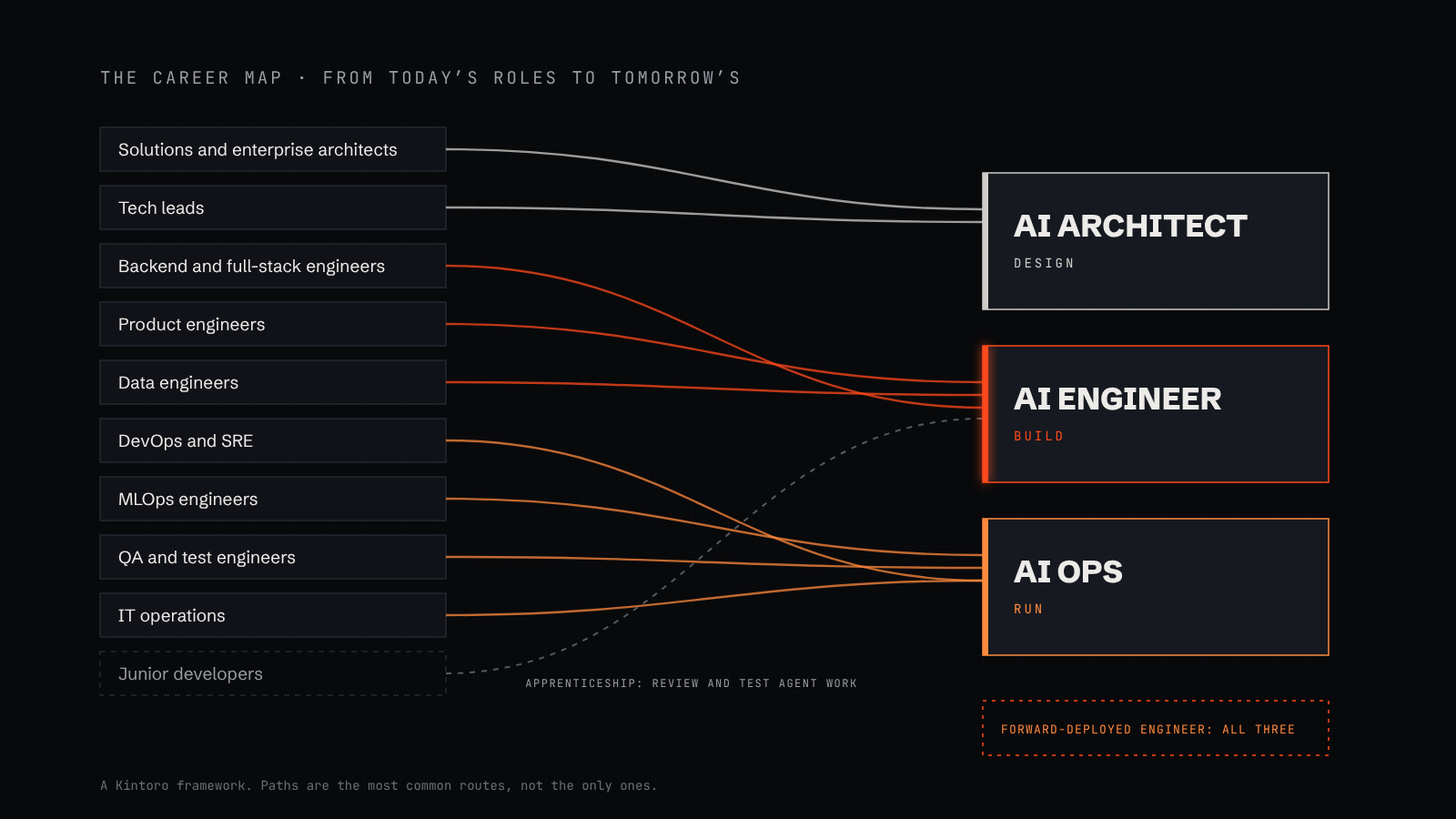
- Architects and tech leads → AI architect. Add model selection, data permissions, agent boundaries and cost design to the system design you already do.
- Backend, full-stack and data engineers → AI engineer. Learn retrieval, tool use, agent workflows and, above all, evaluations. The engineers who write the best tests will build the best agents.
- DevOps, SRE, MLOps and QA → AI Ops. Extend monitoring from uptime to answer quality, add token cost to your dashboards, and own the audit trail.
- Forward-deployed engineers → all three. The FDE, the subject of Feature 02, is the generalist who does all three inside a customer’s business.
- Junior developers → apprenticeship. The entry rung is narrowest here, as Feature 04 showed. The best route in is to review and test agent output under a senior engineer, which is how the next AI architects will learn.
The Business Conclusion
So what does the evolution of software jobs actually mean? My answer, as a forecast, is that software engineering is not shrinking into prompt-writing. It is growing up into system design, agent building and operational governance. Companies that treat AI as a way to need fewer engineers will save money for a year. Companies that treat it as a way for each engineer to do more, more safely, will build a lead that is hard to close.
For a business leader, that becomes five moves over the next eighteen months:
- Name the three roles, even if one person holds two of them. Someone must own the design, the build and the running of every AI system.
- Make evaluations a first-class product. Every agent needs test cases that run before every change, the way code needs tests.
- Put AI Ops on the bill. Track answer quality, agent errors and token cost per task, not just uptime.
- Retrain before you replace. Your backend, DevOps and QA people already know your systems; that is the hardest part to hire.
- Keep an apprentice path. Hire juniors to review and test agent work under senior engineers, or you will have no architects in 2032.
None of this requires waiting for better models. All of it gets harder the more code your agents write without it.
Nobody Says “Web Developer” Anymore
In 2000, “web developer” was a hot new job title. Today almost every developer builds for the web, and the title sounds quaint. “AI engineer” is on the same path. In a few years, every software engineer will work with models, and the word “AI” will drop out of the job title.
At Kintoro, that is how we build piMonk: AI agents handle routine work inside the systems that run the business, while people keep control of the decisions that commit it. That is the same split as the three roles. Someone designs what agents may do, someone builds them well, and someone makes sure they keep doing it.
The code writes itself now. Deciding what it should do, and proving that it does, is still a job. It may be the best job in software.
The code writes itself. The judgment doesn’t.
Sources
- https://stackoverflow.co/company/press/archive/stack-overflow-annual-developer-survey-ai-trust-conditional,Stack Overflow, “2026 Developer Survey Reveals Positive Sentiment Towards AI, but Trust Remains Conditional”, 6 October 2026 (30,000+ responses, 169 countries)
- https://www.techrepublic.com/article/news-dora-ai-report-2025/,TechRepublic, on Google DORA, “2025 State of AI-assisted Software Development”, 23 September 2025 (5,000+ technology professionals)
- https://provenbrief.com/story/the-ai-code-share-tracker-every-verified-public-number-on-ai-written-code-from-n,ProvenBrief, “The AI code share tracker”, 2026 (compiling company statements by Google, Microsoft, Anthropic and others; secondary)
- https://www.techspot.com/news/112408-anthropic-more-than-90-code-now-written-ai.html,TechSpot, “Anthropic says more than 90% of its code is now written by AI”, 14 May 2026 (Krishna Rao, Invest Like the Best)
- https://hiringlab.indeed.com/2026/07/23/the-labor-market-is-tilting-toward-seniority/,Felix Aidala and Sneha Puri, “The Labor Market Is Tilting Toward Seniority”, Indeed Hiring Lab, 23 July 2026
- https://community.xcelerator.siemens.com/en/public/blogs/stanfords-2026-ai-index-what-the-numbers-actually-say-2026-04-23,Siemens Xcelerator Community, “Stanford’s 2026 AI Index: what the numbers actually say”, 23 April 2026 (summary of Stanford HAI, AI Index 2026)
- https://careerdesignstudio.buffalo.edu/blog/2026/03/31/ai-related-jobs-top-linkedins-fastest-growing-roles-list-for-2026/,University at Buffalo Career Design Studio, “AI-related jobs top LinkedIn’s fastest-growing roles list for 2026”, March 2026 (on LinkedIn Jobs on the Rise, January 2026)
- https://www.fastcompany.com/91435680/postings-for-this-ai-job-are-up-800,Sarah Bregel, “Postings for this AI job are up 800%”, Fast Company, 5 November 2025 (citing the Financial Times)
- https://www.bls.gov/ooh/computer-and-information-technology/software-developers.htm,US Bureau of Labor Statistics, Occupational Outlook Handbook: Software Developers, Quality Assurance Analysts, and Testers (projections 2025 to 2035), accessed 24 October 2026
- https://www.bls.gov/ooh/computer-and-information-technology/computer-programmers.htm,US Bureau of Labor Statistics, Occupational Outlook Handbook: Computer Programmers (projections 2025 to 2035), accessed 24 October 2026
- http://homepages.cs.ncl.ac.uk/brian.randell/NATO/,Brian Randell, archive of the NATO Software Engineering Conferences, Garmisch 1968 and Rome 1969
- https://sre.google/sre-book/introduction/,Google, “Site Reliability Engineering”, introduction by Benjamin Treynor Sloss (O’Reilly, 2016)
- https://hbr.org/2012/10/data-scientist-the-sexiest-job-of-the-21st-century,Thomas H. Davenport and D.J. Patil, “Data Scientist: The Sexiest Job of the 21st Century”, Harvard Business Review, October 2012
- https://www.ai.engineer/about,AI Engineer, “About” (history of Shawn Wang’s “The Rise of the AI Engineer”, June 2023, and the AI Engineer Summit)
- https://www.gartner.com/en/newsroom/press-releases/2024-10-03-gartner-says-generative-ai-will-require-80-percent-of-engineering-workforce-to-upskill-through-2027,Gartner, “Gartner Says Generative AI will Require 80% of Engineering Workforce to Upskill Through 2027”, 3 October 2024
- https://www.levels.fyi/blog/ai-engineer-compensation-trends-q3-2025.html,Levels.fyi, “2025 AI Engineer Compensation Trends”, 17 July 2025
- https://www.gartner.com/en/newsroom/press-releases/2025-06-11-gartner-predicts-that-guardian-agents-will-capture-10-15-percent-of-the-agentic-ai-market-by-2030,Gartner, “Gartner Predicts that Guardian Agents will Capture 10–15% of the Agentic AI Market by 2030”, 11 June 2025
- https://www.devclass.com/ai-ml/2018/06/05/aiops-they-did-it-again-played-with-your-heart-new-acronym-shame/1620702,DevClass, on Gartner’s change of AIOps from “algorithmic IT operations” to “AI for IT operations”, 5 June 2018
- https://fpf.org/blog/the-ai-act-implementation-timeline-what-changes-under-the-ai-omnibus/,Future of Privacy Forum, “The AI Act implementation timeline: What changes under the AI Omnibus?”, 2026
- https://www.anthropic.com/research/how-ai-is-transforming-work-at-anthropic,Anthropic, “How AI is transforming work at Anthropic”, 2 December 2025 (survey of 132 staff, August 2025; 53 interviews; ~200,000 Claude Code transcripts)
- https://metr.org/blog/2025-07-10-early-2025-ai-experienced-os-dev-study/,METR, “Measuring the Impact of Early-2025 AI on Experienced Open-Source Developer Productivity”, 10 July 2025
- https://metr.org/blog/2026-02-24-uplift-update/,METR, “We are Changing our Developer Productivity Experiment Design”, 24 February 2026
- https://www.itpro.com/software/development/nearly-two-thirds-of-enterprises-could-reduce-software-engineering-teams-by-2029-but-tiny-teams-wont-be-a-disaster-for-engineers,Ross Kelly, on Gartner’s forecast of smaller software engineering teams by 2029, ITPro, 14 July 2026
- https://www.ivanturkovic.com/2026/04/24/ai-job-titles-2026-naming-chaos/,Ivan Turkovic, “AI Job Titles in 2026: A CTO’s Guide to the Naming Chaos”, 24 April 2026
See the idea working in piMonk
piMonk is the AI company we built on this thinking: agents do the work, people keep the decisions. Try the app this piece points to, or book a demo.
Book a demo