

Scenario · Tuesday, 13 November 2029 · A forecast, not a report
The finance director of a 400-person engineering firm opens her laptop to a message her treasury agent prepared overnight. The company has held a small amount of bitcoin on its balance sheet since 2025. A major wallet provider has just switched on quantum-resistant addresses, and the agent has done the homework: which of the company’s coins sit in addresses whose public keys are already visible on the blockchain, what moving them would cost, and a step-by-step plan.
The agent has not moved anything. It is not allowed to. A Bitcoin transaction cannot be reversed, and moving the company’s holdings is exactly the kind of decision the board said a person must make. The plan waits for two approvals: hers and the chief executive’s.
She reads it, checks the new addresses with the custodian, and approves at 9:40. By lunch, the coins are in their new home. Somewhere, a debate rages about the coins that nobody can move, because their owners lost their keys years ago, or never existed under their own names at all.
The firm and its morning are fictional, and so is November 2029. Everything else in this feature comes from what Chamath Palihapitiya said this month, from research published in 2026 and from the official deadlines governments have set. Where I forecast, I say so. Nothing here is investment advice.
Every few years, someone famous declares that Bitcoin is going to zero. This month it was Chamath Palihapitiya, the venture investor and All-In podcast host who was one of Bitcoin’s earliest high-profile backers. The clip spread fast, and so did a simpler version of the story: that he had sold his bitcoin because quantum computers will one day crack its keys.
That simpler version is not quite what happened. But the question underneath it is a serious one, and the past twelve months have made it more serious. So let us take it in order: what Chamath said, what quantum computers can and cannot do to Bitcoin, how close the threat is, what Bitcoin is doing about it, and whether $0 is a real possibility.
What Chamath Actually Said
01 · Record · Moonshots podcast · TheStreet · Bitcoin.com News · October 2026
“Capped, then hacked, then zero”
On Peter Diamandis’ Moonshots podcast, released on 22 October 2026, Chamath was asked whether Bitcoin is “cooked”. His answer was blunt: “I just think it’s capped, and then I think eventually it gets hacked, and then it goes to zero.”
His argument has three parts. First, a cap: he believes Bitcoin’s privacy and resistance to control mean central banks will never adopt it widely, which limits how far its price can rise. Second, a hack: he pointed to self-improving AI systems and, eventually, quantum computers that could break the cryptography protecting wallets, starting with the most visible ones, such as the roughly one million coins attributed to Bitcoin’s pseudonymous creator, Satoshi Nakamoto. Third, a failure to adapt: Bitcoin would need to move to quantum-resistant cryptography, and he doubts a community that “can’t even agree where to meet” can do it.
He had made a similar case on All-In in April, calling Bitcoin “a very visible and obvious honeypot” and warning that an attacker’s incentive would be “to drain the obvious honeypots… and then tell everybody that it’s broken.” He suggested the community has five to seven years.
And did he sell? Not in the way the headlines suggested. According to TheStreet and Bitcoin.com News, he said he no longer holds bitcoin directly because he transferred his holdings to Digital Currency Group in exchange for equity, to take the custody and security risk off his own hands. He sold earlier coins long ago, including bitcoin he used in 2014 to help buy land at Lake Tahoe, a sale he later called a “$3 or $4 billion mistake”. In January 2021 he predicted bitcoin would reach $200,000.
Chamath did not dump his bitcoin because of quantum computers. He swapped it for equity, and then said the quiet part out loud.
The question in numbers
- ~$81,500bitcoin’s price the day after Chamath’s comments, down from a record above $126,000 in October 2025TheStreet, 23 Oct 2026
- ~7M BTCheld in addresses whose public keys are already visible on the blockchainProject Eleven; similar figure from Coinbase
- <500,000physical qubits Google now estimates could break Bitcoin’s signature keys, about 20× fewer than earlier estimatesGoogle Quantum AI, Mar 2026
- 105qubits on Google’s Willow chip, the kind of machine that exists todayGoogle, as reported by Forbes, 2026
What Quantum Can and Cannot Break
Bitcoin relies on two kinds of cryptography, and quantum computers threaten them very differently.
- Mining and the 21 million cap. Mining uses a hash function, SHA-256. A quantum computer offers only a modest theoretical speed-up against it, and Google’s March 2026 paper said such attacks on mining are not a near-term threat. Quantum does not let anyone print new bitcoin or change the supply.
- Signatures and ownership. Owning bitcoin means holding a private key. The matching public key can be derived from the private key, but not the other way round, at least not by any ordinary computer. A large enough quantum computer, running an algorithm Peter Shor published in 1994, could reverse that step and work out the private key. Whoever has the private key can move the coins.
- Which coins are exposed. In most modern addresses, the public key stays hidden until the owner spends from it. But some coins sit in older address types that show the public key openly, in addresses that have been reused, or in newer Taproot addresses that reveal a key by design. Project Eleven counts about 6.99 million BTC in such addresses, roughly a third of all bitcoin. That includes about 1.72 million in the oldest format, where many of Satoshi’s coins are believed to sit.
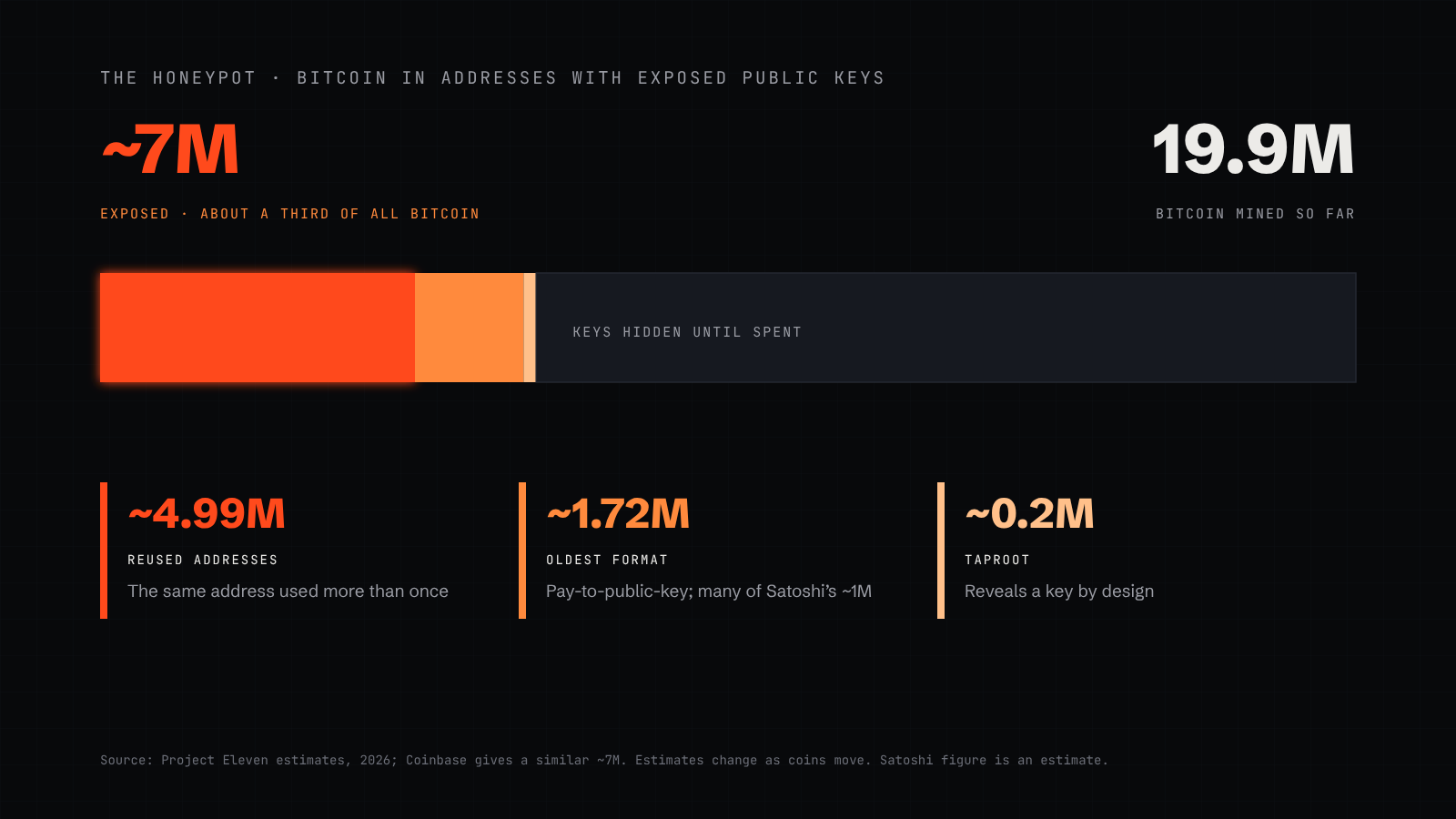
That is the honeypot Chamath means. The risk is not that Bitcoin as a whole is “cracked” overnight. It is that a specific, large, visible pool of coins could become movable by whoever builds the first machine big enough, and that the market might not wait to find out how much.
The risk is not that Bitcoin is cracked overnight. It is that a large, visible pool of coins could become movable by whoever builds the first machine big enough.Kintoro
How Close Is Q-Day?
02 · Evidence · Google Quantum AI · Global Risk Institute · Project Eleven · 2025 to 2026
The estimate fell by 20 times. The machines are still small.
The day a quantum computer can break today’s public-key cryptography is often called Q-Day. In March 2026, Google Quantum AI, with researchers including Ethereum’s Justin Drake and Stanford’s Dan Boneh, published new estimates for the elliptic-curve cryptography Bitcoin uses. Breaking it could take fewer than 500,000 physical qubits, about 20 times fewer than the roughly nine million estimated in 2023. Google said a key might be broken in minutes once such a machine existed. It proved its circuits with a zero-knowledge proof but chose not to publish them.
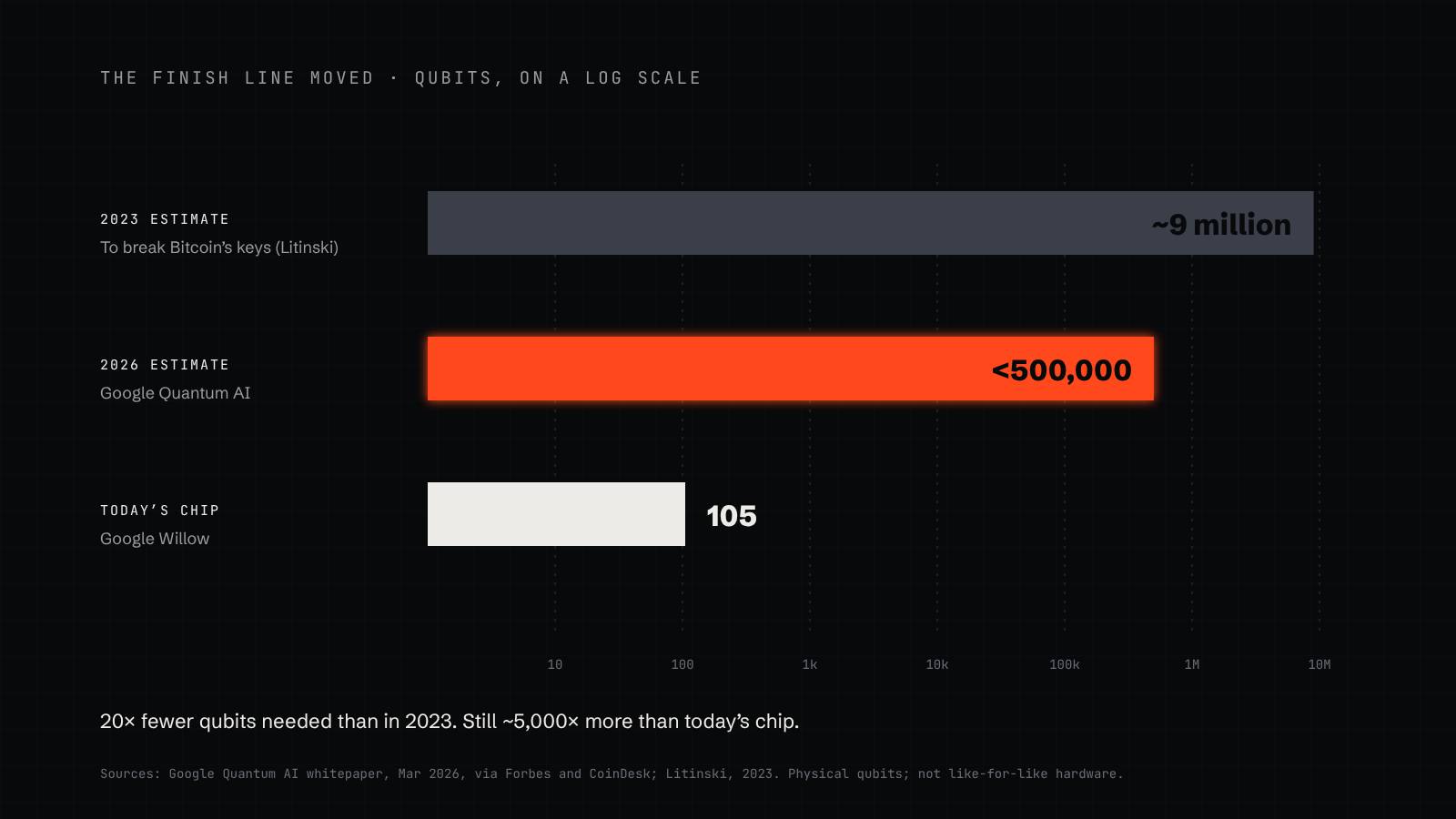
The machines are still a long way off. Google’s own Willow chip has 105 qubits. In April 2026, Project Eleven awarded its Q-Day Prize to Giancarlo Lelli for breaking a 15-bit elliptic-curve key on cloud quantum hardware, the largest such demonstration so far. Bitcoin uses 256-bit keys. “The distance from 15 to 256 bits is large,” Project Eleven said.
Experts disagree on how fast that distance will close. The Global Risk Institute’s 2025 survey of 26 quantum experts found a cryptographically relevant quantum computer “quite possible (28–49%) within the next 10 years” and “likely (51–70%) in the next 15”. After Google’s paper, Drake said his confidence in Q-Day by 2032 had “shot up significantly”, putting it at 10% or more. Adam Back, one of Bitcoin’s most respected early developers, called today’s quantum computers “essentially lab experiments”, while urging preparation now.
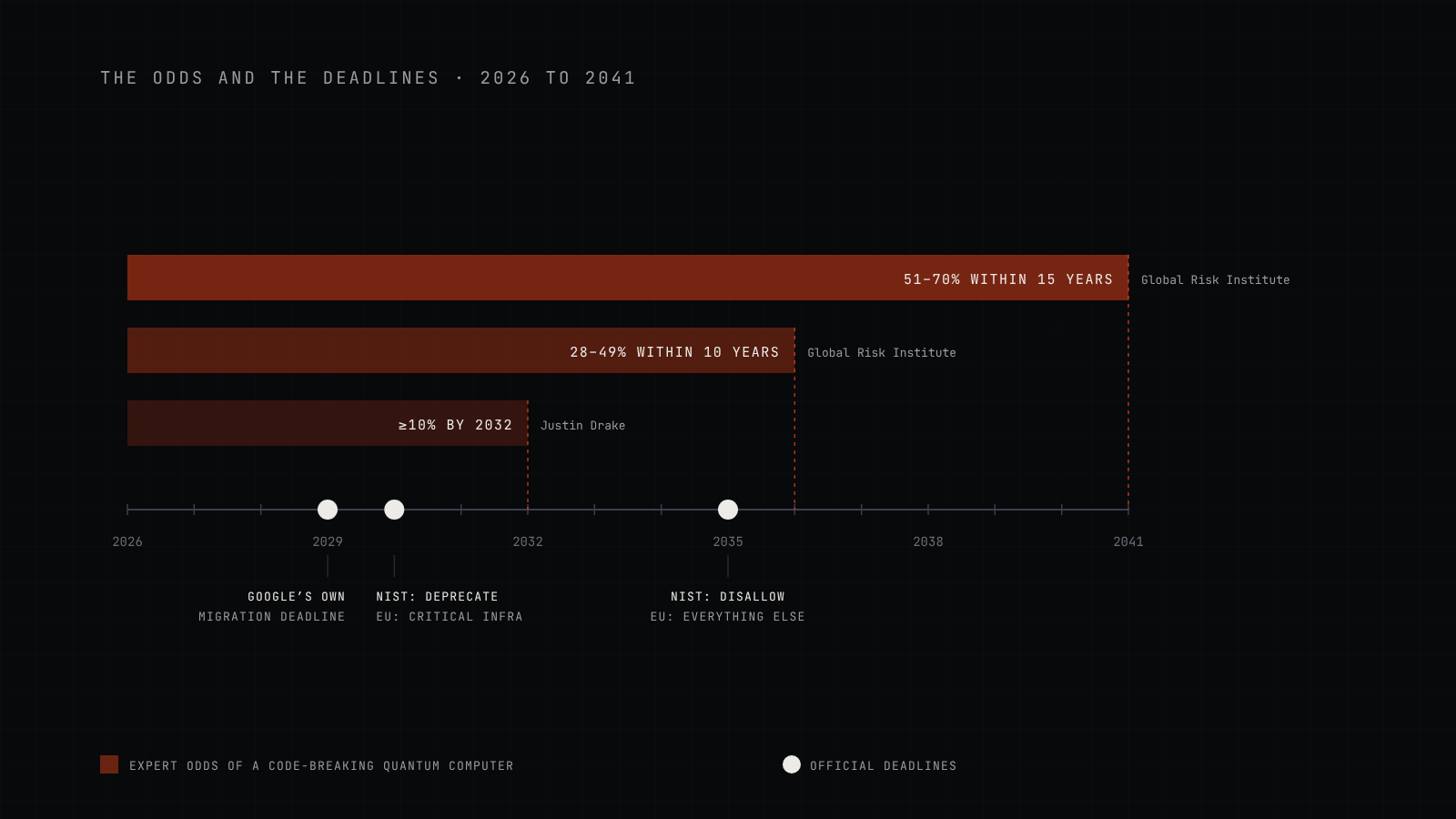
What tells you most is what institutions are doing. Google set 2029 as its own deadline to move to post-quantum cryptography. The US National Institute of Standards and Technology proposes deprecating today’s public-key algorithms in 2030 and disallowing them by 2035. The NSA wants new national security systems signing with quantum-resistant algorithms from January 2027. The EU wants its critical infrastructure migrated by the end of 2030. BlackRock’s Bitcoin ETF prospectus lists quantum computing as a risk factor.
Nobody can tell you the date. But everyone who manages serious keys has picked one, and it is before 2035.
What Bitcoin Is Doing About It
03 · Evidence · BIP-360 · BIP-361 · Bitcoin Magazine · Decrypt · CoinDesk · 2026
An upgrade path exists. Agreement does not.
Chamath’s doubt about coordination is fair, but Bitcoin is not standing still. Changes to Bitcoin are proposed as Bitcoin Improvement Proposals, or BIPs, and activated only when the network broadly agrees.
BIP-360, by Hunter Beast, Ethan Heilman and Isabel Foxen Duke, proposes a new address type, “Pay to Merkle Root”, that hides the public key and is designed so that later upgrades can add quantum-resistant signature schemes standardised by NIST. It has been merged into the BIP repository, which, as Bitcoin Magazine notes, “does not signal endorsement or future activation”. Beast calls it “a first step in a larger set of quantum-resistance proposals.”
BIP-361, published in April 2026 by Jameson Lopp and five other developers, goes much further. About three years after activation, it would stop coins being sent to vulnerable addresses. Two years after that, coins left in legacy addresses would be frozen, with a later path for owners to recover them using a zero-knowledge proof. It is a draft with no activation timeline, and it depends on BIP-360.
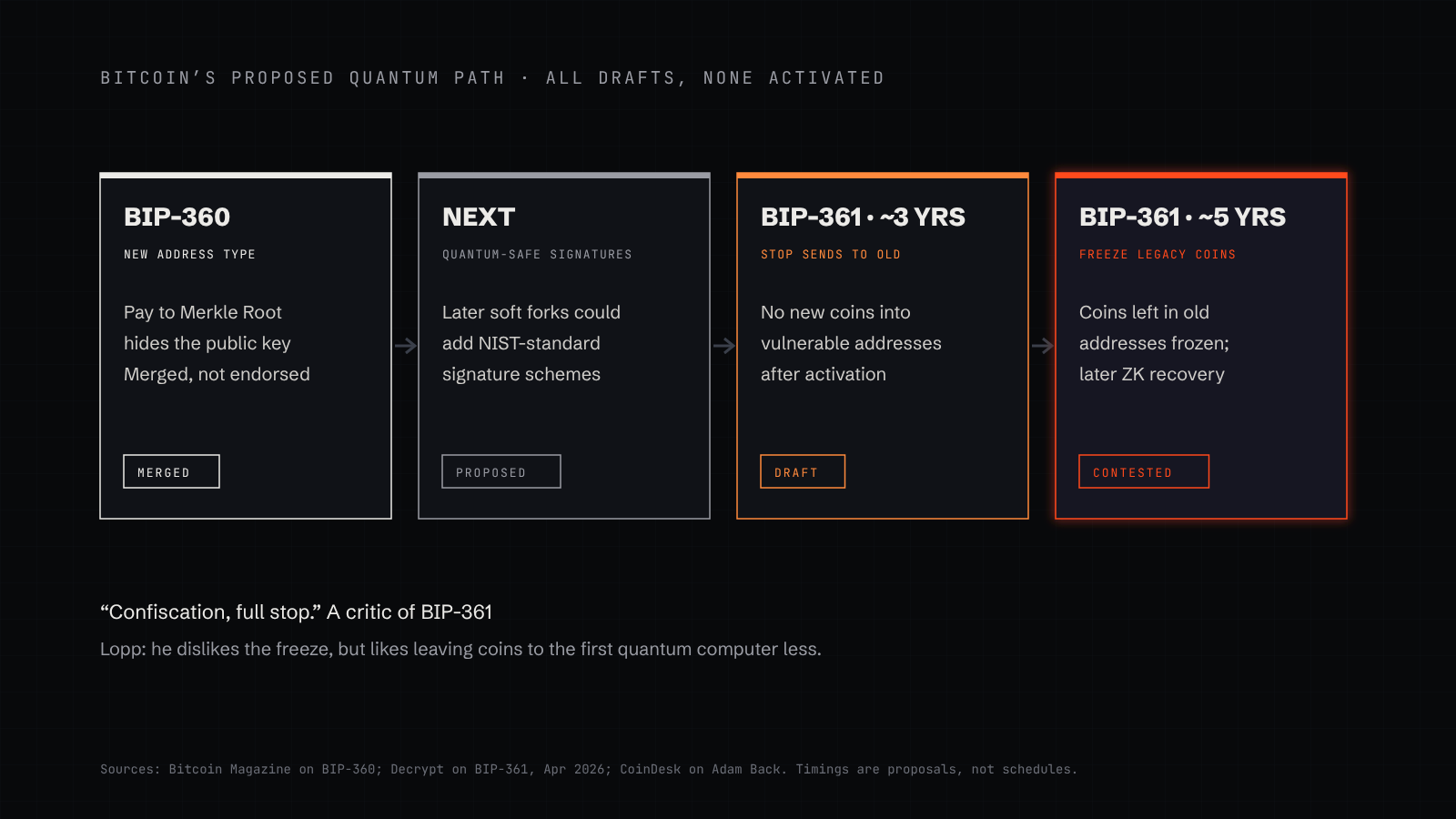
The freeze is where Bitcoin’s real dilemma lives. Critics called it “confiscation, full stop”. Lopp has said he does not like it, but likes the alternative less: leaving millions of coins, including Satoshi’s, for whoever builds a quantum computer first. Adam Back opposes a forced freeze and argues for optional upgrades now, saying migration could take about a decade: “Preparation is key. Making changes in a controlled way is far safer than reacting in a crisis.” Michael Saylor, whose company holds more bitcoin than any other, calls the quantum risk theoretical and solvable.
Bitcoin has upgraded before. SegWit activated in 2017 after a bitter fight, and Taproot in 2021. Both took years. A quantum migration is harder, because it asks every holder to move their coins, and asks the network to decide what happens to coins whose owners never will.
Quantum computers will not kill Bitcoin on their own. A failure to decide in time could.The central statement
So, Is Bitcoin Going to $0?
Here is my view, as a Kintoro framework rather than a forecast of price. I see three broad paths.
- The orderly upgrade. Bitcoin activates a quantum-resistant address type and signatures well before Q-Day. Exchanges, custodians and most holders migrate over several years. The fate of dormant coins is settled by a hard-fought compromise. Bitcoin survives with its supply and its network intact. This is the outcome Back, Lopp and most core developers are working towards.
- The messy migration. Upgrades arrive, but late. Most active holders move, while millions of exposed coins stay put. A credible quantum milestone, or the first suspicious movement of very old coins, triggers a crisis of confidence and a severe price fall. Bitcoin survives, damaged, and the dormant-coin question is settled under pressure.
- The failure. The community cannot agree, a capable quantum computer arrives first, and exposed coins are taken and sold. Confidence collapses. This is Chamath’s path to zero. It needs both a quantum breakthrough and a governance failure, and it is the least likely of the three, but it is not impossible.
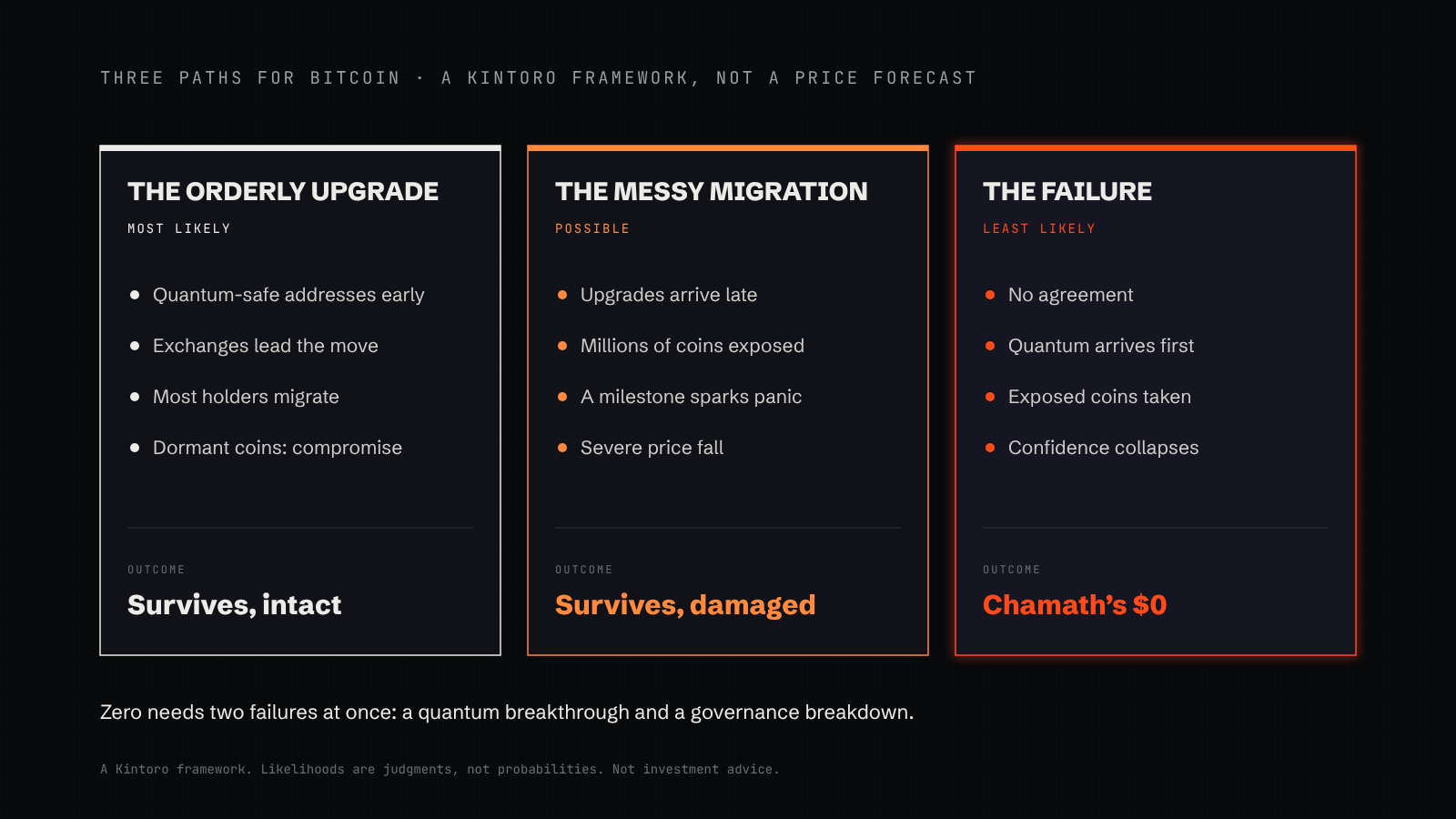
So no, I do not think Bitcoin is going to $0 because of quantum computers. But Chamath has identified the right weakness. The maths has a known fix. The fix is a decision, and Bitcoin is built so that nobody gets to make that decision alone.
The Lesson for Every Business
This is not only a crypto story. The same mathematics protects the logins, payments, contracts, software updates and stored data of almost every company. Bitcoin’s problem is simply the most visible version, because its keys protect money in public, and nobody can roll back a theft.
For encrypted data, the risk has already begun: attackers can collect encrypted data today and read it once quantum computers arrive, a pattern known as “harvest now, decrypt later”. For signatures, Google’s security team argues migration must finish before a capable quantum computer exists, because a forged signature cannot be undone afterwards.
For a business leader, that becomes five moves:
- Make an inventory. List where your company uses public-key cryptography: websites, VPNs, payment systems, signing keys, devices, and any crypto assets.
- Ask your vendors for their post-quantum plan and dates, including your cloud, payments, identity and software providers. Including us.
- Prioritise data that must stay secret for ten years or more, and keys whose compromise could not be undone.
- Build for change. Choose systems that can swap cryptographic algorithms without a rebuild, a quality known as crypto-agility.
- If you hold crypto assets, know which addresses and custodians you use, and decide in advance who approves a migration, and when.
Why This Is a Human-in-the-Loop Problem
04 · Kintoro · piMonk · October 2026
Agents prepare the migration. People approve it.
I should declare an interest. At Kintoro we build piMonk, a suite of business applications for mid-market companies, on one rule: agents do the work, people keep the decisions. We are not a crypto company, and piMonk does not hold or trade digital assets. But Bitcoin’s quantum problem is the clearest example I know of why that rule matters.
A post-quantum migration is mostly work that agents are good at: finding every place a key is used, checking which systems are exposed, drafting the plan, tracking progress across hundreds of systems and suppliers. But its decisive steps cannot be undone. Moving funds, rotating a signing key, retiring a system, or freezing someone else’s coins are decisions that belong to accountable people, with a record of who decided and why.
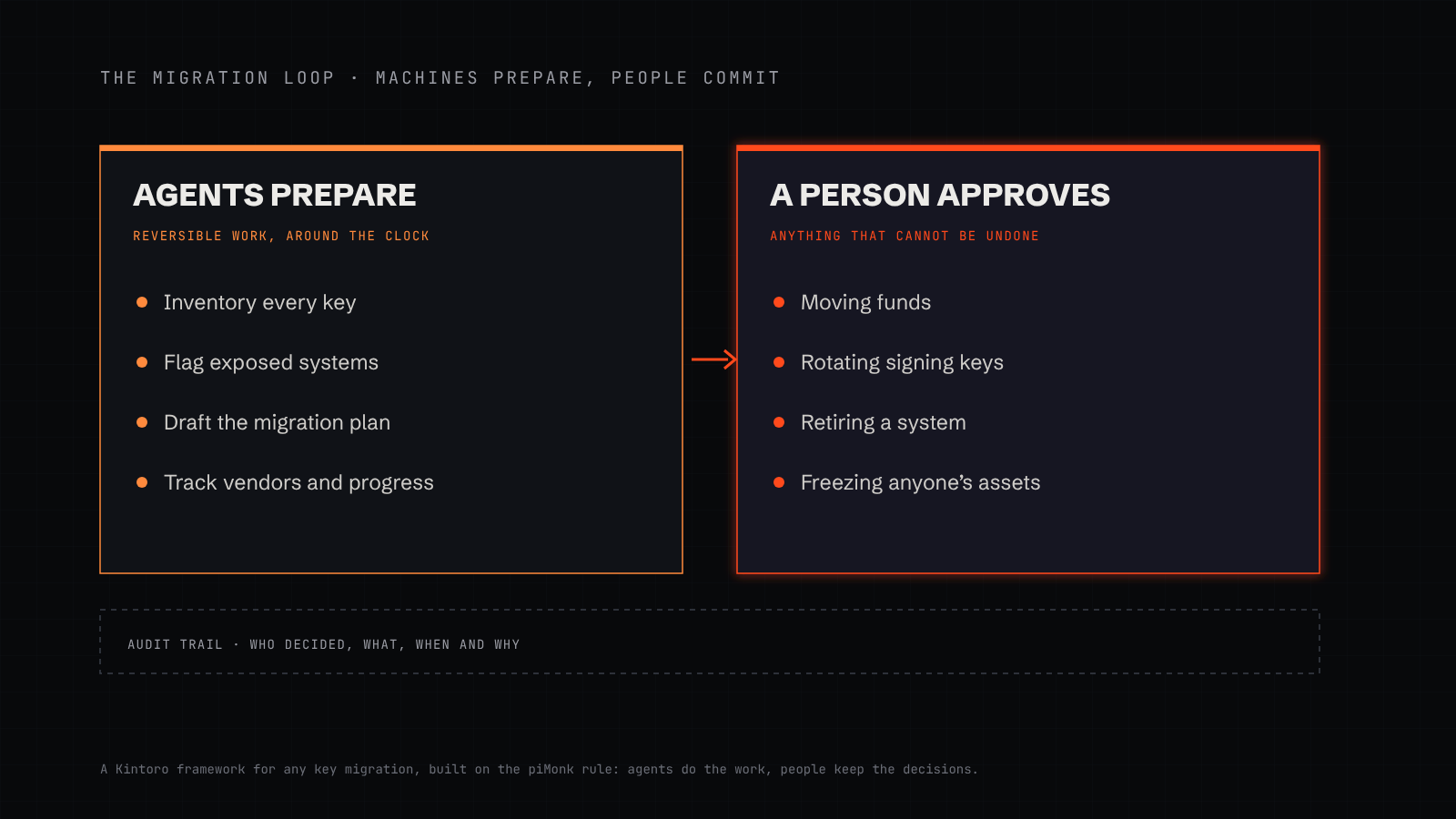
That is the scenario at the top of this feature: an agent that did the overnight homework, and two people who approved the move. It is how we build piMonk, and it is what any company should demand of the tools it uses for this migration.
Five Checkpoints to 2035
This is how I expect the race to unfold, with each checkpoint marked as measured today, scheduled by governments or companies, forecast by experts, or forecast by Kintoro.
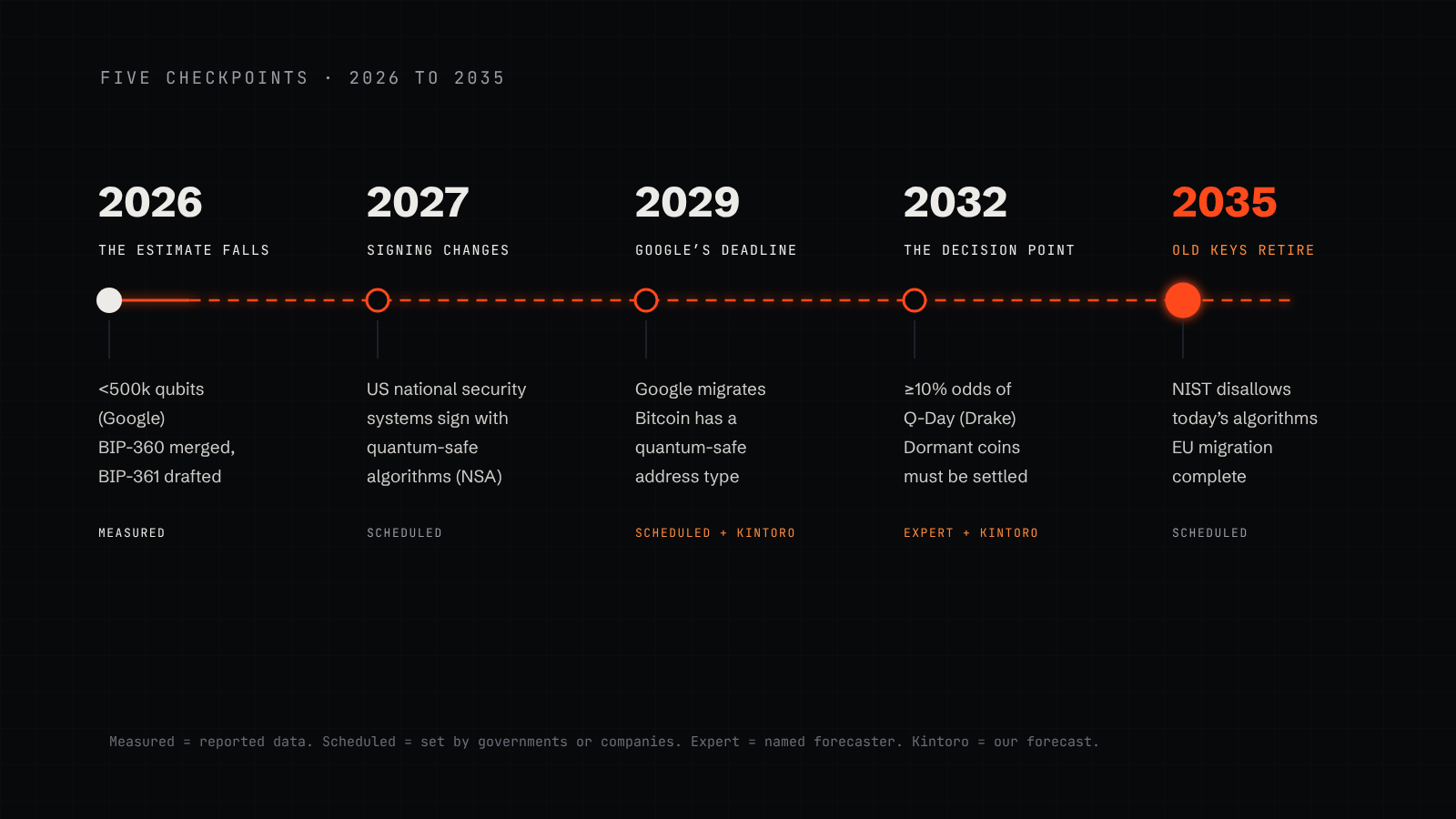
- 2026
The estimate falls Measured
Google cuts the qubits needed to break Bitcoin’s keys to under 500,000. BIP-360 is merged into the BIP repository and BIP-361 is published as a draft. The largest public demonstration breaks a 15-bit key. Chamath says Bitcoin goes to zero.
- 2027
Governments sign differently Scheduled
Under the NSA’s CNSA 2.0 guidance, new US national security systems are expected to use quantum-resistant signatures from 1 January 2027. EU member states should have national migration plans in place from the end of 2026.
- 2029
Google’s deadline Scheduled · Kintoro forecast
Google’s target for its own post-quantum migration. My forecast: by then Bitcoin has activated at least a quantum-resistant address type, and major exchanges and custodians offer migration to their customers.
- 2032
The decision point Expert forecast · Kintoro forecast
Justin Drake puts the chance of Q-Day by 2032 at 10% or more. My forecast: this is the year the dormant-coin question must be settled. If Bitcoin has not decided by now, the market will start deciding for it.
- 2035
The old keys retire Scheduled
NIST proposes disallowing today’s public-key algorithms, and the EU wants all remaining systems migrated. The world’s banks, governments and software will have moved. Bitcoin will need to have moved too.
Not Zero. Not Safe.
Chamath may be right that Bitcoin has a ceiling. Markets will settle that. On quantum, I think he has the right question and the wrong ending. Bitcoin is not doomed by physics. It faces a deadline, a known fix and a hard decision about coins that belong to people who may never return.
That is a governance problem, and governance problems are solved by people deciding in time, with the work done well before the crisis. At Kintoro, that is how we build piMonk: agents prepare, people decide, and the decisions that cannot be undone wait for someone accountable.
Bitcoin is not going to zero because of quantum computers. It could get there only by failing to decide. And so could any business that ignores its own keys.
Not zero. Not safe. Decide in time.
Sources
- https://www.thestreet.com/crypto/markets/chamath-palihapitiya-bitcoin-goes-to-zero,TheStreet, on Chamath Palihapitiya’s comments on the Moonshots podcast (Episode 304), 23 October 2026
- https://news.bitcoin.com/chamath-palihapitiya-bitcoin-capped-hacked-zero/,Bitcoin.com News, Jamie Redman, on Chamath Palihapitiya’s “capped, hacked, zero” comments and DCG equity swap, 24 October 2026
- https://finance.yahoo.com/news/chamath-palihapitiya-bitcoin-honeypot-quantum,Benzinga via Yahoo Finance, on Chamath Palihapitiya’s All-In comments calling Bitcoin a “honeypot”, 8 April 2026
- https://www.forbes.com/sites/digital-assets/2026/03/31/google-quantum-ai-bitcoin-elliptic-curve-estimate,Forbes, on Google Quantum AI’s whitepaper estimating resources to break elliptic-curve cryptography, 31 March 2026
- https://www.coindesk.com/tech/2026/04/01/google-quantum-paper-bitcoin,CoinDesk, on Google’s quantum estimate and its implications for Bitcoin, April 2026
- https://blog.google/technology/safety-security/post-quantum-cryptography-timeline,Google, Heather Adkins and Sophie Schmieg, on Google’s post-quantum migration timeline, 25 March 2026
- https://www.projecteleven.com/blog/q-day-prize-winner,Project Eleven, Q-Day Prize announcement (Giancarlo Lelli, 15-bit key), 24 April 2026
- https://www.projecteleven.com/bitcoin-risq-list,Project Eleven, Bitcoin RISQ List, exposed-public-key estimates, accessed October 2026
- https://globalriskinstitute.org/publication/2025-quantum-threat-timeline-report,Global Risk Institute, “Quantum Threat Timeline Report 2025”
- https://bitcoinmagazine.com/technical/bip-360-merged,Bitcoin Magazine, on BIP-360 (Pay to Merkle Root) being merged into the BIP repository, 2026
- https://decrypt.co/bip-361-bitcoin-quantum-freeze-lopp,Decrypt, on BIP-361 and the proposed freeze of quantum-vulnerable coins, 15 April 2026
- https://www.coindesk.com/tech/2026/04/16/adam-back-quantum-bitcoin,CoinDesk, on Adam Back’s remarks at Paris Blockchain Week, 16 April 2026
- https://www.theblock.co/post/saylor-quantum-bitcoin,The Block, on Michael Saylor’s view of quantum risk, 9 April 2026 (updated 19 October 2026)
- https://csrc.nist.gov/pubs/ir/8547/ipd,NIST, IR 8547 (initial public draft), “Transition to Post-Quantum Cryptography Standards”, November 2024
- https://media.defense.gov/2022/Sep/07/2003071834/-1/-1/0/CSA_CNSA_2.0_ALGORITHMS_.PDF,NSA, Commercial National Security Algorithm Suite 2.0 (CNSA 2.0), with updated FAQ
- https://digital-strategy.ec.europa.eu/en/library/coordinated-implementation-roadmap-transition-post-quantum-cryptography,European Commission, coordinated implementation roadmap for the transition to post-quantum cryptography, June 2025
- https://www.sec.gov/Archives/edgar/data/1980994/,iShares Bitcoin Trust (IBIT) prospectus and filings, including the May 2025 quantum risk disclosure, SEC EDGAR
See the idea working in piMonk
piMonk is the AI company we built on this thinking: agents do the work, people keep the decisions. Try the app this piece points to, or book a demo.
Book a demo