

Scenario · Monday, 4 March 2030 · A forecast, not a report
On her first morning as head of operations at a 900-person food manufacturer, Priya asks the question every new leader asks in their first month: why do we give our second-biggest customer 75-day payment terms when policy says 45? In 2025, the answer would have taken three weeks and a lunch with someone who had been there since 2009.
This time, the company’s brain answers in seconds, with the decision itself. The exception was approved in June 2027 by the finance director, after a supply shortage, for twelve months, with a note to review it. It was renewed twice by a sales agent applying the precedent, and the second renewal was never reviewed by a person. The brain also shows that four other customers now cite the same precedent.
Priya does not let the brain decide what to do about it. She calls the finance director, who left the company last year but is happy to talk. Then she makes the call herself: the terms revert in ninety days, and the precedent is retired. The brain records her decision, her reasons and her name, so that whoever sits in her chair in 2035 will not have to ask.
Priya, her company and her morning are fictional, and so is March 2030. Everything else in this feature comes from what researchers, investors, analysts and software companies are saying and building in 2025 and 2026. Where I forecast, I say so.
Ask anyone who has run a company where its intelligence lives, and they will point in five directions at once. The policy manual. The process documents. The org chart. The ERP and CRM. And, with a shrug, the people: the finance director who knows why that customer is special, the engineer who knows which supplier lies about lead times.
The last of those has always been the most valuable and the least kept. In 1966 the philosopher Michael Polanyi named the problem: “We know more than we can tell.” For sixty years, companies have tried to capture what their people know with manuals, wikis and knowledge-management systems, and mostly failed. In 2026, something has changed. AI agents now sit inside the work itself, and for the first time, a company’s decisions can be recorded as they happen, judged against what happened next, and turned into memory that outlasts the people who made them. People are calling the result the enterprise brain. The question is how far away it really is.
A Brain in Pieces
01 · Evidence · Panopto · Interloom via Fortune · Foundation Capital · 2018 to 2026
Companies know what happened. They rarely know why.
The evidence that companies forget is old and consistent. A 2018 Panopto study found that 42% of institutional knowledge was unique to the individual employee, not shared with anyone else, and that knowledge workers spent 5.3 hours a week waiting for or recreating information. In March 2026, Fabian Jakobi, chief executive of the Munich start-up Interloom, told Fortune that about 70% of operational decisions were never formally documented.
In December 2025, Ashu Garg and Jaya Gupta of Foundation Capital gave the problem a sharper name. Systems of record such as CRMs and ERPs store what is true now, they argued, not the reasoning behind it. “Salesforce knows what happened. It doesn’t know why.” The missing layer is the decision trace: who decided what, with what information, under what constraints, including the exceptions and precedents that live in chat threads, calls and people’s memories. Stitched together over time, those traces form a context graph, “a living record of decision traces stitched across entities and time so precedent becomes searchable”. Gupta calls it “the accumulated judgment of an organization”.
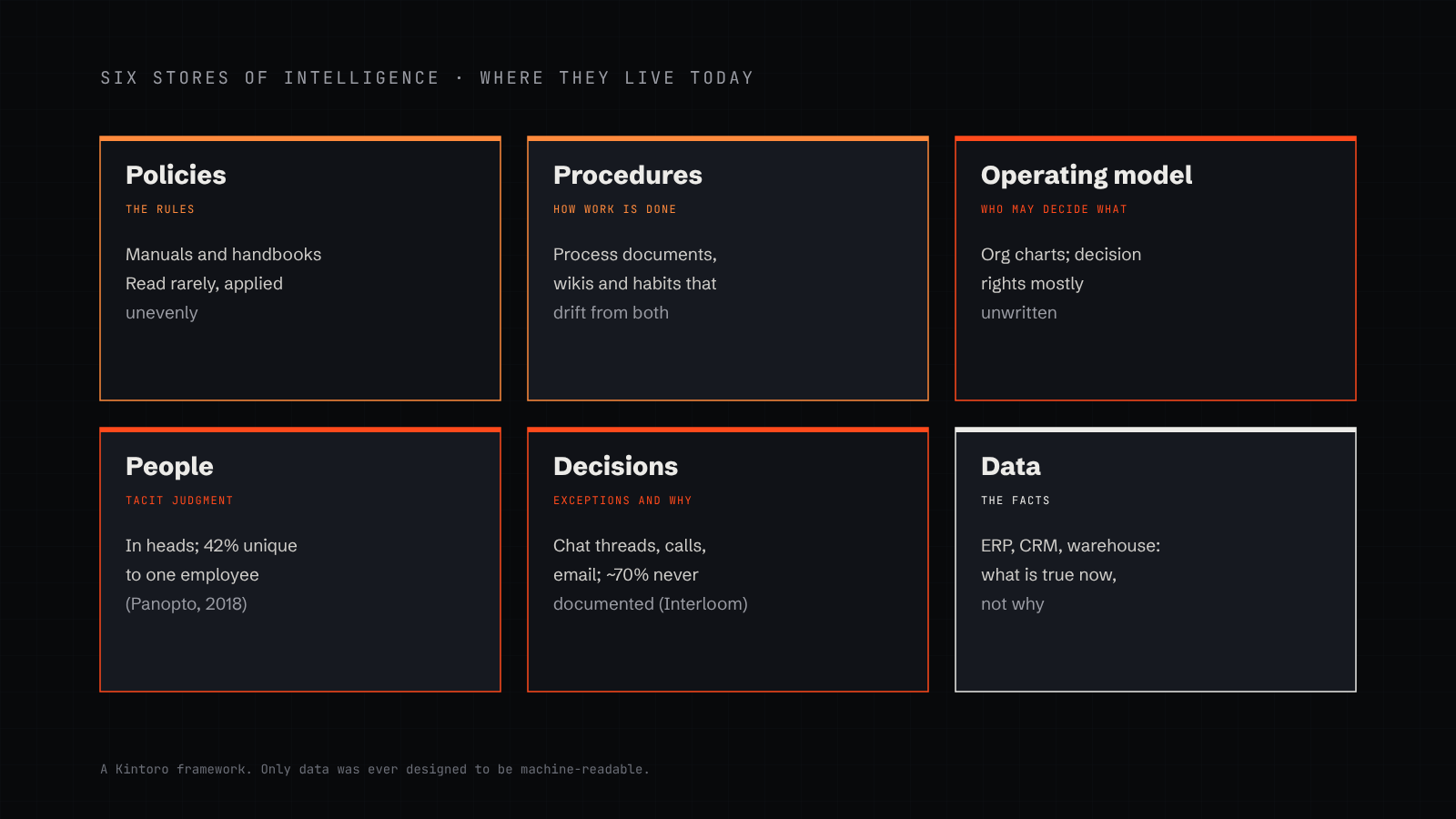
Put the pieces together and every company’s brain has six stores. Policies, the rules. Procedures, how work is done. The operating model, who does what and who may decide what. People, with their tacit judgment. Decisions, the record of every exception and trade-off. And data, the facts in the systems of record. Only the last was ever designed for machines to read. The rest sits in documents, inboxes and heads.
Every company already has a brain. It has just never been able to remember why it decided anything.
The forgetting company in numbers
- 42%of institutional knowledge unique to the individual employee, shared with no onePanopto, 2018
- ~70%of operational decisions never formally documented, according to Interloom’s chief executiveFortune, Mar 2026
- 5%of organisations in MIT’s small sample got custom AI tools into production with marked impact; it blamed a learning gapMIT NANDA, Jul 2025
- 15%of day-to-day work decisions Gartner expects agentic AI to make autonomously by 2028, up from 0% in 2024Gartner, Jun 2025
The Forces at Work
02 · Evidence · McKinsey · Deloitte · Gartner · Nadella · CMR · 2025 to 2026
The fluid enterprise needs a memory
Five forces are pushing companies to build a brain now, after decades of failed knowledge projects.
- The organisation is becoming fluid. Deloitte’s 2026 Human Capital Trends describes “dynamic orchestration”: breaking jobs into tasks and recombining people, contractors and digital agents around outcomes. “Competitive advantage is shifting from scale to adaptability,” it says. A company that reorganises continuously cannot keep its knowledge in its org chart.
- Agents are joining the workforce. McKinsey’s “agentic organization” describes flat networks of small teams, where “a human team of two to five people can already supervise an agent factory of 50 to 100 specialized agents”. It also notes that 89% of organisations still run on an industrial-age model. Agents cannot rely on hallway conversations. They need the context written down.
- Decisions are moving to machines. Gartner predicts that at least 15% of day-to-day work decisions will be made autonomously by agentic AI by 2028, and that 33% of enterprise software applications will include agentic AI. Every one of those decisions can leave a trace, or not.
- Expertise is retiring. Writing in California Management Review in March 2026, Accenture’s Teresa Tung and Philippe Roussiere argued that “tacit knowledge is your next competitive moat”, and warned leaders not to wait until it retires.
- Learning is becoming the strategy. Satya Nadella put it most simply this summer: “A firm is a learning system,” and “you can’t outsource your learning.” A company that cannot remember its own decisions cannot learn from them.
A company that reorganises continuously cannot keep its knowledge in its org chart.Kintoro
The Anatomy Being Built
03 · Evidence · Microsoft · Glean · Anthropic · Memgraph · Kyndryl · 2025 to 2026
Every store is getting its own layer
The striking thing about 2026 is that each of the six stores now has a technology aimed at it, and the biggest software companies are racing to own the whole.
- Data becomes meaning. Microsoft’s Fabric IQ, announced as part of Microsoft IQ, “organizes business data into clear, meaningful structures so AI can interpret it accurately”. The CMR authors found that companies with an established semantic layer rolled out new AI applications in weeks rather than months.
- Documents and policies become retrievable. Microsoft’s Foundry IQ “handles knowledge (such as company documents, policies, and stored content)”, while Work IQ “learns from things like emails, meetings, chats, and documents”. Glean’s Enterprise Graph maps the links between people, documents, processes and tools as “a living map of enterprise context”.
- Policies become code. “Policy as code” turns rules, regulations and controls into machine-readable limits on what agents may do, so every action is checked and logged by design, as Kyndryl described in March 2026.
- Procedures become skills. In December 2025, Anthropic opened its Agent Skills format as a standard: packages of procedural know-how that an agent loads when a task needs it. Microsoft adopted it in VS Code and GitHub. A company’s way of doing a task can now be written once and followed by every agent.
- Decisions become traces. Start-ups such as Interloom build context graphs from tickets, emails and work orders. Memgraph’s Dominik Tomicevic argues that traces alone are not enough: an enterprise brain needs three kinds of memory, as people do. Episodic memory for decisions, semantic memory for facts, and procedural memory for how work is done.
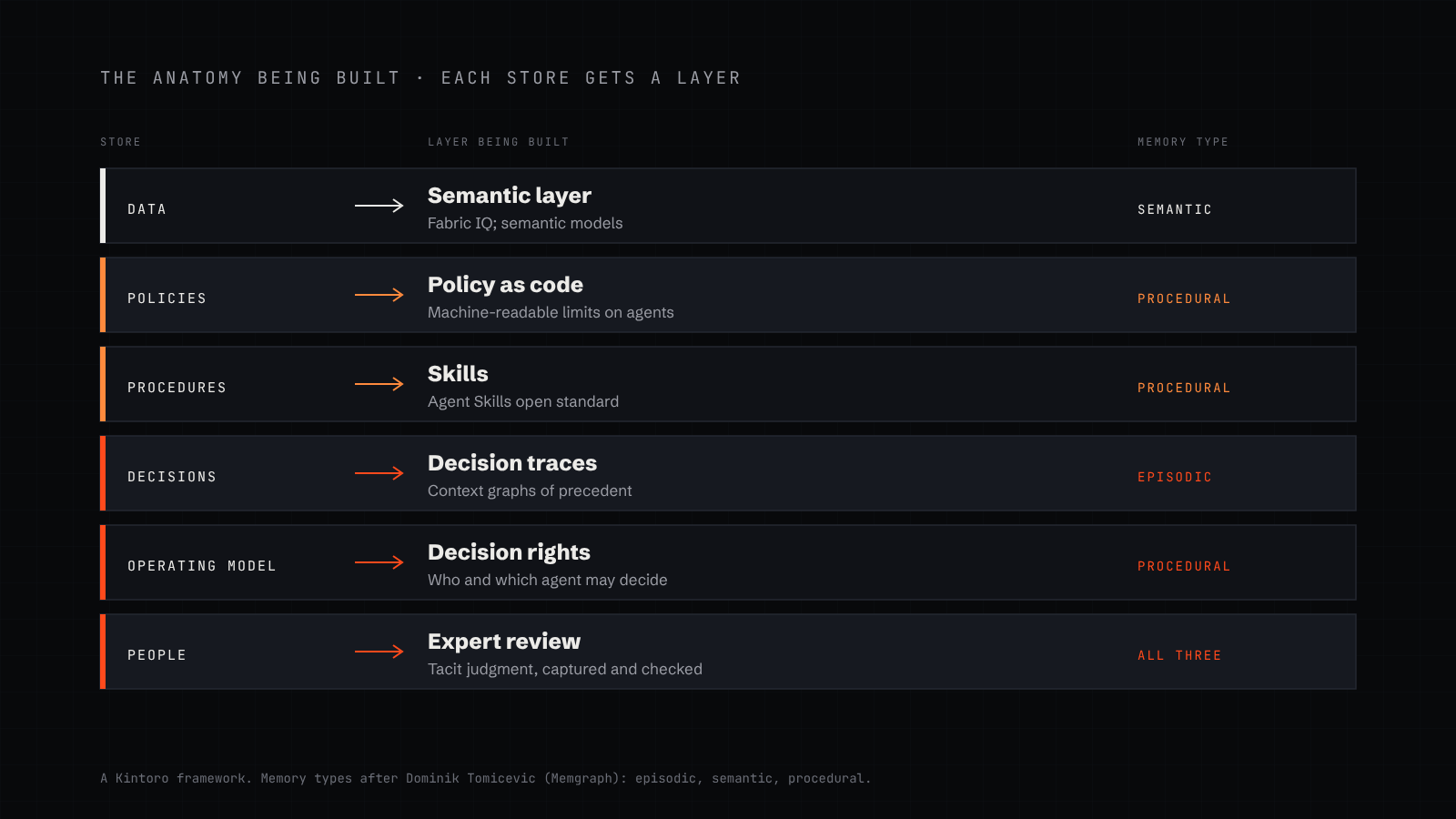
The operating model and people are the hardest pieces. Org charts can be mapped, but decision rights, who may decide what, are usually unwritten. And tacit judgment only becomes memory when an expert reviews what the machine captured. “The evaluation has to come from a human expert,” Jakobi told Fortune. Interloom says it narrowed the gap between documented and actual operational knowledge at Commerzbank from about 50% to 5%.
Tracked, Judged, Institutionalised
A brain is not a filing cabinet. It learns. As a Kintoro framework, I see the enterprise brain working as a loop in five steps.
- Track. Every decision, by a person or an agent, is recorded at the moment it is made: what was decided, by whom, on what information, under which rule, and whether it was an exception.
- Judge. Decisions are compared with what happened next. Did the discount win the deal? Did the exception cause a loss? Experts review the patterns, because outcomes alone can mislead.
- Institutionalise. Precedents that keep working are proposed as new policy or a new procedure. Precedents that keep failing are retired.
- Enforce. The approved policy becomes a rule agents must follow, and a limit on what they may do alone.
- Explain. Anyone, human or agent, can ask why a rule exists and see the decisions behind it.
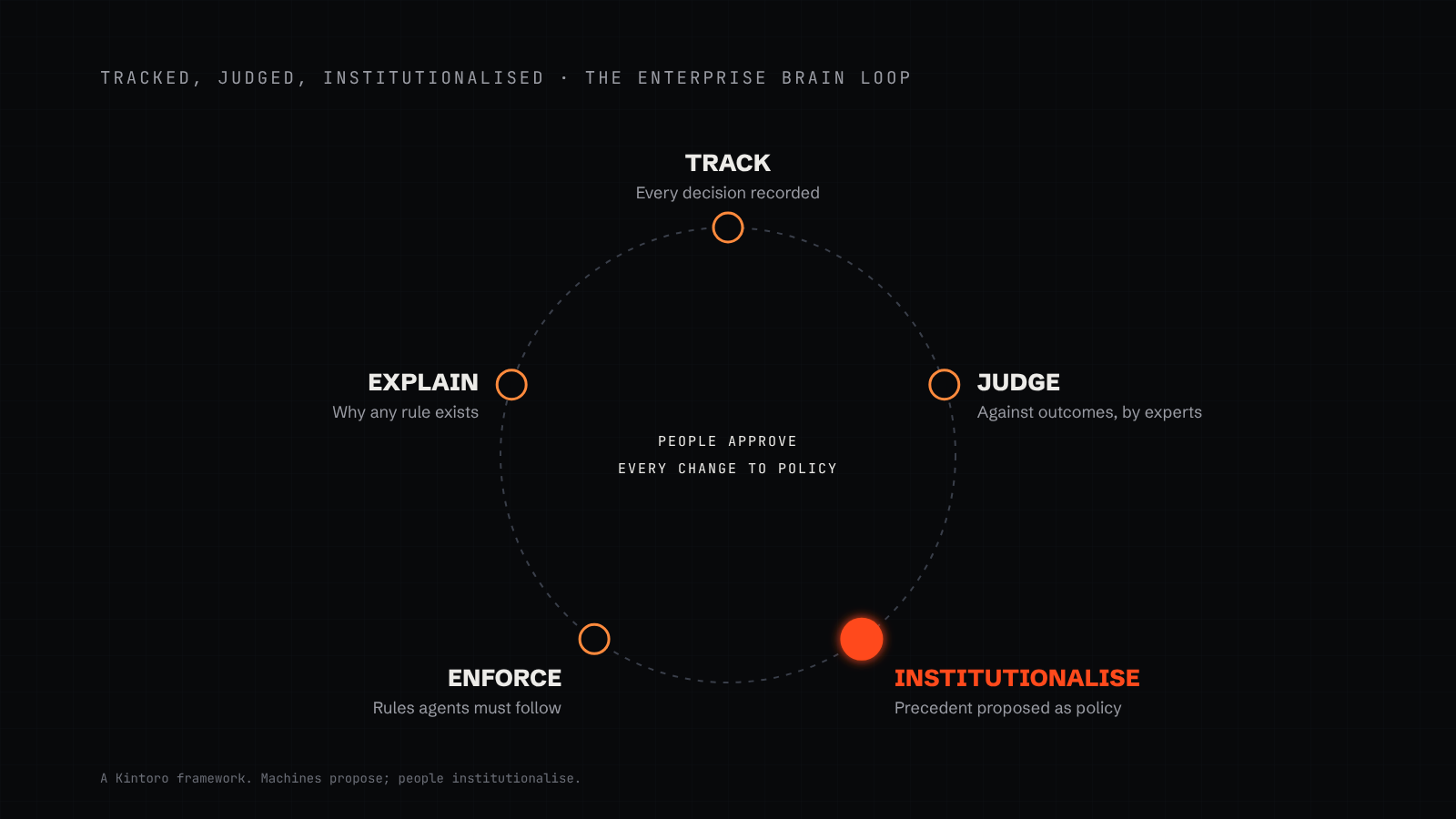
The crucial step is the third. A brain that turns its own decisions into policy without a person’s approval is a company that has handed its governance to its software. In the loop, machines propose and people institutionalise.
So, How Far Away Are We?
04 · Evidence · MIT NANDA · Gartner · Spinach · BARC · Cloud Security Alliance · 2025 to 2026
The parts exist. The brain does not, yet.
The honest answer is: closer than ever, and further than the marketing suggests. MIT’s Project NANDA found in a small, preliminary July 2025 study that only 5% of the organisations it looked at got custom AI tools into production with marked impact, and blamed a learning gap: “Most GenAI systems do not retain feedback, adapt to context, or improve over time.” One user said a tool “repeats the same mistakes and requires extensive context input for each session.” Gartner expects over 40% of agentic AI projects to be cancelled by the end of 2027.
Even the companies building “company brains” list what is missing. An October 2026 review by Spinach AI named seven unsolved gaps, including true context graphs, knowing when a fact stopped being true, scoping what each agent may see, and flagging decisions that contradict each other. Spinach said it has not yet shipped some of those features itself. A BARC study in June 2026 found only 29% of organisations fully know where their AI-relevant unstructured data lives. And the Cloud Security Alliance found in April 2026 that 82% of security teams had discovered AI agents they did not know were running.
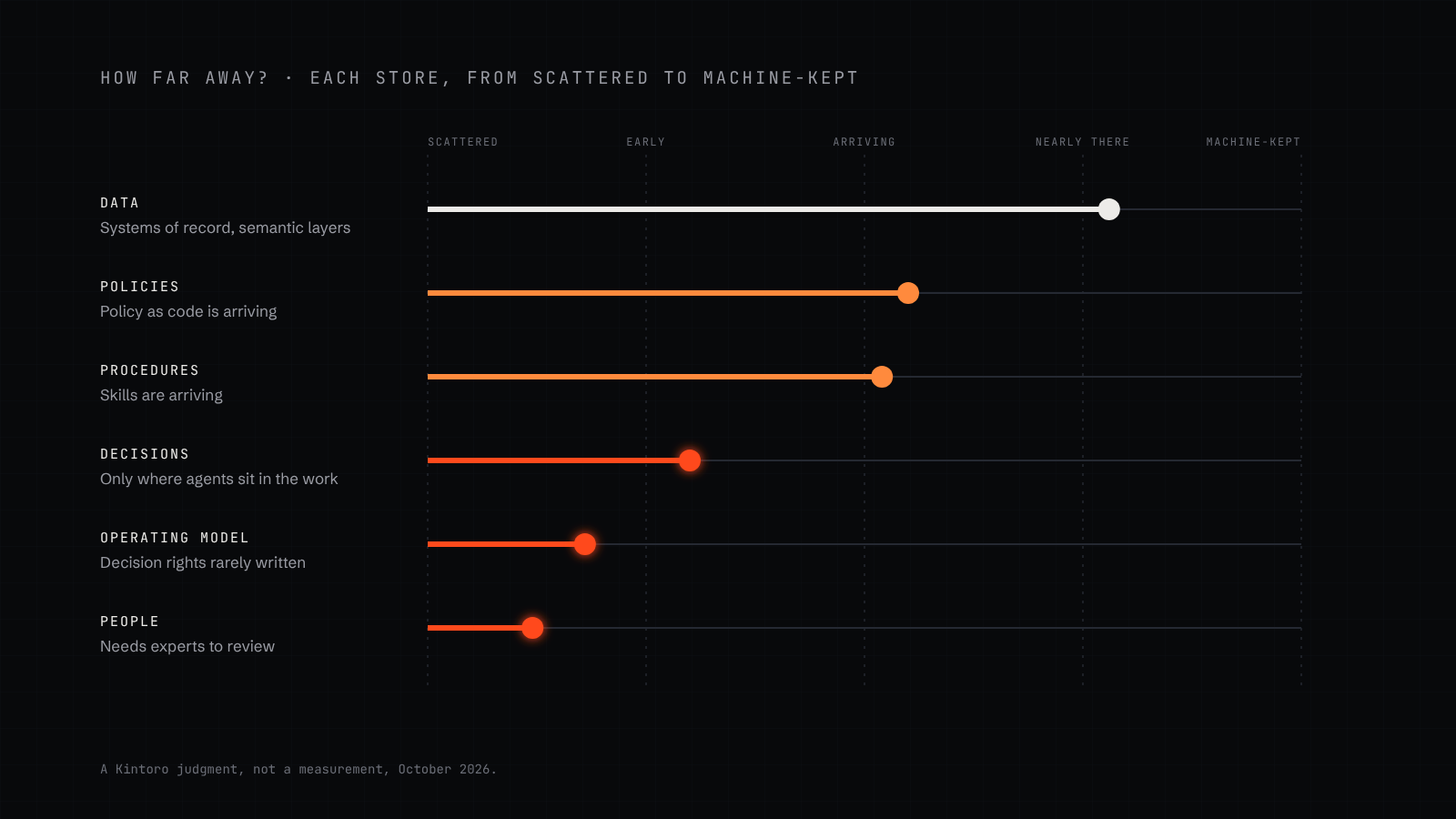
My judgment, as a Kintoro framework: data is nearly there; policies and procedures are arriving now, through policy as code and skills; decisions are at the start, because traces are only captured where agents sit in the workflow; and the operating model and people are furthest away, because decision rights are rarely written down and tacit judgment needs experts to review it. My forecast is that a working enterprise brain, covering most decisions in a mid-market company, is three to five years away. It will never be complete, and it should not be.
The parts of the enterprise brain exist today. The wiring between them is the work of the next five years.
What Must Stay Human
An enterprise brain raises three risks that every leader should name before building one.
- Institutionalising mistakes. A brain that learns from precedent will copy bad precedent as faithfully as good. The 75-day terms in our scenario were renewed by an agent because a precedent existed. Judgment about when a precedent should die belongs to people.
- Surveillance instead of memory. Tracking decisions is not the same as watching people. Employees must know what is recorded, why, and who can see it, or the brain will learn only what people are willing to say in front of it.
- Losing ownership. A company’s decisions, traces and corrections are its most valuable learning. As Nadella warned in July, “what you create should belong to you.” The brain should live inside a company’s trust boundary, not in a vendor’s training data.
The enterprise brain will not replace judgment. It will remember every judgment, so the company stops forgetting why.The central statement
How We Build It into piMonk
05 · Kintoro · piMonk · October 2026
The decision record is live. The shared memory is not, yet.
I should declare an interest. At Kintoro we build piMonk, a suite of twelve business applications for mid-market companies, on one rule: agents do the work, people keep the decisions. Without planning it that way, we have been building the first layers of an enterprise brain.
Two pieces are live in our launched apps. The first is the decision record. “Every action is recorded: proposed, approved, edited or rejected,” and “entries can be added, never changed.” Every item waiting for approval “shows the agent’s reason: why, not only what.” That is a decision trace. The second is policy as rules: “You decide what an agent may do alone,” and “an unclear rule waits for a person.”
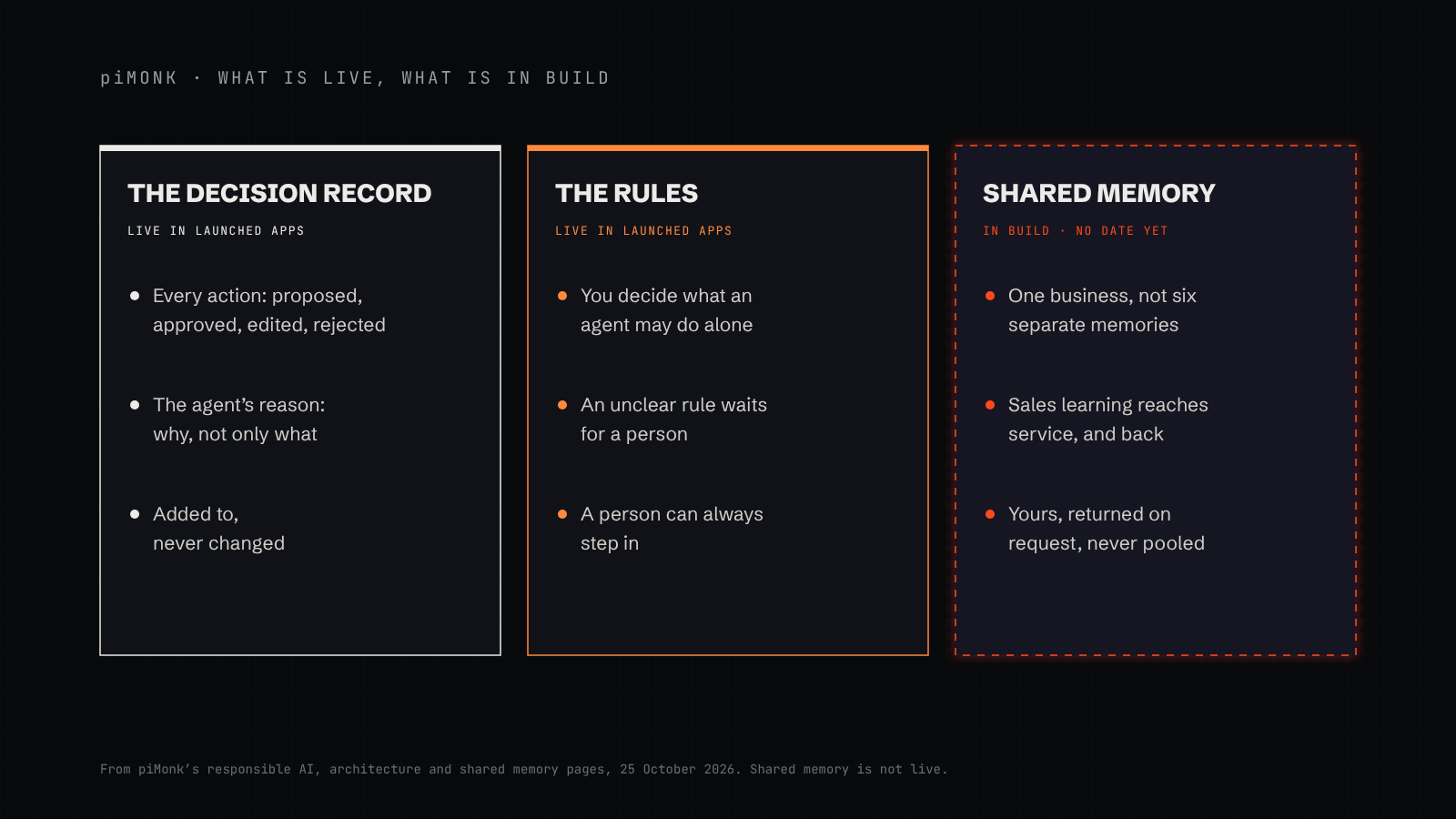
The third piece is not finished, and our own architecture page says so: “No shared memory yet.” Today, each app remembers its own work: piRevenue holds the history of accounts, and piCS holds guides, tickets and history. Our shared business memory, “one business, not six separate memories”, is in build, with no date yet. When it ships, what sales learns will reach service when a ticket opens. Its rules are already set: “Yours. Returned on request. Never pooled.”
Five Checkpoints to 2030
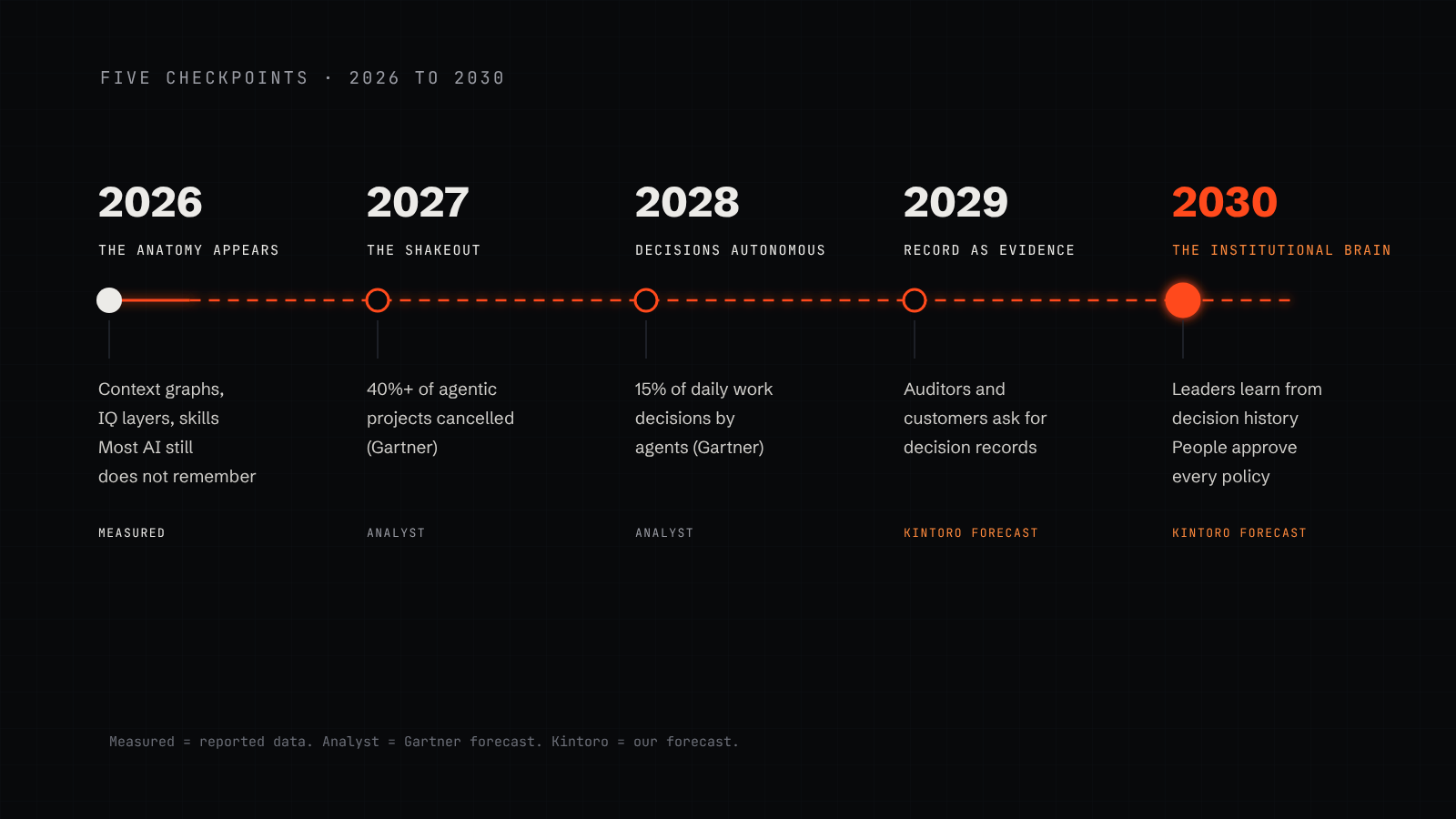
This is how I expect the enterprise brain to develop, with each checkpoint marked as measured, forecast by analysts, or forecast by Kintoro.
- 2026
The anatomy appears Measured
Context graphs and decision traces are named. Microsoft launches its IQ layers. Agent Skills becomes an open standard. Start-ups build context graphs for banks and insurers. Most companies still see little return, because their AI does not remember.
- 2027
The shakeout Analyst forecast
Gartner expects over 40% of agentic AI projects to be cancelled by the end of 2027. My view: the survivors are the ones that captured context and decisions, not just automated tasks.
- 2028
Decisions go autonomous Analyst forecast
Gartner expects at least 15% of day-to-day work decisions to be made autonomously by agentic AI, and 33% of enterprise software to include it. The question shifts from “can agents decide?” to “can we explain what they decided?”.
- 2029
The record becomes evidence Kintoro forecast
My forecast: auditors, insurers and large customers ask for decision records, not just policies. A company that can show who decided what, and why, wins contracts that others cannot.
- 2030
The institutional brain Kintoro forecast
My forecast: in leading mid-market companies, new leaders learn the business from its decision history, precedents are reviewed every quarter, and policies are rewritten from evidence, with people approving every change.
The Business Conclusion
You do not need to buy an enterprise brain to start building one. You need to stop throwing away the most valuable thing your company produces every day: its decisions.
For a business leader, that becomes five moves over the next twelve months:
- Pick one decision-heavy process, such as pricing exceptions, credit terms or refunds, and record every decision in it: who, what, why, under which rule.
- Write down decision rights. For each important decision, name who may make it, which agent may act alone, and when it must wait for a person.
- Turn your top ten procedures into instructions an agent could follow, and have the people who do the work review them.
- Sit your two most experienced people with the record once a month, and ask them which precedents should become policy and which should die.
- Make it yours. Keep the decision record inside your own walls, tell employees what it records, and make sure no vendor learns from it.
Then review it every quarter. A company that remembers why it decided will make better decisions next time, and so will its agents.
A Company That Remembers
The enterprise brain will not arrive as a single product on a single day. It is arriving in pieces: a semantic layer here, a set of skills there, a decision record in one app, a shared memory on a roadmap. The companies that wire those pieces together first will be the ones that stop losing their judgment every time someone leaves.
But the brain is not the mind. It remembers, connects and explains. People still decide, and people still decide what the company should learn. At Kintoro, that is how we build piMonk: agents do the work and keep the record, and people keep the decisions.
Tracked. Judged. Institutionalised. And always, decided by people.
A company that remembers why. People who decide what.
Sources
- https://ashugarg.substack.com/p/ais-trillion-dollar-opportunity-context,Ashu Garg and Jaya Gupta (Foundation Capital), “AI’s trillion-dollar opportunity: Context graphs”, 26 December 2025
- https://ramp.com/leading-indicators/how-ai-gets-built-jaya-gupta,Ramp, Leading Indicators, interview with Jaya Gupta, 28 April 2026
- https://www.infoworld.com/article/4156909/contexts-graphs-ai-memory-and-enterprise-knowledge-are-decision-traces-enough.html,InfoWorld, Dominik Tomicevic, “Context graphs, AI memory, and enterprise knowledge: Are decision traces enough?”, 19 May 2026
- https://www.fortune.com/2026/03/23/interloom-ai-agents-raises-16-million-venture-funding,Fortune, Jeremy Kahn, on Interloom and tacit knowledge, 23 March 2026
- https://www.hrdive.com/news/inefficient-knowledge-sharing-costs-large-us-businesses-47m-a-year/527892/,HR Dive, on Panopto’s Workplace Knowledge and Productivity Report, 18 July 2018
- https://cmr.berkeley.edu/assets/documents/pdf/2026-03-tacit-knowledge-is-your-next-competitive-moat.pdf,California Management Review, Teresa Tung and Philippe Roussiere, “Tacit Knowledge Is Your Next Competitive Moat”, 16 March 2026
- https://www.mckinsey.com/capabilities/people-and-organizational-performance/our-insights/the-agentic-organization-contours-of-the-next-paradigm-for-the-ai-era,McKinsey, “The agentic organization: Contours of the next paradigm for the AI era”, 26 September 2025
- https://www.deloitte.com/be/en/services/consulting/blogs/2026-global-human-capital-trends-dynamic-orchestration.html,Deloitte, 2026 Global Human Capital Trends, “Dynamic orchestration”, 28 September 2026
- https://www.gartner.com/en/newsroom/press-releases/2025-06-25-gartner-predicts-over-40-percent-of-agentic-ai-projects-will-be-canceled-by-end-of-2027,Gartner, “Over 40% of Agentic AI Projects Will Be Canceled by End of 2027”, 25 June 2025
- https://pureai.com/articles/2025/09/23/most-genai-investments-fail.aspx,Pure AI, on MIT Project NANDA, “The GenAI Divide: State of AI in Business 2025”, 23 September 2025
- https://tech.yahoo.com/ai/copilot/articles/microsofts-satya-nadella-says-every-084101935.html,Yahoo Tech, on Satya Nadella’s interview with Yash Patil, 27 June 2026
- https://snscratchpad.com/posts/reverse-information-paradox/,Satya Nadella, “The Reverse Information Paradox”, SN Scratchpad, 12 July 2026
- https://petri.com/microsoft-iq-ai-enterprise-intelligence/,Petri, “Build 2026: Organizations Can Unlock Enterprise Intelligence with Microsoft IQ”, 2 June 2026
- https://www.glean.com/press/glean-introduces-third-generation-ai-assistant-new-enterprise-graph-to-enable-the-superintelligent-enterprise,Glean, press release on its Enterprise Graph, 25 September 2025
- https://venturebeat.com/ai/anthropic-launches-enterprise-agent-skills-and-opens-the-standard,VentureBeat, “Anthropic launches enterprise Agent Skills and opens the standard”, 18 December 2025
- https://www.kyndryl.com/gb/en/insights/articles/2026/03/policy-as-code-agentic-ai,Kyndryl, Michael Bradshaw, on policy as code for agentic AI, 5 March 2026
- https://www.spinach.ai/blog/company-brain-still-cant-do,Spinach AI, “Company Brains in 2026: The Gaps Still Unsolved”, 16 October 2026 (cites BARC, June 2026, and the Cloud Security Alliance, April 2026)
- https://pimonk.com/trust/ai-governance/,piMonk, Responsible AI page, accessed 25 October 2026
- https://pimonk.com/platform/architecture/,piMonk, Architecture page, accessed 25 October 2026
- https://pimonk.com/platform/memory/,piMonk, Shared business memory page, accessed 25 October 2026
See the idea working in piMonk
piMonk is the AI company we built on this thinking: agents do the work, people keep the decisions. Try the app this piece points to, or book a demo.
Book a demo